

TL;DR:
- Most FMCG brands benefit from outsourcing marketing through models that combine strategic leadership, execution, and real-time data integration to drive growth. Fractional teams offer cost-effective senior expertise, while full-service agencies provide broad channel coverage, and AI platforms enhance digital visibility. Hybrid approaches, paired with unified data systems, optimize ROI by ensuring coordinated efforts aligned with measurable business outcomes.
Outsourced marketing models for FMCG brands are defined as structured arrangements where brands delegate some or all marketing functions to external specialists, including fractional CMOs, full-service agencies, AI-driven platforms, or hybrid combinations. 66% of brands outsourced marketing work to agencies or partners in the 12 months before April 2025, a figure that reflects the mounting complexity of managing SEO, paid media, retail activation, and creator economies simultaneously. For FMCG marketers, the real question is not whether to outsource but which model delivers the right balance of strategic leadership and execution speed. The answer depends on your brand's growth stage, budget, and channel complexity.
1. What outsourced marketing models work for FMCG brands
The term "outsourced marketing" covers a wide spectrum. At one end sits the freelance copywriter hired for a product launch. At the other sits a fully integrated fractional marketing team running your entire go-to-market operation. For FMCG brand managers, the industry-recognized framework groups these arrangements into four primary models: fractional teams, full-service agencies, AI-specialized platforms, and hybrid configurations.

Each model solves a different problem. Fractional teams solve the leadership gap without the cost of a full C-suite hire. Full-service agencies solve execution bandwidth when internal teams are stretched. AI-specialized platforms solve measurement and visibility in an environment where AI is beginning to decide what consumers buy. Hybrid models solve the coordination problem when brands need all three capabilities at once.
Selecting the wrong model is expensive. An FMCG brand that hires a full-service agency when it actually needs fractional strategic leadership will get polished creative work with no coherent growth strategy behind it. Getting this decision right is the single most important outsourcing choice you will make.
2. Fractional marketing teams and why they suit FMCG brands
A fractional marketing team is a group of senior specialists who work part-time across multiple client brands, functioning as an embedded unit rather than an external vendor. The team typically includes a fractional CMO, a performance media lead, a content strategist, and a data analyst. They collaborate directly with your internal stakeholders, bypassing the account manager layer that slows down traditional agency relationships.
The cost case is compelling. Fractional teams cost 40 to 60% of a full-time in-house department while delivering senior-level expertise across every function. For a mid-size FMCG brand spending $800,000 annually on a marketing department, that translates to $320,000 to $480,000 in direct savings without sacrificing strategic capability.
The INOV8 Fractional CMO program reports an average ROI increase of 247% for clients, with clear executive oversight aligning marketing spend to revenue targets. That figure signals something important: fractional leadership does not just cut costs, it sharpens accountability.
Fractional teams work best for FMCG brands in these situations:
- Growth-stage brands that need CMO-level strategy but cannot justify a $300,000 full-time hire
- Portfolio brands managing three to eight SKUs across DTC and retail channels simultaneously
- Legacy brands modernizing their marketing stack without dismantling existing internal teams
- Post-acquisition brands needing rapid marketing integration across merged product lines
Pro Tip: When evaluating fractional teams, ask for direct Slack or Teams access to the CMO and specialists. If the answer involves scheduling through a coordinator, you are looking at an agency with a fractional label, not a true embedded team.
You can explore the fractional CMO vs. agency comparison in detail to understand the structural differences before committing to either model.
3. How full-service marketing agencies support FMCG brand growth
Full-service agencies offer the broadest execution capability of any outsourced model. A single agency relationship can cover SEO, paid search, social media, influencer programs, retail media, TV production, and brand identity work. For FMCG brands operating across multiple retail banners and DTC channels, that breadth matters.
Modern FMCG marketing requires mastering formats from traditional TV storytelling to digital creator economies, a range that no single in-house team realistically covers. Full-service agencies solve this by maintaining specialist teams across every channel under one contract and one accountability structure.
The practical advantages for FMCG brands include:
- Technology access without licensing costs. Agencies absorb the cost of tools like programmatic DSPs, retail media platforms, and attribution software.
- Scalable execution during peak seasons, such as holiday or back-to-school, without permanent headcount increases.
- Cross-category intelligence drawn from working with multiple FMCG clients in adjacent categories.
- Unified reporting across paid, earned, and owned channels through a single account team.
The trade-off is integration depth. Agencies manage your brand from the outside. Strategic decisions still require internal leadership to brief, approve, and redirect agency work. Without a strong internal marketing director or fractional CMO setting direction, agency output defaults to execution without strategy. That is where many FMCG brands lose money on agency retainers.
4. Specialized outsourcing models using AI-driven marketing platforms
AI-driven marketing platforms represent the newest category of outsourced marketing for FMCG brands. These platforms do not replace human strategists. They give your outsourced team a real-time data layer that traditional agencies cannot replicate through manual reporting.
Platforms like NeuroRank specialize in AI visibility and Generative Engine Optimization (GEO), tracking how FMCG brands appear in AI-generated search results from tools like ChatGPT, Perplexity, and Google's AI Overviews. FMCG brands using AI visibility platforms have achieved up to 47% improvement in AI visibility within 90 days. That improvement directly affects purchase consideration, since AI-generated recommendations increasingly influence which products consumers discover at the shelf and online.
The challenge with technology-centric outsourcing is integration. Brands that fail to connect AI-driven shelf and visibility data with their agency briefs lose the real-time feedback loop that makes these platforms valuable. The data exists, but it sits in a separate dashboard that no one on the agency side reads.
Pro Tip: Require your AI platform provider to deliver a monthly data brief in the same format your agency uses for campaign planning. One shared document eliminates the silo between technology insight and creative execution.
For FMCG brands investing in digital transformation, building AI marketing infrastructure before selecting an outsourced model gives you a clearer picture of which gaps an external partner actually needs to fill.
5. Hybrid outsourced marketing models and best practices for FMCG
Hybrid models combine two or more outsourced structures to cover the full marketing function. The most effective configuration for FMCG brands pairs a fractional CMO for strategic leadership with a full-service agency for execution bandwidth, supported by an AI platform for performance measurement.
This structure works because each component handles what it does best. The fractional CMO owns the growth strategy, sets the agency brief, and interprets AI platform data. The agency executes campaigns across channels. The AI platform tracks brand visibility and feeds performance signals back to both. The result is a closed loop that most single-model outsourcing arrangements cannot achieve.
Common hybrid configurations for FMCG brands:
- Fractional CMO plus performance agency: Best for brands with strong creative assets needing media efficiency and growth leadership.
- Full-service agency plus AI visibility platform: Best for established brands wanting to modernize measurement without changing their agency relationship.
- Fractional team plus specialized content studio: Best for DTC-first brands scaling organic and paid content simultaneously.
- Fractional CMO plus in-house junior team: Best for brands that have execution capacity but lack senior strategic direction.
The biggest pitfall in hybrid models is siloed data. When the agency, the fractional CMO, and the AI platform each report through separate dashboards, no one sees the full picture. Unifying data across DTC and retail channels is the defining factor between hybrid models that accelerate growth and those that create expensive confusion.
| Hybrid configuration | Best for | Key risk |
|---|---|---|
| Fractional CMO plus agency | Growth-stage brands needing strategy and scale | Misaligned briefs without strong CMO oversight |
| Agency plus AI platform | Established brands modernizing measurement | Data sits unused without integration protocol |
| Fractional team plus content studio | DTC-first brands scaling content volume | Brand voice inconsistency across outputs |
| Fractional CMO plus in-house team | Brands with junior staff needing senior direction | Over-reliance on CMO for execution decisions |
6. Comparing outsourced marketing models: which fits your FMCG brand?
Choosing between fractional teams, full-service agencies, AI platforms, and hybrid models comes down to four variables: brand size, growth stage, budget, and marketing complexity. No single model is universally superior. Each solves a specific problem at a specific cost point.
| Model | Cost relative to in-house | Strategic depth | Execution speed | Best fit |
|---|---|---|---|---|
| Fractional team | 40 to 60% of in-house cost | High | Medium | Growth-stage and portfolio brands |
| Full-service agency | Variable, often higher | Medium | High | Brands needing broad channel execution |
| AI-specialized platform | Low to medium | Low (tool-driven) | High | Brands prioritizing digital visibility |
| Hybrid model | Medium to high | High | High | Established brands with complex needs |
For FMCG brands at the startup or early growth stage, the fractional team model delivers the highest return per dollar because it provides strategic leadership without the overhead of a full agency retainer. For brands managing national retail distribution across 10 or more retail banners, a full-service agency with a fractional CMO overlay gives the execution scale and strategic coherence that neither model provides alone.
Scaling marketing without account executives is a proven approach for brands that want agency-level output without the management overhead. The key is selecting a model where accountability flows directly to measurable business outcomes, not to activity metrics like impressions or content volume.
Outsourcing with a leadership focus avoids execution fatigue and connects marketing activities to measurable business performance. That connection is what separates outsourced models that drive growth from those that simply keep the marketing calendar moving.
Key takeaways
The most effective outsourced marketing models for FMCG brands combine strategic leadership with specialized execution, measured through unified data systems that connect every external partner to the same performance targets.
| Point | Details |
|---|---|
| Fractional teams cut costs sharply | Fractional teams cost 40 to 60% of in-house departments while delivering senior strategic leadership. |
| AI platforms accelerate visibility | FMCG brands using AI visibility tools have achieved up to 47% improvement in AI visibility within 90 days. |
| Hybrid models require data unity | Siloed reporting across agencies and platforms is the primary reason hybrid models underperform. |
| Model selection drives ROI | Choosing the wrong model for your growth stage wastes budget on execution without strategy or strategy without execution. |
| Leadership alignment is non-negotiable | Fractional CMO oversight consistently improves marketing ROI by connecting spend to measurable revenue outcomes. |
Why most FMCG brands pick the wrong outsourcing model
I have seen this pattern repeat across dozens of FMCG brands: a marketing director inherits a fragmented mix of freelancers, a creative agency, and a media buyer with no one coordinating the strategy across all three. Each partner delivers their piece. None of them talk to each other. The brand spends more than it should and grows slower than it could.
The uncomfortable truth is that most outsourcing decisions are made reactively. A brand needs a campaign, so it hires an agency. It needs content, so it hires a freelancer. It needs data, so it buys a platform subscription. The result is a collection of vendors, not a marketing system.
What actually works is starting with the leadership layer. Before you hire an agency or subscribe to an AI platform, decide who owns the growth strategy. A fractional CMO or a strong internal marketing director with clear authority over all external partners changes the entire dynamic. Suddenly, the agency has a coherent brief. The AI platform data gets read and acted on. The content studio knows what the brand stands for.
The brands I have seen grow fastest in FMCG are not the ones with the biggest agency retainers. They are the ones with the clearest strategic leadership and the most disciplined approach to measuring what their outsourced partners actually deliver. Experiment with models, but never outsource accountability for results.
— Matthew
How Cpgagent helps FMCG brands manage outsourced marketing
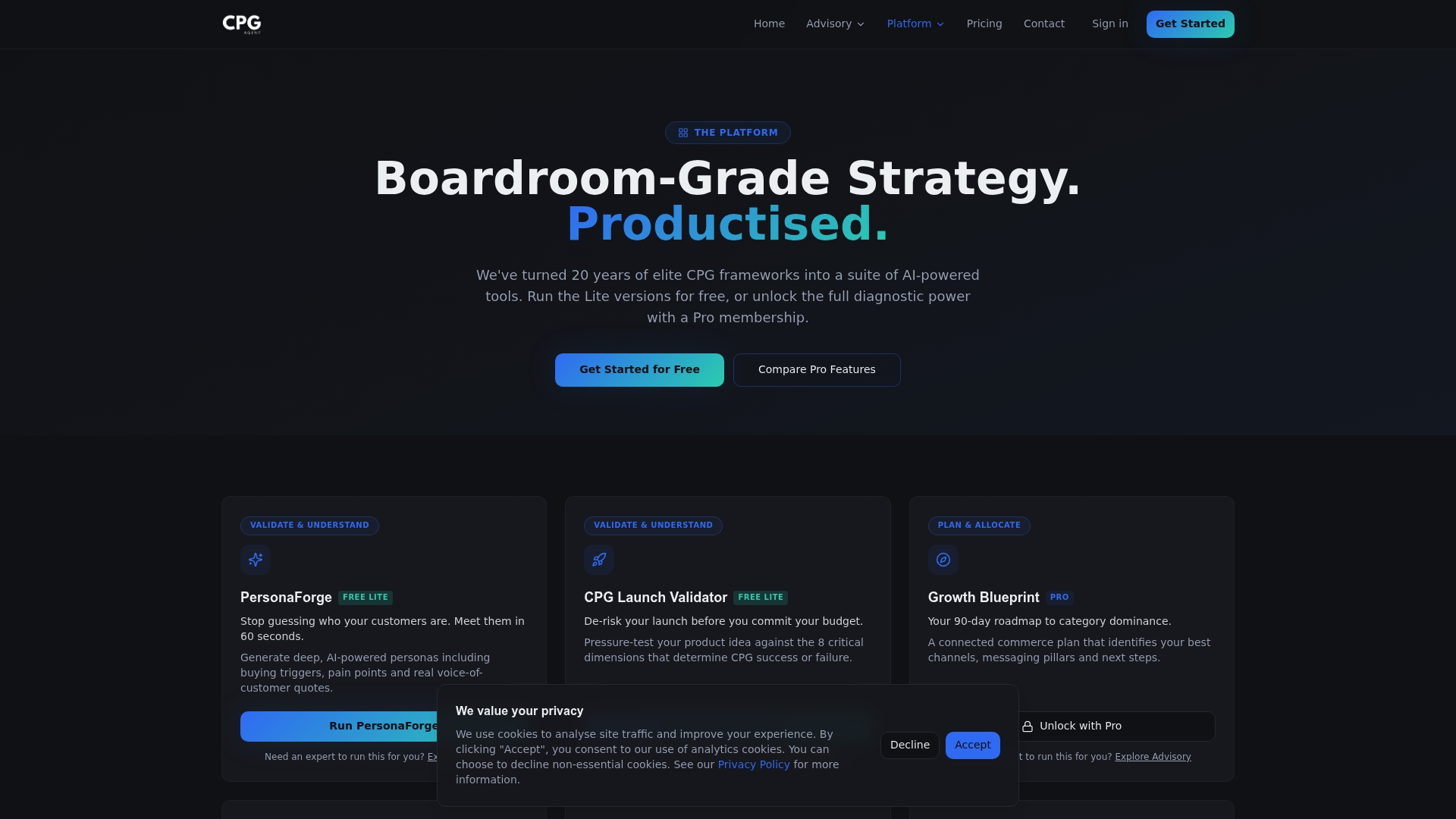
Cpgagent is built specifically for FMCG and CPG brands that need to coordinate fractional leadership, agency partners, and AI-driven tools without the overhead of a traditional agency model. The Cpgagent platform provides AI-driven strategy tools, automated workflows, and fractional CMO advisory in a single environment, so your outsourced marketing model operates as one connected system rather than a collection of separate vendors. Tools like PersonaForge and Launch Validator give your team data-backed direction before campaigns go live, cutting the discovery time that traditional agencies charge for. If you are evaluating which outsourced marketing model fits your brand's current stage, Cpgagent gives you the infrastructure to deploy faster and measure what matters.
FAQ
What is outsourced marketing for FMCG brands?
Outsourced marketing for FMCG brands is the practice of delegating marketing functions to external specialists, including fractional CMOs, full-service agencies, or AI platforms, rather than building all capabilities in-house. The model gives brands access to senior expertise and specialized tools at a fraction of the cost of a full internal department.
How much do fractional marketing teams cost compared to in-house teams?
Fractional marketing teams typically cost 40 to 60% of a full-time in-house marketing department while providing equivalent senior expertise. For most FMCG brands, this represents a significant budget reallocation toward media spend and growth experiments rather than fixed salaries.
When should an FMCG brand use a hybrid outsourced marketing model?
A hybrid model is the right choice when a brand needs both strategic leadership and broad execution capability across multiple channels. The most effective hybrid configuration pairs a fractional CMO with a full-service agency and an AI visibility platform, with unified reporting connecting all three.
What is Generative Engine Optimization and why does it matter for FMCG?
Generative Engine Optimization (GEO) is the practice of optimizing brand content to appear in AI-generated search results from tools like ChatGPT and Perplexity. For FMCG brands, GEO directly affects product discovery, since AI recommendations increasingly influence purchase decisions before consumers reach the shelf.
How do I avoid siloed data when using multiple outsourced marketing partners?
Require all outsourced partners to report through a shared dashboard or unified data brief updated on the same cadence. Brands that connect AI platform data with agency campaign planning close the feedback loop that most multi-partner outsourcing arrangements leave open.