

Most brand managers know they have a portfolio problem long before they can name it. Products overlap. Sub-brands cannibalize each other. Marketing budgets get spread thin across too many identities. The root cause is almost always the same: no one ever built a deliberate brand architecture. Understanding what is a brand architecture is not a naming exercise or a visual identity project. It is the strategic framework defining relationships between every brand in your portfolio, and getting it wrong costs you market share, margin, and years of wasted spend.
Table of Contents
- What is brand architecture and why it matters
- Core types of brand architecture models
- How brand architecture drives strategy and portfolio growth
- Choosing and evolving your brand architecture
- Practical implications of brand architecture in CPG and FMCG
- Why brand architecture is often misunderstood but essential for CPG growth
- Explore brand architecture solutions with CPG Agent
- Frequently asked questions
Key Takeaways
| Point | Details |
|---|---|
| Strategic framework | Brand architecture is a strategic system defining how parent and sub-brands relate and communicate. |
| Model selection | Choosing the right architecture model depends on your company’s goals and market complexity. |
| Growth driver | Effective architecture guides investment, prioritizes brands, and uncovers growth opportunities. |
| Governance importance | Consistent governance ensures brand architecture remains aligned and evolves thoughtfully. |
| Marketing alignment | A clear architecture streamlines marketing, increases visibility, and reduces customer confusion. |
What is brand architecture and why it matters
Brand architecture is the strategic framework that defines relationships between a company's parent brand and its sub-brands, shaping identity, naming, and market communication. Think of it as the organizational chart for your brand portfolio. It tells consumers, internal teams, and investors how your brands relate to each other, which ones carry the most equity, and how each one should be positioned and marketed.
Without this framework, you get chaos. Consumers cannot tell whether your new product line is a premium extension or an entry-level alternative. Retailers do not know how to shelve your products. Marketing teams duplicate campaigns across brands that are essentially competing with each other for the same shopper.
Here is what a well-designed brand architecture actually does for you:
- Reduces consumer confusion by making brand relationships visible and intuitive
- Improves marketing efficiency by aligning messaging across related brands
- Protects equity by isolating brand risk within specific parts of the portfolio
- Guides naming decisions so new products fit logically into the existing structure
- Enables portfolio growth by identifying where gaps exist and where new brands belong
The numbers back this up. Organizations with clear architecture achieve 3.5 times more visibility than those without it, because aligned identity and messaging compound over time rather than fragment.
Brand architecture is not just about how things look. It is about how your entire portfolio functions as a system. Every brand decision, from naming to packaging to media spend, flows from this structure.
Core types of brand architecture models
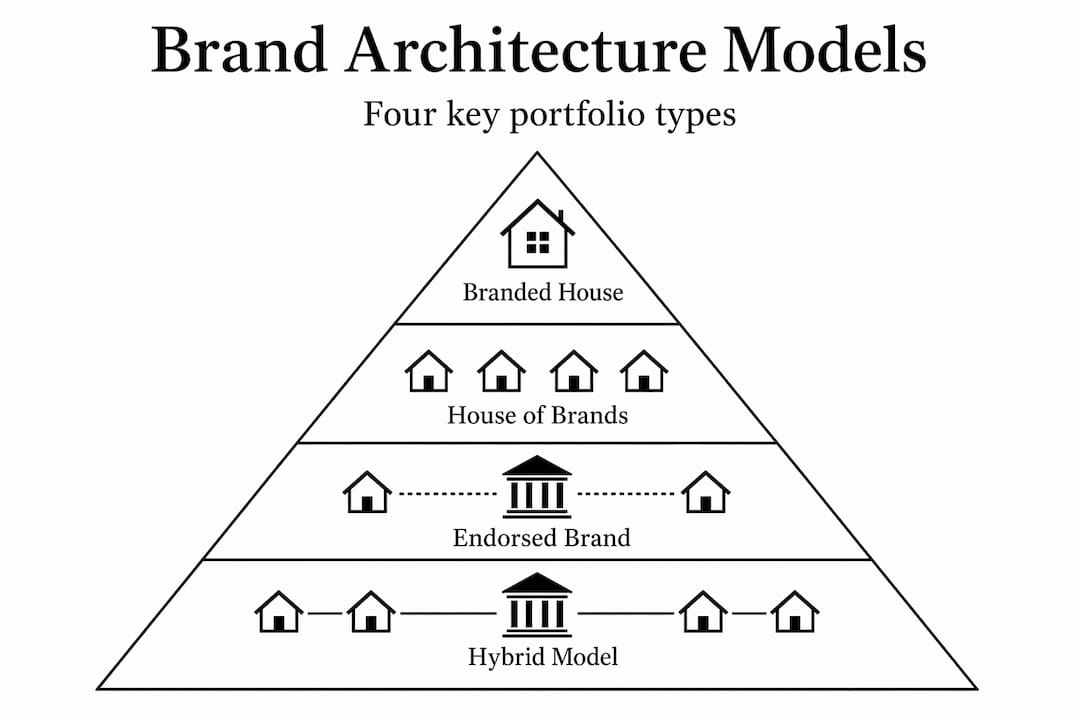
There are four primary models you need to understand when thinking about types of brand architecture. Each one represents a different philosophy about how brand equity should be built, shared, and protected.

The four main models are branded house, house of brands, endorsed brand, and hybrid, each defining different identity and equity-sharing relationships across a portfolio.
| Model | Parent brand visibility | Brand independence | Best for |
|---|---|---|---|
| Branded house | High | Low | Single category, unified identity |
| House of brands | Low | High | Multi-category, distinct audiences |
| Endorsed brand | Medium | Medium | Credibility transfer to new brands |
| Hybrid | Variable | Variable | Complex, diversified portfolios |
Here is how each model plays out in practice:
- Branded house: Every product or service lives under one master brand. Apple is the classic example. Every product carries the Apple name and identity. This concentrates equity in one place and makes marketing spend work harder, but it also means one brand failure can damage everything.
- House of brands: The parent company is invisible or nearly invisible to consumers. Think of how P&G operates. Tide, Pampers, and Gillette each have their own identity, their own positioning, and their own consumer relationship. Branded house concentrates equity in the master brand, while house of brands allows brands to operate independently with limited parent visibility.
- Endorsed brand: The sub-brand stands on its own but carries a visible endorsement from the parent. Marriott Courtyard is a good example. "Courtyard" is the primary identity, but "by Marriott" lends credibility and signals quality standards.
- Hybrid: Most mature CPG and FMCG companies end up here. Parts of the portfolio run as a branded house, other parts run as independent brands, and some carry endorsements. It is flexible but requires strong governance to prevent the structure from becoming incoherent.
Pro Tip: Do not choose a model based on what feels right aesthetically. Map your consumer segments first. If the same shopper buys across multiple brands in your portfolio, a branded house or endorsed model will reinforce loyalty. If your brands serve genuinely different audiences with different values, a house of brands protects each brand's positioning from the others.
How brand architecture drives strategy and portfolio growth
Understanding brand architecture models is only useful if you connect them to portfolio decisions. This is where the real value lives for brand managers and executives.
Brand architecture informs investment allocation, helps identify underperforming brands, and pinpoints portfolio gaps that offer growth opportunities. That means your architecture is not just a communications tool. It is a financial planning tool.
Here is how to use it that way:
- Map current brand roles. Define what job each brand does in your portfolio. Is it a volume driver, a premium anchor, a flanker brand, or a market-entry vehicle? If you cannot answer that for every brand, you have a governance problem.
- Identify overlap and duplication. Brands that serve the same consumer need in the same channel are competing with each other. Architecture makes this visible so you can prune or consolidate.
- Find the white space. Once you know what each brand covers, the gaps become obvious. Which consumer segments are underserved? Which price tiers are empty? Architecture turns portfolio planning from guesswork into a structured process.
- Allocate investment with purpose. Not every brand deserves equal spend. Architecture helps you prioritize based on strategic role, not just current revenue.
- Manage risk across the portfolio. A single brand failure in a house-of-brands model stays contained. In a branded house, it can damage the entire portfolio. Knowing your model helps you plan for this.
Brand architecture aligns identity and messaging across the portfolio, functioning as a roadmap for consistent execution. Without that roadmap, even well-funded brands drift.
Pro Tip: If you are running a house-of-brands portfolio, build a formal brand governance calendar. Review each brand's role, performance, and strategic fit at least annually. The brands that looked like growth bets three years ago may now be diluting equity and absorbing budget that should go elsewhere.
Choosing and evolving your brand architecture
Knowing how to develop brand architecture starts with an honest audit of where you are today. Many CPG companies inherit their architecture through acquisitions and organic growth rather than designing it deliberately. The result is a hybrid model by accident rather than by choice.
Brand architecture is a strategic blueprint that evolves with your business and should be adapted as you grow or acquire new brands. That means the architecture you need at $50 million in revenue is not the same one you need at $500 million.
Practical guidance for choosing and evolving your architecture:
- Start with your business goals, not your brand names. Are you trying to build a category-defining master brand or capture multiple segments with distinct identities? The answer shapes everything.
- Assess market complexity. If your brands compete in fundamentally different categories with different retail channels and different consumer mindsets, a house-of-brands model protects each brand's relevance. If they share a core consumer and a core value proposition, a branded house or endorsed model builds cumulative equity faster.
- Build governance before you need it. Companies design governance to enforce chosen architecture consistently and evolve it when their portfolio's needs change. Governance means clear rules about naming, visual identity, messaging hierarchy, and who has authority to make brand decisions.
- Review the architecture when the portfolio changes. An acquisition, a product line extension, or entry into a new market can all stress-test your current structure. Do not assume your existing architecture absorbs new additions automatically.
- Plan for pruning. Not every brand deserves to survive. Architecture makes the case for retirement or consolidation clearer because you can see when a brand no longer has a distinct role.
Pro Tip: When evaluating whether to extend an existing brand versus launch a new one, run the architecture test. Ask whether the extension would strengthen or dilute the parent brand's positioning. If the answer is "dilute," you either need a new brand or a different architecture model to contain the risk.
Practical implications of brand architecture in CPG and FMCG
The importance of brand architecture becomes most concrete when you look at what happens inside CPG and FMCG companies that get it wrong. Fragmented portfolios, inconsistent retail presentation, and marketing teams that cannot explain how their brands relate to each other are all symptoms of architectural neglect.
Brand architecture decisions affect customer navigation and marketing efficiency by balancing umbrella identity and brand independence. In practical terms, this means your architecture determines how a shopper moves through your portfolio, whether they trade up, trade across, or leave for a competitor.
Here is what strong architecture looks like in practice for CPG and FMCG teams:
- Clear brand roles documented and shared across marketing, sales, and product development
- Naming conventions that signal brand relationships without requiring explanation
- Packaging hierarchy that visually communicates whether a product is a premium extension or a core offering
- Media planning aligned to brand role, not just brand revenue
Multi-brand structures require internal governance to prevent brand duplication and fragmented equity management. This is especially true in house-of-brands portfolios where individual brand teams can drift toward decisions that make sense locally but damage the portfolio overall.
Practical steps to implement architecture in your organization:
- Define and document each brand's role in writing, not just in presentations
- Create a brand relationship map that shows parent, sub-brand, and endorsed brand connections visually
- Establish naming and identity guidelines that apply across the portfolio
- Assign clear ownership for architecture governance, typically at the CMO or VP of Brand level
- Build architecture review into your annual planning cycle so it stays current
| Architecture element | Impact on CPG/FMCG operations |
|---|---|
| Brand role clarity | Reduces internal conflict over investment priorities |
| Naming conventions | Speeds up new product launch decisions |
| Governance structure | Prevents brand equity dilution over time |
| Portfolio mapping | Identifies gaps and overlap systematically |
Pro Tip: The fastest way to expose architectural problems in your portfolio is to ask your retail partners how they categorize your brands. If they are confused, your shoppers are too.
Why brand architecture is often misunderstood but essential for CPG growth
Here is the uncomfortable truth most brand architecture articles skip: the companies that treat architecture as a branding project almost always end up redoing it within five years. The companies that treat it as a business strategy rarely need to.
The mistake is treating architecture as something you design once and hand to the creative team. Real architecture requires ongoing governance, regular portfolio reviews, and executives who understand that every brand decision either reinforces or erodes the structure you built. Brand architecture is not just aesthetics; it is a business strategy that links your brands into an interdependent system guiding investment, governance, and portfolio health.
What we see consistently in CPG and FMCG companies is that brand architecture problems compound quietly. A new product launch here, an acquisition there, a line extension that made sense in isolation but created overlap. By the time the problem is visible in the numbers, it has been building for years. Fixing it then is expensive, disruptive, and often requires killing brands that have real consumer equity.
The most successful CPG companies we observe design their architecture with the end state in mind, not just the current portfolio. They ask: if we double in size, does this structure still work? If we enter a new category, where does that brand live? If we acquire a competitor brand, how does it fit? These are not branding questions. They are business questions that happen to have brand implications.
The other thing most articles get wrong is the role of governance. Architecture without governance is just a diagram. The companies that sustain strong portfolios over decades have clear rules about who can make brand decisions, what approvals are required for new brand creation, and how conflicts between brand teams get resolved. That is not bureaucracy. That is how you protect a long-term asset.
Explore brand architecture solutions with CPG Agent
Understanding what brand architecture is and how it drives portfolio growth is the first step. Executing it across a complex, fast-moving portfolio is where most teams need support.

CPG Agent is built for exactly this challenge. The platform gives brand managers and executives the AI-driven tools and fractional leadership support to organize, govern, and grow their brand portfolios without the overhead of a traditional agency. From mapping brand roles to running growth experiments across portfolio segments, brand portfolio management solutions at CPG Agent are designed to move at the speed your market demands. If your architecture needs a reset or your portfolio strategy needs sharper execution, CPG Agent puts the right tools and expertise in your corner.
Frequently asked questions
What is brand architecture in simple terms?
Brand architecture is the organized system defining relationships between a parent brand and its sub-brands, product lines, and endorsed brands, guiding how they are named, positioned, and marketed together.
Why is a clear brand architecture important for companies?
A clear brand architecture increases visibility, reduces customer confusion, and supports efficient marketing. Organizations with clear architecture achieve 3.5 times more visibility than those without it.
What are the main models of brand architecture?
The four main brand architecture models are the branded house, house of brands, endorsed brand, and hybrid model, each representing a different approach to sharing and protecting brand equity.
How should companies evolve their brand architecture over time?
Companies should treat architecture as a living strategy, adapting it as markets shift and portfolios grow. Brand architecture should be adapted as you acquire new brands or enter new categories, with governance in place to maintain consistency through those changes.
What role does brand architecture play in marketing efficiency?
Brand architecture aligns identity, messaging, and positioning across the portfolio, reducing duplication and giving marketing teams a clear framework for where each brand competes and how it should communicate.