

What is a product brief in CPG, and why does it matter?
A CPG product brief is a concise, problem-focused document created at the start of product development that defines the "why" and "what" of a new product before any technical work begins. Think of it as the strategic contract between your brand team, R&D, marketing, and sales: everyone reads the same document, agrees on the problem worth solving, and understands what success looks like before a single formula is tested or a package is designed.
The CPG context adds specific pressure. Consumer packaged goods move fast, get replaced frequently, and live across both physical retail and digital channels. Slightly more than half of CPG shopping still happens in physical stores, which means a brief that ignores shelf placement, retailer velocity, or in-store shopper behavior is already incomplete before the first draft is done.
A strong product brief covers:
- Problem statement: The specific consumer pain point or unmet need the product addresses
- Product objectives: Measurable goals the product must achieve
- Target audience profile: Who buys it, why they buy it, and where they shop
- Key features and functionality: The core capabilities required to solve the problem
- Competitive overview: Where the product sits relative to existing options
- Timeline and milestones: Key development and launch phases
- Success metrics: How you will know the product worked
- Budget and resource allocation: Investment required and team members involved
One distinction worth locking in early: a product brief is not a Product Requirements Document (PRD). The brief defines the problem and success criteria at a high level to align stakeholders, while the PRD provides detailed technical specifications for implementation. Brief = "why and what." PRD = "how." Conflating the two is one of the most common ways CPG teams end up building the wrong product with perfect precision.
Effective product briefs stay under three pages. That constraint is intentional. A brief that sprawls into a 20-page document has already failed its primary job: giving every stakeholder a fast, clear read on what the team is building and why.
How a product brief fits into CPG product development
The product brief belongs in the discovery and planning stage, before R&D commits resources, before marketing builds a campaign, and before supply chain starts sourcing ingredients or materials. Its job at that moment is to serve as a single source of truth that prevents two expensive problems: scope creep and solution bias.

Scope creep happens when teams add features or requirements that were never tied to the original problem. Solution bias happens when someone falls in love with a specific product format or ingredient before validating whether consumers actually want it. A well-written brief forces the team to articulate the problem clearly enough that both failure modes become visible early.
Cross-functional alignment is where the brief earns its keep in CPG specifically. R&D needs to know the target cost of goods sold. Marketing needs the consumer insight and positioning angle. Sales needs the retailer and velocity expectations. Manufacturing needs the timeline. Without a shared document, each function optimizes for its own priorities and the product that reaches the shelf is a compromise nobody planned for.
Consumer insights and market research belong in the brief from day one, not as an afterthought. CPG marketing connects multiple touchpoints across the shopper journey, from social discovery to in-store purchase, and the brief should reflect where and how the target consumer actually behaves. Omnichannel considerations, including e-commerce velocity and retail placement strategy, are not launch-day concerns. They shape product design decisions made months earlier.
Pro Tip: Treat the product brief as a living document. Update it when consumer research shifts, when a retailer changes its category strategy, or when a cost constraint forces a formulation change. A brief that freezes at draft one becomes a liability, not an asset, by the time the product hits production.
What goes into a CPG product brief: a component-by-component breakdown
Every element of a CPG product brief serves a specific alignment function. Missing one does not just leave a gap in the document. It leaves a gap in the team's shared understanding that will surface as a costly disagreement later.
- Problem statement: The foundation. It should describe the consumer problem in plain language, grounded in research, not assumption.
- Product objectives: Specific, measurable goals tied to business outcomes, not just feature lists.
- Target audience profile: Goes beyond demographics. Includes shopping behavior, channel preference, and purchase frequency.
- Key features and functionality: Only the capabilities directly tied to solving the stated problem. Everything else is scope creep waiting to happen.
- Competitive overview: Not just who else is on the shelf, but how your product's positioning differs in a way consumers will notice.
- Timeline and milestones: Realistic phases from concept to launch, including regulatory review windows.
- Success metrics: Velocity targets, trial rates, repeat purchase rates, and margin thresholds.
- Budget and resource allocation: Including target COGS and margin profiles. Stating these explicitly prevents the team from designing a product that works brilliantly but cannot be sold profitably.
CPG briefs carry a few components that generic product brief templates miss entirely:
| Component | What to include |
|---|---|
| Shelf readiness | Packaging dimensions, planogram fit, retailer-specific requirements |
| Regulatory and compliance | Labeling requirements, ingredient restrictions, claim substantiation |
| Retailer and distributor alignment | Velocity expectations, promotional calendar, slotting considerations |
| Unit economics | Target COGS, gross margin, price point relative to category |
| AI workflow specification | Which AI-enabled tools will support demand forecasting or consumer insight at launch |
Shelf readiness and regulatory checkpoints belong in the brief early, not in a separate compliance review at the end of development. Catching a labeling conflict or a retailer shelf-size mismatch at the brief stage costs a conversation. Catching it after tooling is done costs months and real money.
Pro Tip: Use visuals, bullet points, and a one-page summary wherever possible. A brief that requires a 45-minute meeting to explain has already lost the room.
How to write a product brief that actually drives alignment in CPG
Writing a product brief is a process, not a single sitting. The product manager typically leads it during the planning stage, but the brief only works if it reflects input from every function that will touch the product.
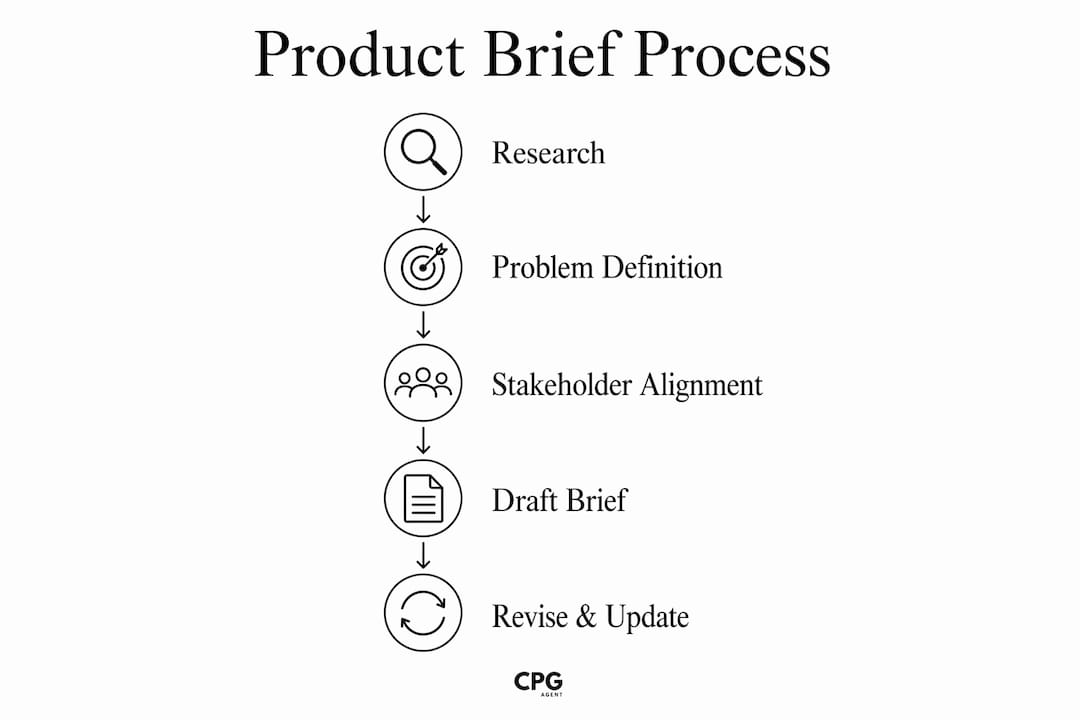
Step-by-step process:
- Research and discovery: Pull consumer research, category data, and retail performance insights before writing a single word. The brief should reflect what you know, not what you hope.
- Define the problem: Write the problem statement first and get cross-functional agreement on it before moving to solutions. If R&D and marketing cannot agree on the problem, the product will reflect that disagreement.
- Stakeholder alignment: Share an early draft with R&D, marketing, sales, and supply chain. Collect their constraints and priorities. A brief written in isolation by one function is a brief that other functions will quietly ignore.
- Set success criteria: Define what "good" looks like in measurable terms before anyone starts building. Velocity targets, margin floors, and trial rate goals belong here.
- Draft and iterate: Write a tight first draft, circulate it, and revise based on feedback. The goal is not a perfect document on the first pass. It is a document that the whole team will actually use.
Practical writing tips:
- Keep the brief under three pages. If a section is growing beyond a paragraph, it probably belongs in a separate spec document.
- Write the problem statement before the solution. Teams that start with the solution and work backward almost always end up with a brief that justifies a decision already made.
- State the target COGS and margin profile explicitly. Leaving economics vague invites R&D to design a product the business cannot afford to sell.
- Include open questions. A brief that pretends to have all the answers is less useful than one that flags what still needs validation.
- Validate against real consumer data and retail feedback before finalizing. A brief built on internal assumptions is a hypothesis, not a strategy.
For early-stage concept validation, the brief serves as the framing document that defines what you are testing and what a passing result looks like.
Best practices and common pitfalls when using product briefs in CPG
The most effective CPG teams treat the product brief as a working tool, not a box to check before development starts. The least effective teams write a brief, file it, and never look at it again until a post-mortem.
Best practices worth building into your process:
- Update the brief when material facts change. Consumer research shifts, retailer requirements evolve, and cost constraints tighten. A brief that no longer reflects reality is worse than no brief at all.
- Integrate AI-driven consumer intelligence early. Data-driven marketing at scale can deliver 3–5% growth in net sales and improve marketing efficiency by 10–20%, and the brief is where that intelligence first gets applied to a specific product opportunity.
- Specify which AI workflows will be used at launch. CPG organizations are centralizing AI capabilities and moving analytics in house. The brief should name the tools and workflows that will support demand forecasting, consumer segmentation, or content generation for this specific product.
- Align retailer and distributor velocity expectations in the brief. A product that achieves technical success but misses velocity targets gets delisted. That outcome is preventable when the brief sets realistic commercial expectations from the start.
Common pitfalls:
- Treating the brief as a formality. If the team writes it to satisfy a process requirement and then ignores it, the brief has no value.
- Skipping problem validation. Briefs built on assumed consumer pain points rather than research-backed ones tend to produce products that solve problems consumers do not actually have.
- Omitting unit economics. Leaving COGS and margin targets out of the brief is one of the most reliable ways to end up with a product that works in the lab and fails on the shelf.
- Neglecting compliance and regulatory checkpoints. In categories like food, beverage, and personal care, a labeling issue discovered late in development can delay a launch by a full quarter.
- Ignoring omnichannel context. AI-informed brief planning improves launch scalability and market fit precisely because it accounts for how consumers discover and buy across channels, not just in one.
What a CPG product brief looks like in practice
A useful way to understand the brief is to see how its components map to a real product scenario. Consider a beverage brand launching a new functional hydration drink targeting active adults aged 25–40.
The problem statement would not say "we want to launch a hydration drink." It would say: "Active adults in our target segment are dissatisfied with existing hydration options because current products either taste artificial or carry a sugar load that conflicts with their health goals." That framing immediately tells R&D what formulation constraints matter, tells marketing what the positioning angle is, and tells sales which retail channels and shelf sections to target.
A practical CPG product brief template for this scenario would include:
- Problem statement: Consumer dissatisfaction with taste and sugar content in existing hydration products
- Target audience: Active adults, 25–40, purchasing in natural grocery and sports retail channels
- Product objectives: Achieve trial rate of X% in target accounts within 90 days of launch; hit gross margin of Y% at target retail price
- Key features: Clean-label electrolyte formula, no added sugar, flavor profile validated in consumer testing
- Shelf readiness: Fits standard 12-oz beverage slot; compliant with natural channel retailer labeling requirements
- Regulatory checkpoints: Claim substantiation for electrolyte content; ingredient review for natural channel compliance
- Retailer alignment: Target velocity of Z units per store per week in natural grocery; promotional calendar aligned with Q3 fitness season
- Success metrics: Velocity, repeat purchase rate at 90 days, gross margin at scale
This kind of brief gives every function a clear picture of what winning looks like, and it does it in a format that fits on two pages. For teams building brand strategy alongside product development, the brief also anchors positioning decisions that will carry through packaging, marketing, and retail execution.
How to tailor a product brief for marketing, R&D, and sales
A single brief serves multiple audiences, and the best ones are written with that tension in mind. The document does not change by function, but the emphasis does.
For marketing teams, the most critical sections are the target audience profile, the competitive positioning, and the success metrics tied to trial and awareness. Marketing needs to understand the consumer insight deeply enough to build a campaign around it, and the brief should give them that without requiring a separate research briefing. The AI-powered consumer research that informs the brief should be summarized here in plain language, not buried in an appendix.
For R&D teams, the key sections are the problem statement, the key features tied to that problem, the target COGS, and the regulatory and compliance checkpoints. R&D does not need the marketing positioning angle in detail. They need to know what the product must do, what it cannot cost, and what it cannot contain. Ambiguity in any of those three areas produces formulation rework.

For sales teams, retailer and distributor alignment, velocity targets, and the promotional calendar are the sections that drive decisions. Sales needs to know what the product is designed to do commercially, not just technically. A brief that gives sales a clear velocity target and a realistic promotional plan is one they will actually use in buyer conversations.
The practical approach is to write one brief that covers all three audiences, then create a one-page summary for each function that highlights their most relevant sections. The full brief stays the source of truth. The summaries make it usable in a 15-minute team meeting.
How Cpgagent helps you build better product briefs
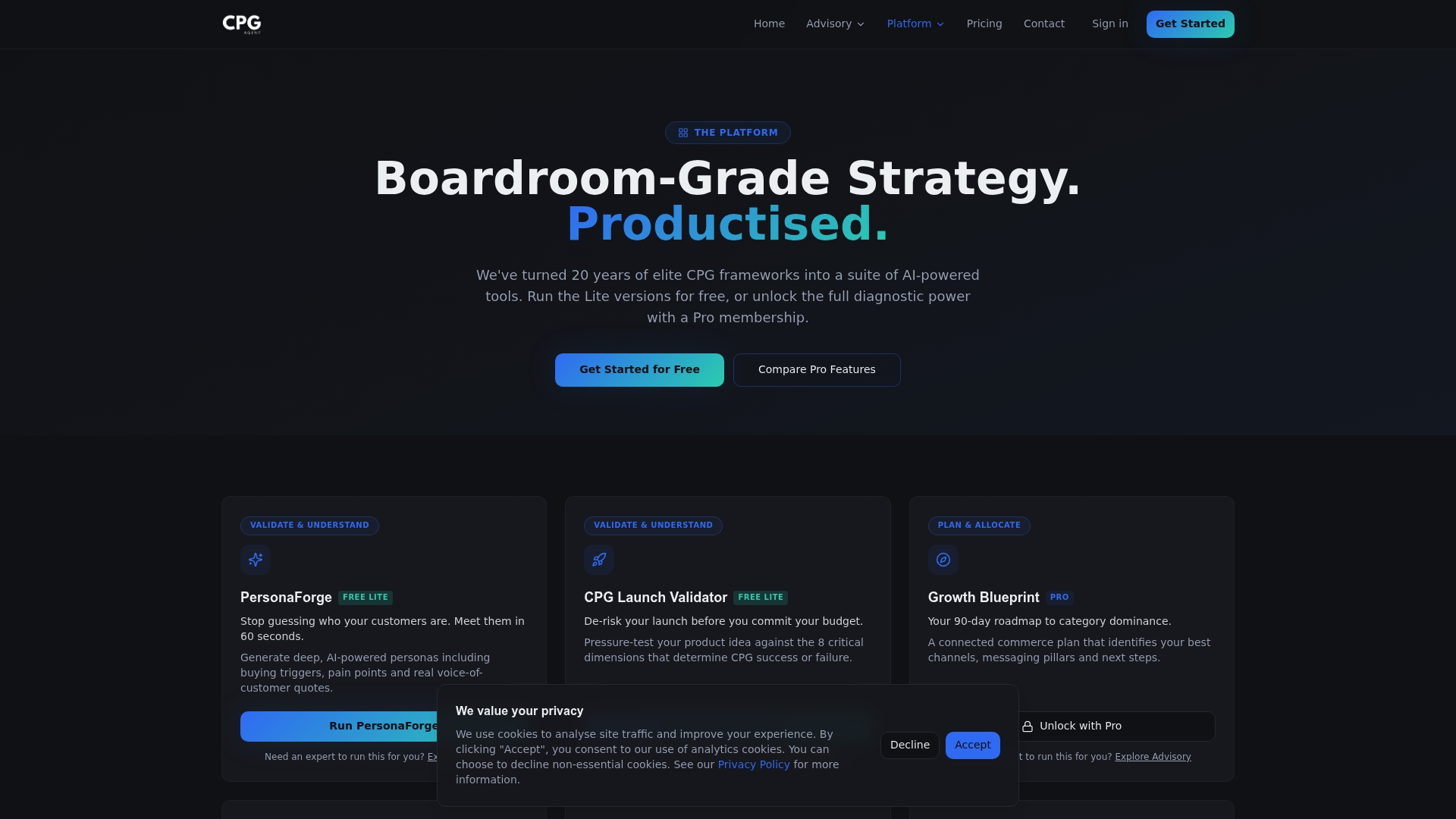
Cpgagent is built for CPG and FMCG brands that need to move from insight to brief to launch without the overhead of a traditional agency. The Cpgagent platform includes AI-driven tools like PersonaForge for consumer segmentation and Launch Validator for concept testing, both of which feed directly into the research and problem-definition stages of a product brief. Instead of spending weeks gathering consumer data manually, brand teams can generate data-backed audience profiles and validate product concepts before the brief is even finalized.
For teams that need senior strategic input without a full-time hire, Cpgagent's fractional leadership services bring CMO-level experience to the brief process, including retailer alignment, unit economics review, and omnichannel positioning. The result is a brief that reflects real market conditions, not internal assumptions.
Key Takeaways
A CPG product brief is the single most important alignment document in early-stage product development, and its quality directly shapes whether a launch succeeds commercially.
| Point | Details |
|---|---|
| Brief vs. PRD | The brief defines "why and what"; the PRD defines "how." Never conflate the two. |
| Concise by design | Effective briefs stay under three pages to remain usable across all functions. |
| CPG-specific components | Shelf readiness, COGS targets, retailer velocity, and regulatory checkpoints belong in the brief from day one. |
| Living document | Update the brief when consumer research, retailer requirements, or cost constraints change during development. |
| AI integration | Specifying AI workflows in the brief improves launch scalability and market fit. |
FAQ
What is a product brief?
A product brief is a concise internal document that defines a product's problem statement, target audience, objectives, and success metrics to align all stakeholders before technical development begins.
What does CPG mean in products?
CPG stands for consumer packaged goods, referring to products consumers buy regularly and replace frequently, such as food, beverages, cleaning supplies, and personal care items.
What is the difference between a product brief and a PRD?
A product brief focuses on the "why and what," defining the problem and strategic opportunity at a high level, while a Product Requirements Document (PRD) provides the detailed technical specifications for how to build the product.
What is the product brief process?
The process typically runs from research and discovery through problem definition, cross-functional stakeholder alignment, success criteria setting, and iterative drafting, with the product manager leading each stage.
Why do CPG product briefs need retailer alignment?
Aligning retailer and distributor velocity expectations in the brief prevents teams from building products that achieve technical success but miss commercial targets, which leads to delisting.