

TL;DR:
- Focus groups are slow, costly, and often poor at predicting actual purchase behavior, unlike digital tests and AI-driven tools. Validating a CPG concept cost-effectively involves using surveys, home usage tests, and in-market trials, starting from secondary data and advancing sequentially. Building precise consumer personas and leveraging AI tools accelerates validated product launches without relying on expensive focus groups.
You don't need a $20,000 focus group to know if your product idea has legs. Learning how to validate a CPG product launch concept without a focus group budget is one of the most practical skills a product manager or founder can build. Focus groups are slow, expensive, and notoriously bad at predicting actual purchase behavior. The good news: a combination of quantitative surveys, in-home usage tests, and AI-driven predictive tools gives you faster, more accurate signals at a fraction of the cost. This guide shows you exactly how to do it.
Table of Contents
- Key takeaways
- How to validate a CPG product launch concept without a focus group budget
- Building a consumer persona prototype fast
- Evaluating retail feasibility and market fit
- Common pitfalls in low-budget validation
- Interpreting your results and making the call
- My take on the focus group problem
- How Cpgagent accelerates your validation process
- FAQ
Key takeaways
| Point | Details |
|---|---|
| Skip focus groups for prediction | IHUTs and concept surveys outperform focus groups at predicting actual purchase behavior. |
| Sequence your validation steps | Start with free secondary data, then run small surveys before escalating to real-world tests. |
| Comprehension before intent | Always confirm consumers understand your product before measuring purchase intent scores. |
| Build a persona first | A tight consumer persona reduces sampling bias and sharpens every subsequent test you run. |
| Use AI tools to accelerate | Predictive analytics platforms cut weeks off your validation timeline without adding budget. |
How to validate a CPG product launch concept without a focus group budget
Digital concept validation is the process of measuring a product idea's comprehension, differentiation, and purchase intent using structured digital methods. No moderated rooms. No travel costs. No six-week timelines.
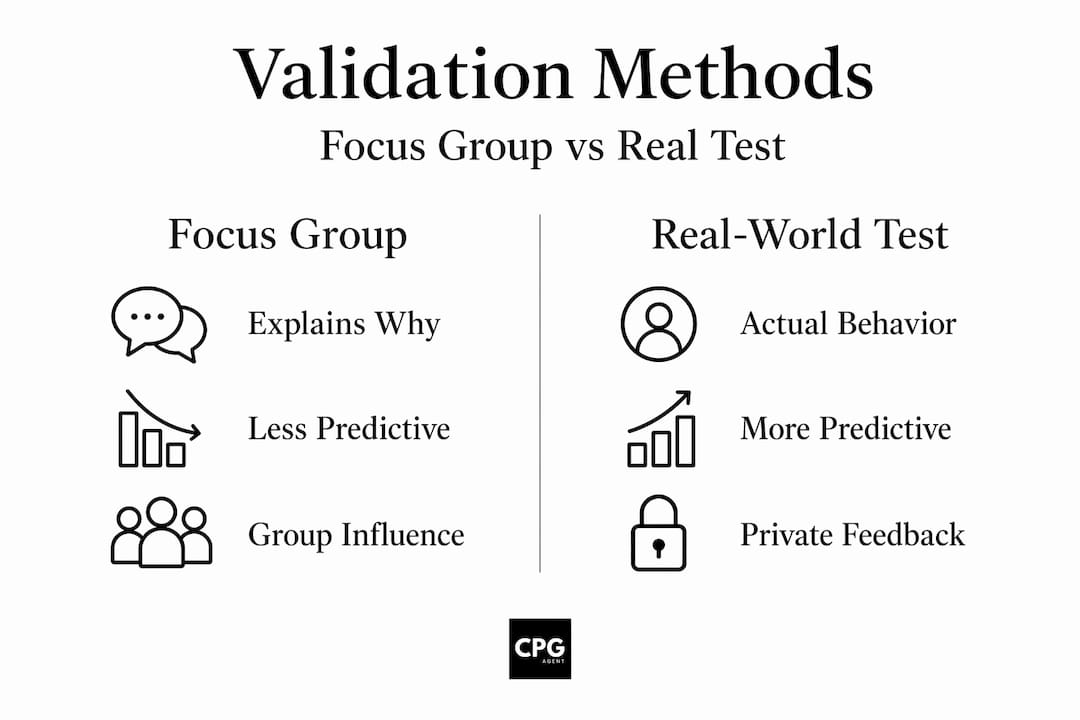
The core insight here is that focus groups explain the "why" but are weak predictors of actual adoption. Real-world testing closes that gap. Here are the three methods that do the heavy lifting.
Quantitative concept testing surveys
A concept test is a structured survey that exposes consumers to your product idea and measures whether they understand it, see value in it, and would buy it. The key design principle: sequence your questions as comprehension first, then differentiation, then purchase intent. Ordering questions this way prevents inflated purchase intent scores from respondents who misread your concept entirely.
For purchase intent specifically, use a top-2-box scoring approach. A positive signal sits around 30% or higher indicating they would "probably" or "definitely" buy. Always pair that number with an open-ended question about purchase barriers. Purchase intent without barrier data is half a story.
Pro Tip: Use monadic test design, showing one concept per respondent rather than asking them to compare multiple concepts. Monadic designs reduce cross-concept bias and produce cleaner signals, especially when working with smaller sample sizes.
In-home usage tests (IHUTs)
An IHUT sends your product to real consumers and lets them use it in their natural environment, then collects structured feedback via diary entries and wrap-up surveys. The advantage over a focus group is enormous: IHUTs lower the gap between what people say they like in a controlled setting and what they actually do at home.
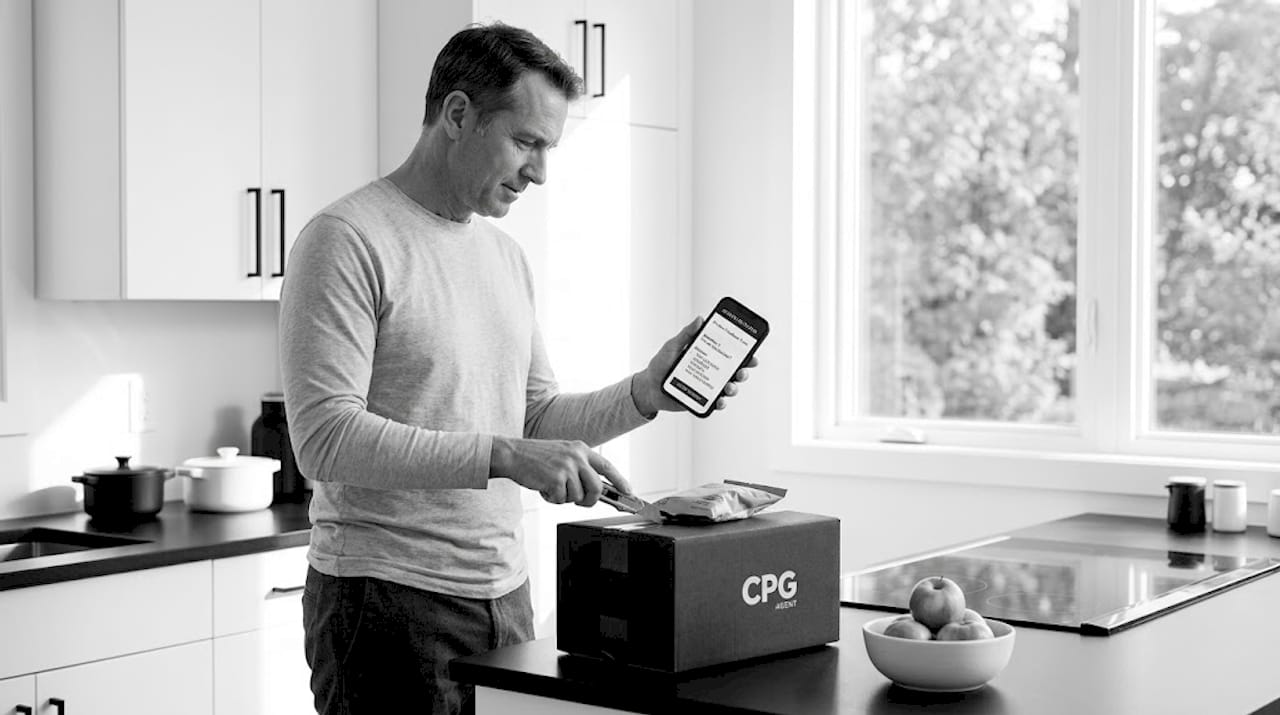
To make an IHUT decision-ready, your survey must go beyond satisfaction ratings. High-engagement IHUTs link usage diaries to purchase-decision questions, including repeat purchase likelihood, value perception, and adoption blockers. Those three data points tell you whether you have a sustainable product or a novelty.
In-market transactional tests
If your concept passes survey and IHUT thresholds, a Retail Lab test is the next step. These programs mimic a real product launch with shelf placement, marketing support, and tracked purchase data at volume. The data you get is actual buying behavior, not stated intent. That difference matters enormously when you're pitching a buyer or justifying a production run.
| Method | Cost range | Speed | Predictive strength |
|---|---|---|---|
| Traditional focus group | $15,000–$40,000 | 4–8 weeks | Low for adoption |
| Concept testing survey | $500–$3,000 | 1–2 weeks | Moderate |
| IHUT | $2,000–$8,000 | 2–4 weeks | High |
| Retail Lab / in-market test | $5,000–$20,000 | 4–8 weeks | Very high |
Building a consumer persona prototype fast
A persona is not a marketing decoration. In validation work, it is a filter. A clearly defined persona tells you exactly who to recruit for your survey, which channels to source from, and whether your open-ended feedback is coming from people who actually represent your buyer. Without it, you are collecting noise.
Here is how to build a useful persona quickly using only free or low-cost tools.
- Define your core demographic and behavioral profile. Start with age range, household income bracket, lifestyle habits, and the specific problem your product solves. Be specific enough to exclude, not just include.
- Pull secondary data from free sources. Census Bureau data, category trend reports from Nielsen or SPINS summaries on public sites, and Reddit community threads for your category are all free. They tell you what your buyer already buys and why they switch brands.
- Run a 5-question screener survey. Use a platform like Google Forms or a low-cost survey tool to screen 50 to 100 respondents. Ask about current category behavior, purchase frequency, and top frustrations. This takes two days and costs almost nothing.
- Identify two or three behavioral patterns. Look for clusters in your screener responses. The respondents who share the strongest problem-fit become your primary persona segment.
- Feed the persona into your concept test design. Use it to write relevance-check questions and to filter out respondents who don't fit. This single step dramatically improves the signal-to-noise ratio in your results.
For founders building a lean CPG strategy, the persona step is where most of the budget protection happens. Recruiting the wrong respondents is the most common and most expensive mistake in low-budget validation.
Pro Tip: If you are pressed for time, Cpgagent's PersonaForge tool can generate a fully structured consumer persona prototype in under 60 seconds using category inputs you already know. It is one of the fastest ways to get from idea to structured research design.
Evaluating retail feasibility and market fit
Knowing consumers like your concept is not the same as knowing the market has room for it. These are two separate questions. Market fit validation runs alongside consumer validation, not after it.
Start with the evidence ladder principle. Free data first, then small paid tests as assumptions prove out. Here is how that plays out in practice.
- Category size and growth rate: Pull this from publicly available market research summaries, category trade publications, or retail scanner data aggregators. You need to know if the segment is growing or contracting.
- Competitive density: Count the SKUs on shelf in your category at two or three retail accounts. Look at pricing spread and positioning gaps. An overcrowded shelf at flat price points is a red flag no survey can fix.
- Pricing elasticity signals: Run a price sensitivity question inside your concept survey. The Van Westendorp Price Sensitivity Meter is a four-question module you can add to any survey at no extra cost. It gives you an acceptable price range based on real consumer responses.
- Velocity benchmarks: Talk to category buyers or broker contacts to understand expected turns per store per week for new items in your category. Stack that against your production economics to see if the math works.
AI-driven tools now make it possible to run this analysis in hours rather than weeks. Platforms that integrate sales data, social listening, and concept validation tools can surface demand signals and competitive white space before you spend a dollar on sampling. That kind of speed matters when your launch window is narrow.
Common pitfalls in low-budget validation
Low-budget does not have to mean low-quality. But it does mean the margin for methodological error is thinner. These are the mistakes that waste both money and time.
- Treating purchase intent as the headline number. Purchase intent inflates when respondents do not fully understand what they are evaluating. Always confirm comprehension first. Concept testing works as a logic check, confirming understanding before you record intent.
- Using convenience samples. Your social media followers are not your market. Neither is your email list. They already like you. Recruit through panels or screened communities that match your actual buyer profile.
- Skipping the barrier question. Knowing 35% would buy tells you nothing about why 65% would not. The open-ended barrier question is where your product's real problems surface.
- Running validation in the wrong sequence. Many teams run an IHUT before they have a concept that consumers even understand. A staged-gate approach confirms concept clarity first, then moves to usage tests once the idea is proven at the survey level.
The most expensive validation mistake is skipping comprehension checks and launching on inflated purchase intent scores. A 40% intent score on a misunderstood concept is not a green light. It is a false signal.
Pro Tip: Set a minimum sample size of 150 respondents per concept for monadic designs before you trust the numbers. Below that threshold, top-2-box scores shift too easily with a handful of responses, and your confidence intervals are too wide for a sound launch decision.
Interpreting your results and making the call
Data without a decision framework is just noise. Here is how to turn validation outputs into a clear go, iterate, or stop decision.
- Check comprehension rates first. If fewer than 70% of respondents correctly describe what your product does, your concept statement needs a rewrite before anything else matters.
- Apply the 30% purchase intent threshold. A top-2-box score at or above 30% in a concept survey is a recognized positive signal for CPG categories. Below that, examine barriers before deciding to proceed.
- Cross-reference IHUT repeat use likelihood. If IHUT participants score repeat purchase likelihood below 50%, usage experience is not matching the concept promise. That is a formulation or communication problem to fix.
- Read the open-ended feedback for patterns, not outliers. Group responses by theme. Three or more respondents raising the same barrier independently is a signal worth acting on. One respondent raising it is probably noise.
- Build a one-page validation summary for internal stakeholders. Include your comprehension rate, intent score, top three barriers, and a clear recommendation. Framing your findings this way makes the internal conversation faster and harder to derail by opinion.
Concept iteration is normal. Most strong launches go through at least one concept revision before achieving passing scores. Knowing when to refine the concept versus when to kill it entirely is the judgment call that separates experienced product managers from first-time launchers. Strong CPG brand differentiation is often discovered in the gap between a first-pass concept score and a revised one.
My take on the focus group problem
I've sat in on focus groups. I've also watched founders build multi-million dollar brands without ever running one. The honest truth is that focus groups became the default not because they're the best tool, but because they're familiar. Agencies sell them. Clients trust them because they generate hours of recorded conversation and thick reports.
What I've learned over years working with CPG teams is this: stated preference in a moderated room is the worst proxy for behavior. People perform for an audience. They give answers that sound reasonable. IHUTs and transactional tests catch actual behavior, and actual behavior is what retailers and investors care about.
The other thing I've noticed is that small brands who build a lean validation workflow early make better product decisions throughout the whole lifecycle. They learn to read their own data instead of outsourcing judgment to a moderator's report. That skill compounds.
If you have $3,000 to spend on validation, a well-designed concept survey and a small IHUT will tell you more than a focus group twice the price. Spend your budget on sample quality and barrier analysis, not room rental.
— Matthew
How Cpgagent accelerates your validation process
If you've been running validation on spreadsheets and manual survey tools, there's a faster path.
Cpgagent was built specifically for CPG founders and product teams who need to move at the speed of the market. The platform includes AI-driven tools like PersonaForge for building consumer personas in under a minute and Launch Validator for running structured concept tests with built-in scoring frameworks. Instead of piecing together multiple tools, you get one workflow that takes you from raw concept to validated launch readiness. No agency overhead. No six-week timelines. For product teams ready to replace expensive traditional focus groups with smarter, faster alternatives, Cpgagent's platform is where that work gets done.
FAQ
What is the minimum budget needed for CPG concept validation?
You can run a meaningful concept test for as little as $500 to $1,500 using online survey platforms with screened panels. Scaling to an IHUT typically requires $2,000 to $8,000 depending on sample size and product category.
How accurate is a concept survey compared to a focus group?
Concept surveys with proper monadic design and comprehension checks are more predictive of purchase behavior than focus groups, which tend to capture social performance rather than genuine intent.
What purchase intent score is good enough to move forward?
A top-2-box score of 30% or higher is the generally accepted positive threshold in CPG concept testing. Always pair that number with comprehension and barrier data before making a launch decision.
When should I use an IHUT instead of a survey?
Run an IHUT after your concept passes the survey stage. IHUTs are most valuable for measuring real-world usage patterns and repeat purchase likelihood, signals that surveys cannot reliably capture.
Can AI tools replace traditional market research for CPG launches?
AI tools can significantly accelerate and sharpen your validation work, especially for persona building and predictive market fit analysis. They work best when combined with primary consumer data from surveys or usage tests, not as a standalone replacement.