

A founder exit strategy for a CPG brand is a documented, multi-year plan that turns your company into a transferable asset while mapping how you will realize personal liquidity or transfer ownership on your terms. It is not the six-month scramble before a sale. It is the three-to-five-year operating program you run while the business is still growing. Three things you can do in the next 30 days: (1) commission or run a baseline valuation so you know your current multiple and the gap to your target; (2) draft an advisor shortlist covering tax counsel, an M&A-experienced CPA, and a valuation specialist; (3) start a management-delegation log that records every decision you make and who could make it instead. The useful planning window for most CPG exits is several years, commonly considered multi-year. Start earlier than you think you need to.
Key Takeaways
A CPG founder exit strategy is a 3–5 year operational program, not a transaction sprint, and the founders who start earliest consistently sell for more and on better terms.
| Point | Details |
|---|---|
| Start 3–5 years out | Most CPG exits require multi-year preparation; the active sell process takes 6–12 months on top of that. |
| Management independence | Buyers pay the highest multiples for businesses that pass the 30/60/90-day independence test without the founder. |
| Customer concentration | Flag any single account above 20% of revenue; above 30% is a structural problem that depresses price or kills deals. |
| Net proceeds vs. headline | Deal structure can shift actual founder proceeds by 20–40%; model three scenarios before engaging a banker. |
| Cpgagent for readiness | Cpgagent's platform tools and fractional CMO advisory accelerate the commercial and operational workstreams that move CPG multiples. |
Table of Contents
- What does a CPG founder exit strategy actually mean?
- What exit routes are available to CPG founders?
- When should you start planning your CPG exit?
- Is your CPG business actually transferable?
- What do acquirers actually pay for in CPG?
- How does deal structure affect what you actually receive?
- What mistakes kill or depress CPG exits?
- Who should be on your exit advisory team?
- What does a 3–5 year exit roadmap look like?
- The tradeoff most founders do not see coming
- How Cpgagent accelerates exit readiness for CPG founders
- Sources
- FAQ
What does a CPG founder exit strategy actually mean?
Most founders conflate two very different programs. Exit planning is the multi-year, operational work of building a business that a buyer or successor can run without you. M&A preparation is the six-to-twelve-month execution phase where you hire a banker, run a process, and negotiate a deal. Confusing them is expensive.
Exit planning is an operational program spanning three to five years, not the six-to-twelve-month M&A sprint. The distinction matters because the decisions you make during exit planning change how you operate right now: which SKUs you invest in, whether you document your co-packer contracts, how you structure retail slotting agreements, and whether you build a management team that can run the business without you in the room.
For CPG brands specifically, the gap between planning and execution is wider than in most categories. Retail contracts have renewal windows, and formulations and ingredient IP require clean ownership documentation well in advance. Supply chain resilience, QA systems, and recall readiness are buyer checklist items that take significant lead time to fix properly. A founder who starts thinking about exit six months before going to market will almost certainly leave money on the table or fail to close at all.

An exit plan covers business, financial, legal, and tax dimensions and should exist even when you are not thinking about selling today. Think of it as a business-improvement program with a liquidity event as the proof point.
CPG-specific items that belong in exit planning now
- IP and formulation ownership: Confirm your recipes, formulations, and trade secrets are owned by the entity being sold, not a founder personally or a related party.
- Co-packer contracts: Ensure agreements are assignable, have reasonable notice periods, and reflect current pricing.
- Retail slotting and distribution proof: Buyers want documented proof of placement, not verbal assurances. Collect retailer agreements and distribution contracts now.
- QA and recall systems: A documented QA protocol and a tested recall procedure reduce regulatory risk that acquirers price into their offers.
What exit routes are available to CPG founders?
Common exit structures include strategic sale, sale to private equity, recapitalization, ESOP, management buyout, and family transfer. Each carries different cash timing, tax treatment, and cultural implications. Here is how to match your situation to the right route.
-
Strategic acquisition fits brands with strong retail distribution, differentiated positioning, and a category a larger CPG player wants to enter or defend. A strategic acquisition process from launch to close typically takes several months to about a year. Structure is usually majority cash at close with an earnout tied to post-close revenue milestones. Founders often stay 12–24 months for transition. Best suited for brands with strong retail distribution, differentiated positioning, and a clear category narrative.
-
Private equity sale or recap suits founders who want partial liquidity now and a second bite at the apple when the PE-backed company sells again. PE buyers care intensely about EBITDA quality, management depth, and a growth thesis they can execute without the founder. Earnouts are common; rollover equity of 10–30% is standard. Best suited for brands with healthy EBITDA and founders willing to stay operationally involved for multiple years post-close.
-
Roll-up or consolidator is the fastest path for smaller brands ($1M–$5M revenue). Consolidators move quickly and pay lower multiples, but the process is lighter and the timeline shorter (3–6 months). Earnouts are common and can be aggressive. Best for: founders who want speed over maximum price.
-
IPO is rarely realistic for independent CPG brands below $100M revenue. The regulatory burden, ongoing reporting costs, and investor relations demands make it impractical for most founder-led brands. Worth mentioning only to set expectations.
-
ESOP (Employee Stock Ownership Plan) lets founders sell to employees through a trust, often with significant tax advantages. It preserves culture and rewards the team. The mechanics are complex and require specialized legal and financial counsel. Best suited for founders who prioritize legacy preservation and have a strong management team.
-
Management buyout (MBO) works when a capable leadership team exists and can access financing (SBA loans, seller notes, PE co-investment). Founders typically carry a seller note, which means deferred proceeds. Best suited for founders with a capable leadership team and a willingness to accept a longer payout timeline.
-
Family or next-generation transfer requires the most advance planning of any route, particularly for estate and gift tax structuring. Best suited for founders with a family member prepared to lead and who have planned a multi-year transition.
-
Gradual liquidation or wind-down is the right answer when the brand lacks transferable value. Better to recognize this early and maximize cash extraction through inventory sell-off and contract wind-down than to spend two years in a failed sale process.
Pro Tip: If you are unsure which route fits, run a partial-liquidity scenario first. A minority recapitalization lets you take chips off the table, stress-test working with outside capital, and still pursue a full sale later at a higher multiple.
When should you start planning your CPG exit?
The short answer: now, regardless of your timeline. Advisory consensus recommends a three-to-five-year window for meaningful value-building, with the active sell process itself taking 6–12 months. That means a founder targeting a sale in 2029 should be running an exit-readiness program today.
Many lower middle market businesses that go to market do not sell because they were not prepared to be transferable because they were not prepared to be transferable. That is not a deal-market problem. It is a preparation problem. The businesses that do sell, and sell well, are the ones that spent years building transferability before a buyer ever called.
Several triggers should accelerate your timeline regardless of where you are in the 3–5 year window:
- Unsolicited interest from strategic buyers or PE firms signals market interest; being prepared is advisable.
- Key-person risk events such as a co-founder departure or a key sales lead leaving
- Approaching a major capital event (a large retailer expansion that will require outside capital)
- Founder ownership tenure extending beyond a number of years can contribute to decision fatigue and concentration risk.
- A significant change in category dynamics (a competitor acquisition that reshapes your buyer universe)
A practical cadence: quarterly checkpoints against a gap-analysis framework, with 12-month, 24-month, and 36-month milestones mapped to specific workstreams. Early planning improves both profitability and transferability, which means the work pays off even if you never sell.
Is your CPG business actually transferable?
Transferability is the single most important concept in exit planning, and most founders overestimate theirs. Run through this checklist honestly.
Governance
- Independent board or advisory structure with documented meeting cadence
- Mapped decision rights: who approves what, at what dollar threshold
- Founder decisions that have been delegated and documented
Financials
- Three years of clean, consistently prepared financials (accrual basis, not cash)
- Documented add-backs with clear explanations a buyer's CPA can verify
- Working capital requirements calculated and normalized
- Quality of Earnings (QofE) prep started at least 12 months before going to market
Management depth
- The 30/60/90-day independence test: can the business run without you for 30 days? 60? 90? Documentable operational independence moves multiples more than optimistic forecasts.
- A COO or operations lead hired or promoted, with a documented succession plan
- Key roles with written job descriptions and performance metrics
Commercial
- Customer concentration below 20% for any single account (above 20% is a flag; above 30% is a structural problem buyers will re-trade on or walk away from)
- Recurring revenue developed through subscriptions, DTC bundles, or auto-replenishment programs
- Retailer contracts documented, current, and assignable
Operations and IP
- SOPs written for every critical process (production, QA, logistics, customer service)
- Co-packer agreements reviewed for assignability and pricing accuracy
- Ingredient and formulation IP confirmed as owned by the selling entity
- Recall readiness protocol documented and tested
Pro Tip: Sequence remediation by impact and lead time. IP and contract fixes take the longest (legal review, renegotiation). Start those in year 3. Financial cleanup and management delegation can happen in year 2. Commercial concentration reduction is a 12–18 month sales effort.
What do acquirers actually pay for in CPG?
Buyers pay for transferability and risk profile. The business that looks the same after the founder leaves sells for the highest multiple. Here is what moves the number.
Primary valuation drivers
- Growth trajectory: last-twelve-months (LTM) revenue growth rate, with proof it is repeatable
- Gross margin profile: 40%+ is the threshold most strategic buyers want to see; below 35% triggers margin-improvement questions
- Distribution reach: number of retail doors, velocity per door, and e-commerce channel mix
- Brand equity: consumer recognition, repeat purchase rate, and category positioning
- Recurring revenue: subscription or auto-replenishment as a percentage of total revenue
- EBITDA quality: normalized, documented, and defensible
Risk reductions buyers pay a premium for
- Management independence (the 30/60/90-day test)
- Diversified customer base (no single account above 20%)
- Clear IP and formulation ownership
- Supply chain resilience (backup suppliers, documented lead times)
For CPG brands specifically, acquirers care about category longevity, brand positioning, scalable operations, and regulatory or QA risk. A brand with strong retail velocity but a single-source ingredient and no QA documentation will trade at a discount, sometimes a steep one.
Practical levers you can pull now
- SKU rationalization: cutting low-margin SKUs improves gross margin and simplifies operations. A brand with 12 SKUs and 48% gross margin is more attractive than one with 40 SKUs and 38%.
- Subscription or DTC bundle development: even 10–15% recurring revenue as a share of total changes how buyers model risk.
- Distributor partnerships: adding a regional or national distributor reduces customer concentration and proves scalability. See how expanding into new retailers can directly improve your acquisition appeal.
KPIs that move multiples
- LTM revenue growth %
- Gross margin %
- Customer concentration % (top account, top three accounts)
- Recurring revenue % of total
- CAC payback period
- Management independence test result (30/60/90 days)
How does deal structure affect what you actually receive?
Headline price and net proceeds are not the same number.
Common deal components
- Cash at close: the portion paid on day one. This is the number you can bank immediately.
- Rollover equity: you reinvest a portion (typically 10–30%) into the acquiring entity. You get a second bite if the acquirer grows the business and sells again, but you carry risk.
- Seller note: deferred payment from the buyer, usually at a fixed interest rate. Adds risk if the buyer's business deteriorates post-close.
- Earnout: additional payments tied to post-close performance milestones (revenue, EBITDA, distribution targets). Earnouts are common in CPG because buyers want to share execution risk. They are also the most frequently disputed element of any deal.
- Escrow and reps & warranties holdbacks: a portion of proceeds held in escrow (typically 10–15% for 12–18 months) to cover indemnification claims. This is real money that arrives late.
Many founders attempt the transaction without the value-building and leave money on the table. The same dynamic applies to deal structure: founders who do not model net proceeds under multiple scenarios routinely accept structures that look good on paper and pay out poorly.
Set your walk-away number before the process starts. This is the minimum net-after-tax proceeds you will accept. Review it quarterly. Involve tax counsel and an M&A-savvy CPA early enough to model three structure scenarios: all-cash, cash-plus-earnout, and cash-plus-rollover. The difference between scenarios can be material, and you need to know your number before a buyer puts one in front of you.
What mistakes kill or depress CPG exits?
Most deal failures are preventable. Here are the eight mistakes that show up most often, each with a 30-day fix.
- Starting too late. The 3–5 year window exists for a reason. Fix: start a gap analysis this month, even if your target exit is five years out.
- Optimizing for headline price, not net proceeds. A $20M all-cash deal often beats a $25M deal with a $5M earnout and $3M rollover. Fix: model net proceeds under three scenarios before you engage a banker.
- Founder dependence. If you are the primary customer relationship, the head of product development, and the de facto CFO, buyers will discount heavily. Fix: delegate one major function this quarter and document it.
- Messy books. Cash-basis accounting, personal expenses run through the business, and inconsistent revenue recognition all trigger buyer skepticism. Fix: switch to accrual accounting and engage a CPA to clean up the last two years.
- Single-customer concentration. One account at 35% of revenue is a structural problem. Fix: set a 12-month target to reduce that account below 25% by adding two new retail or distributor relationships.
- Undocumented IP. Formulations, trade secrets, and brand assets that live in a founder's head or personal files are not transferable. Fix: engage IP counsel to document and assign all formulations and trade secrets to the entity.
- Supplier fragility. A single-source ingredient with no backup supplier is a supply chain risk buyers will price in. Fix: identify your top three single-source ingredients and qualify one backup supplier for each.
- Not knowing your walk-away number. Founders who enter a process without a floor accept whatever the market offers. Fix: set your walk-away number today and write it down.
Buyer red flags that create re-trade risk include: undisclosed litigation, QA incidents without documented remediation, retail contracts that are not assignable, and revenue recognized in ways that do not survive a QofE review. Preempt all of these in diligence preparation, not during the buyer's diligence.
Who should be on your exit advisory team?
The right advisors at the wrong time cost money and slow progress. Here is how to sequence the hires.
- Valuation and exit planning advisor (start now, year 3–5): establishes your baseline multiple, identifies the gap to your target, and builds the roadmap. Look for advisors with CPG-specific transaction references. See types of strategic advisors CPG brands need for a framework on evaluating candidates.
- Tax counsel and estate planner (start now, year 3–5): deal structure has enormous tax implications. The difference between a stock sale and an asset sale, or between ordinary income and capital gains treatment on an earnout, can be worth hundreds of thousands of dollars. Engage early.
- Fractional COO or operations lead (year 2–3): builds the management depth and process documentation that passes the 30/60/90-day independence test. This hire often pays for itself in multiple expansion alone.
- M&A advisor or investment banker (transaction phase, year 1): runs the sell-side process, manages buyer outreach, and negotiates deal terms. Select based on CPG transaction track record, not general M&A volume. Fee models vary: success fees of 3–7% of transaction value are standard for lower middle market deals; some advisors charge a retainer plus success fee.
- Corporate counsel experienced in CPG deals (pre-LOI and transaction phase): reviews and negotiates the letter of intent, purchase agreement, representations and warranties, and non-compete terms. Do not use a generalist for this.
Selection criteria across all advisors: CPG-specific references, clear fee structures disclosed upfront, and a conflict check (your banker should not also represent buyers in your category).
What does a 3–5 year exit roadmap look like?
Here is a practical year-by-year framework. Compress it for smaller businesses; expand it for complex multi-SKU brands with international distribution.
Year 3 (value-building foundation)
- Commission baseline valuation and gap analysis
- Engage tax counsel; begin entity structure review
- Hire or promote operations lead; start management delegation log
- Switch to accrual accounting; engage CPA for financial cleanup
- Document all formulations, trade secrets, and IP; assign to entity
- Review and renegotiate co-packer contracts for assignability
- Begin customer concentration reduction plan (target: no account above 20%)
Year 2 (scale and proof)
- Complete QofE-readiness financial review
- Build or strengthen independent advisory board
- Launch subscription or DTC recurring revenue program
- Expand distribution to reduce customer concentration
- Document SOPs for all critical processes
- Qualify backup suppliers for top three single-source ingredients
- Run the 30-day management independence test; document results
Year 1 (final stretch to market)
- Engage M&A advisor; prepare Confidential Information Memorandum (CIM)
- Complete QofE with your CPA
- Run 60-day and 90-day management independence tests
- Finalize tax and estate planning for deal structure
- Set walk-away number; model net proceeds under three scenarios
- Begin controlled buyer outreach with your banker
KPIs to track across all three years
| KPI | Target |
|---|---|
| LTM revenue growth % | 15%+ preferred by most strategic buyers |
| Gross margin % | 40%+ for premium CPG; 35% minimum |
| Top-account concentration % | Below 20% |
| Top-3 account concentration % | Below 40% |
| Recurring revenue % of total | 10%+ materially improves risk profile |
| Management independence test | 30 days passing by year 2; 90 days by year 1 |
| Years of clean financials | 3 years minimum |
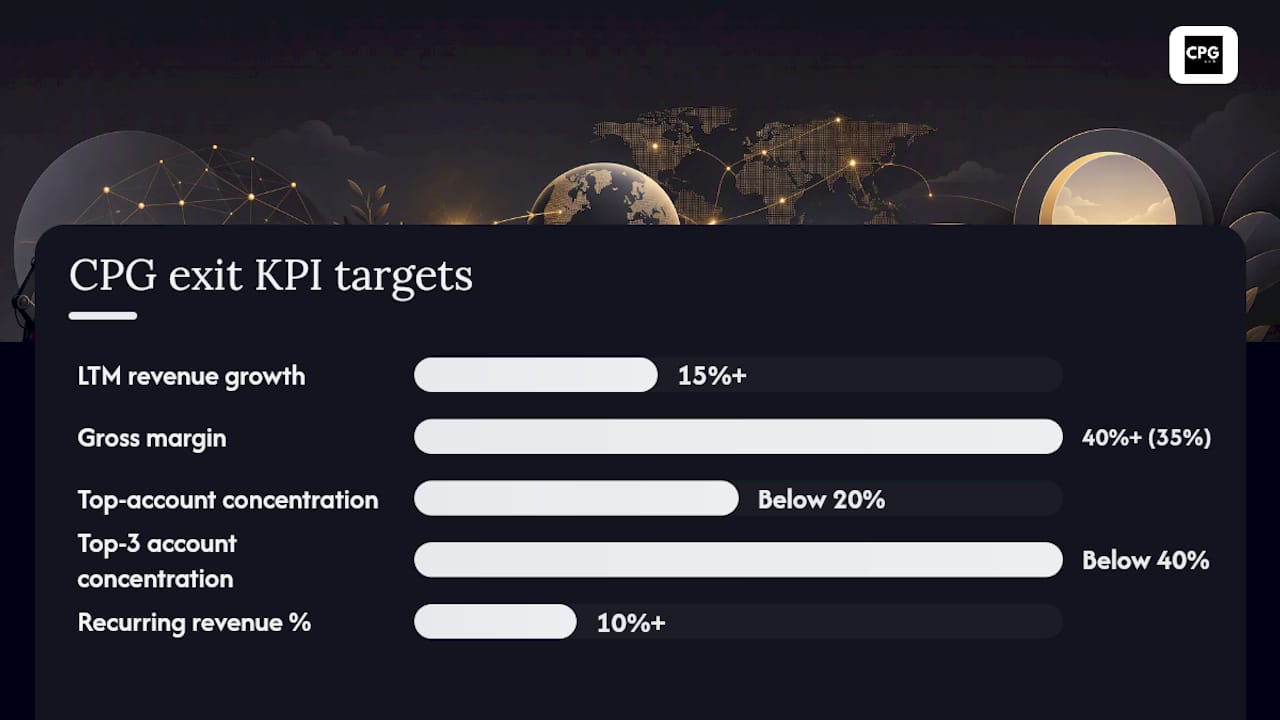
Platform tools and fractional advisory can accelerate this work significantly. Cpgagent's platform includes KPI dashboards, growth roadmap tools, and fractional CMO advisory that map directly to the commercial and operational workstreams above.
For CPG brands, internal readiness matters more than trying to time market windows. Build transferability first. The deal options follow.
The tradeoff most founders do not see coming
The founders who get the best exits are rarely the ones who optimized hardest for price. They are the ones who built businesses that did not need them anymore. That sounds simple. It is not.
Most CPG founders are the brand. They know the buyer relationships, the formulation history, the retailer contacts, the co-packer quirks. Transferring that knowledge to a team and a set of documented processes requires a kind of deliberate self-removal that feels counterintuitive when you are still growing. But buyers pay for the version of your business that runs without you. The version that needs you is worth less, sometimes significantly less.
The post-exit considerations are equally underestimated. Non-compete clauses in CPG deals routinely run 3–5 years and cover your entire category. Retention agreements for your key team members are often a condition of close. The cultural handoff to a new owner is a real transition that affects your employees, your retail partners, and the brand you spent years building. Plan for life after the exit before you sign the LOI, not after.
How Cpgagent accelerates exit readiness for CPG founders
Exit readiness is mostly operational work: KPI tracking, commercial expansion, process documentation, and management depth. Cpgagent's AI-powered platform gives founders the tools to run that work without a full agency retainer. The platform's growth roadmap tools, persona research, and launch validation capabilities map directly to the commercial workstreams that move multiples: distribution expansion, recurring revenue development, and brand equity documentation.
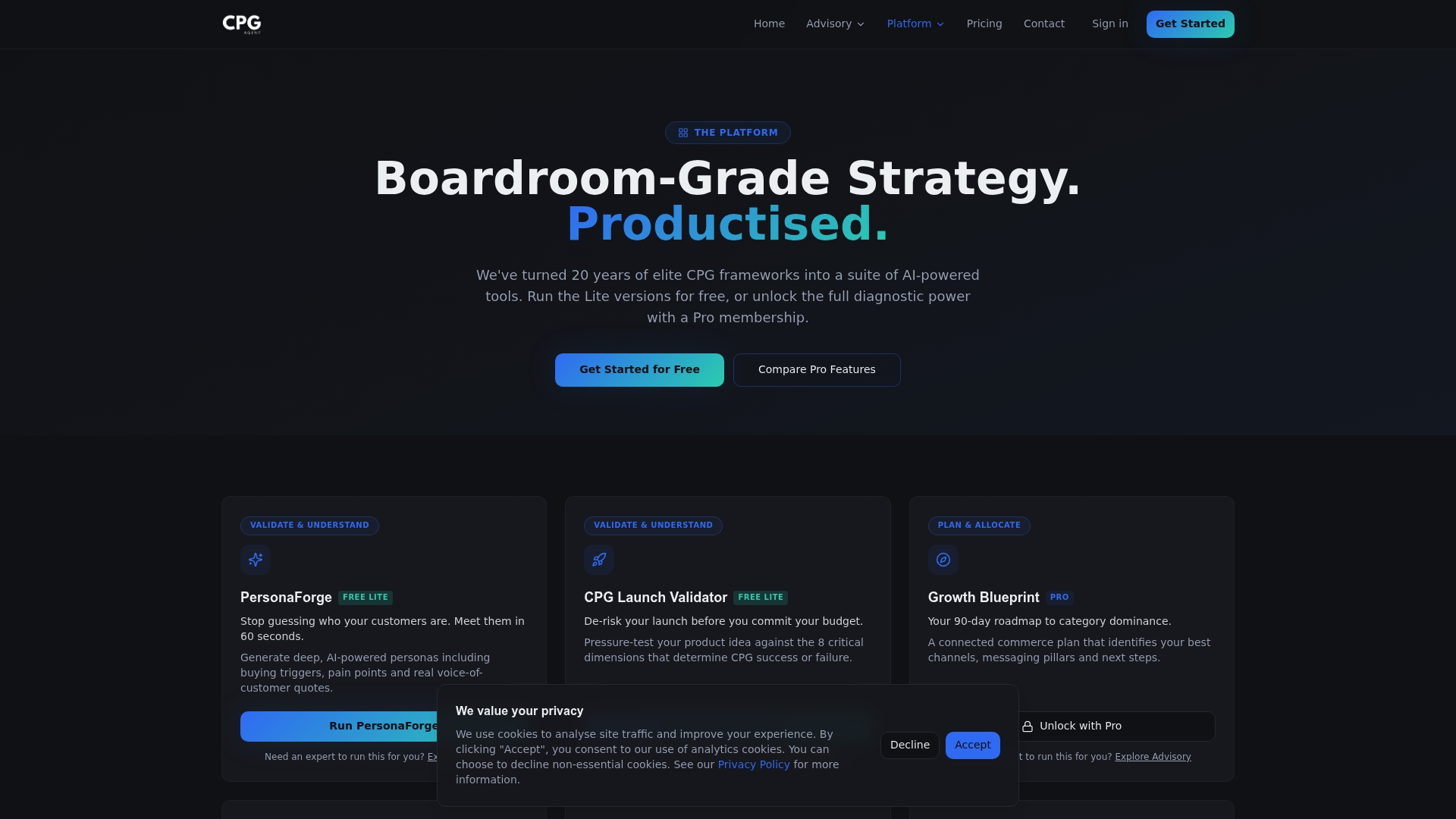
For founders who need senior marketing leadership during the exit-readiness window, Cpgagent's fractional CMO advisory fills that role without a full-time hire. You get experienced CPG leadership on the commercial workstreams that matter to buyers, at a fraction of the cost of a permanent executive. The platform also includes retail audit tools and conversion optimization that support the distribution and velocity metrics acquirers scrutinize most. Start with a readiness scan or an advisory call to identify your highest-leverage gaps. Visit Cpgagent's platform to see the full tool suite, or learn more about the CPG Agent approach to fractional leadership and AI-driven strategy.
Sources
- Exit Planning for Founder-Owned Business | M&A Advisory Experts
- Exit Planning for Founders
- Exit Planning for Founder-Owned Companies: How to Sell for Maximum Value
- Business Exit Planning: A Complete 2026 Guide · Iconic
This article is general information, not a substitute for advice from a qualified financial advisor. Consult a qualified financial professional about your own circumstances before acting on anything here.
FAQ
What is a founder exit strategy in CPG?
A CPG founder exit strategy is a documented, multi-year plan that builds the business into a transferable asset and defines how the founder will realize liquidity or transfer ownership. It covers operational, financial, legal, and tax dimensions and typically requires 3–5 years of preparation before a transaction.
What does a CPG founder mean?
A CPG founder is the original owner-operator of a consumer packaged goods brand, typically someone who built the product, distribution, and brand from the ground up and retains significant equity and operational control.
What is an example of a CPG exit strategy?
A common example is a strategic acquisition: a founder spends three years building management depth, reducing customer concentration, and documenting IP, then runs a six-to-twelve-month sell-side process that results in a larger CPG company acquiring the brand for cash at close plus an earnout tied to post-close revenue targets.
How much equity do founders typically have at exit?
Founder equity at exit varies widely based on how much outside capital was raised.
When should a CPG founder start exit planning?
The recommended window is 3–5 years before a planned exit. Founders who start earlier have more time to fix customer concentration, build management depth, and clean up financials, all of which directly improve the sale price and the probability of closing.