

TL;DR:
- Synthetic user research uses AI-created virtual personas to quickly generate consumer insights from existing data. It speeds up early concept screening while reducing costs but should always be validated with real consumers before final decisions. The method guides hypotheses rather than replacing traditional research, emphasizing honesty and validation throughout the process.
Synthetic user research is defined as an AI-driven method that generates data-grounded virtual personas to simulate consumer feedback for rapid, early-stage product insights. For product managers and marketers in CPG and FMCG, this approach cuts concept screening from weeks down to hours, without the $30,000+ price tag of traditional panel studies. The industry term for this practice is "synthetic usability research" or "AI-moderated virtual user research," and both labels are gaining traction across product development teams. Cpgagent's tools, including PersonaForge and Launch Validator, sit directly in this space, helping brands generate and stress-test consumer hypotheses before committing to costly validation rounds.
What is synthetic user research and how does it work?
Synthetic user research builds AI-powered personas from real qualitative datasets, then simulates how those personas respond to product concepts, messaging, or usability scenarios. The method does not invent consumer behavior from scratch. It extracts patterns from historical interviews, ethnographies, surveys, and behavioral data, then uses AI to replay and extend those patterns against new stimuli.
The quality of the output depends almost entirely on the quality of the input data. Data depth determines accuracy more than the AI model itself, which means a well-trained persona built on a decade of behavioral data will outperform a generic demographic profile every time. This is the single most important thing to understand before running any virtual user research program.
The process follows four core stages:
- Evidence gathering: Pull from past consumer interviews, focus group transcripts, ethnographic notes, and survey verbatims. The richer the source material, the more credible the synthetic persona.
- Persona construction: AI models cluster behavioral patterns into distinct consumer profiles. These are not demographic archetypes. They reflect actual decision-making logic, purchase triggers, and friction points.
- Simulated interaction: The AI runs the persona through concept tests, discussion guides, or usability scenarios. Responses are generated based on the behavioral logic embedded in the persona.
- Output interpretation: Results are flagged as hypotheses, not conclusions. Teams use them to prioritize which ideas deserve real-world validation.
Pro Tip: Always include anti-personas in your synthetic research setup. Anti-personas reduce confirmation bias by forcing the model to surface objections, abandonment triggers, and edge cases that optimistic personas will miss.
What are the advantages and limitations of synthetic user research?
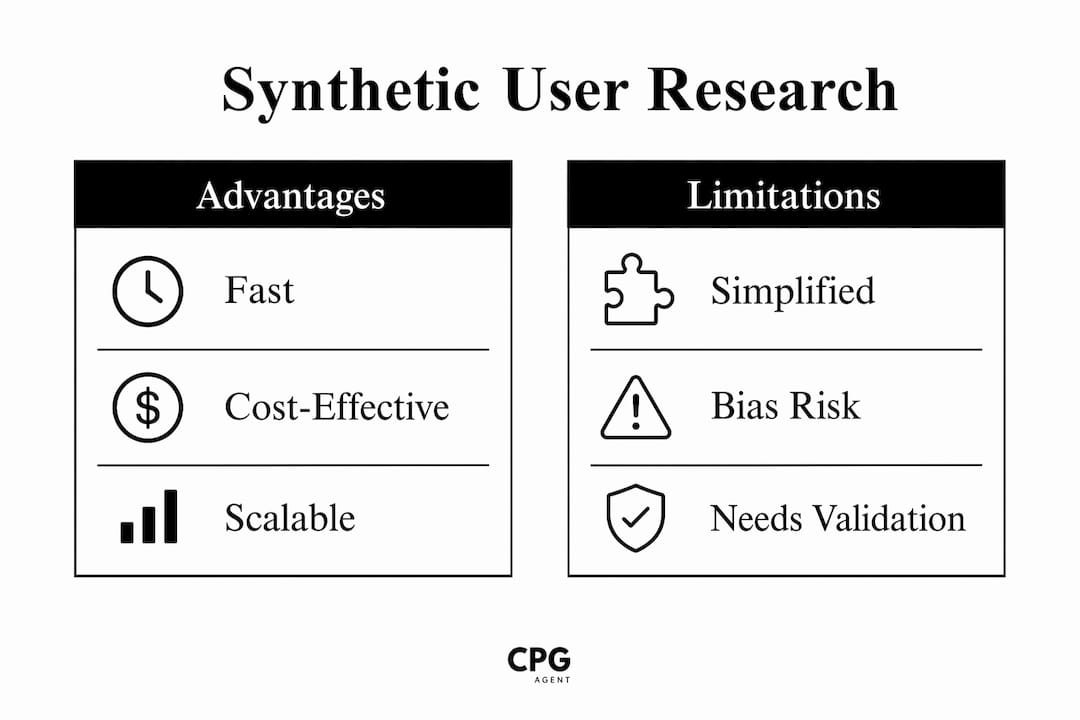
Synthetic user research delivers its clearest value in speed and cost. Concept screening cycles complete in 1–2 hours, compared to weeks for traditional panel-based studies. For FMCG brands running multiple SKU launches per quarter, that speed difference is the gap between catching a positioning problem before production and discovering it at retail.
The cost advantage is equally significant. Traditional qualitative research can exceed $30,000 per study. Synthetic methods bring that cost down by an order of magnitude, making it feasible to test five concepts where a brand previously tested one.
"A review of 12 studies found synthetic users lack reliability replicating human qualitative depth and variance in complex tasks. Experts at Nielsen Norman Group caution against using them for core product validation."
That caution is grounded. Synthetic personas flatten behavioral complexity. They cannot replicate the hesitation a shopper feels in a crowded aisle, the social pressure behind a purchase decision, or the irrational loyalty that drives repeat buying. Synthetic personas risk creating false certainty, which is the most dangerous outcome in product research because it reduces the motivation to run real-world testing.
| Dimension | Synthetic user research | Traditional user research |
|---|---|---|
| Speed | 1–2 hours per cycle | 2–6 weeks per study |
| Cost | Fraction of panel costs | Often exceeds $30,000 |
| Depth of insight | Surface to moderate | Deep behavioral nuance |
| Confirmation bias risk | High without guardrails | Lower with skilled moderation |
| Best use case | Early-stage hypothesis generation | Final validation and product decisions |
| Scalability | High across multiple concepts | Limited by budget and recruitment |
The table above shows where each method wins. Synthetic research is not a replacement for traditional methods. It is a front-end filter that makes traditional research more targeted and efficient.
How synthetic user research complements real user research
Synthetic research functions as decision rehearsal, not decision proof. Synthetic findings guide what to validate, not what to decide upon finally. This distinction matters enormously in CPG, where a wrong product decision costs shelf space, retailer relationships, and brand equity.
The right integration model treats synthetic research as the first gate in a two-stage pipeline:
- Run synthetic concept screening to identify which of five or ten ideas shows the strongest simulated consumer response. Eliminate the bottom half before spending a dollar on real recruitment.
- Refine your discussion guide using synthetic interviews. Run the AI through your planned questions and identify where the logic breaks down or where answers drift off-topic.
- Conduct real user validation on the top two or three concepts. Use the synthetic findings to sharpen your hypotheses and focus your moderator on the most contested assumptions.
- Compare outputs. Where synthetic and real findings align, confidence increases. Where they diverge, you have found a gap in your persona data that needs to be addressed before the next cycle.
Epistemic honesty is non-negotiable in this workflow. Synthetic findings should be explicitly labeled as hypotheses in every internal report and stakeholder presentation. Labeling prevents teams from treating AI-generated outputs as validated consumer truth, which is the most common way synthetic research causes strategic missteps.
Pro Tip: Before trusting synthetic outputs on a new product concept, validate your model against historical data you already have. Run the synthetic personas through a concept you already launched and see how closely the simulated response matches what real consumers said. If the gap is large, your input data needs work.
The behavioral segmentation approach used in advanced persona modeling aligns directly with this two-stage pipeline. Behavioral clusters built from real purchase and usage data produce synthetic personas that are far more predictive than demographic proxies.
Practical steps for applying synthetic research in CPG product development
CPG and FMCG product managers face a specific challenge: consumer preferences shift fast, retail windows are narrow, and the cost of a failed launch is high. Synthetic user research fits this environment well when applied correctly.
Step 1: Prepare quality data inputs. Pull from every qualitative source you have. Past consumer interviews, focus group transcripts, shopper ethnographies, and online review verbatims all feed persona construction. Thin data produces thin personas. If your historical research is sparse, run a small real-user study first to build the foundation.

Step 2: Generate category-specific synthetic personas. Generic consumer personas do not work in CPG. A synthetic persona for a functional beverage brand needs to encode category-specific behaviors: label-reading habits, health claim skepticism, flavor fatigue patterns, and channel preferences. The more category-specific the input data, the more useful the output.
Step 3: Run rapid concept screening cycles. Test packaging concepts, flavor profiles, benefit claims, and price points against your synthetic personas. AI-moderated research requires quality guardrails to maintain neutrality, including checks for leading questions and conversation drift. A well-run synthetic screening cycle surfaces the top-performing concept in hours, not weeks.
Step 4: Interpret results with skepticism. Flag every synthetic output as a hypothesis. Note where multiple personas agree and where they diverge. Divergence is often more informative than consensus because it signals a segment worth investigating with real consumers.
Step 5: Build in real-user validation checkpoints. Synthetic research feeds the pipeline. Real consumers close it. Schedule at least one real-user validation round before any concept moves to formulation or packaging development.
The table below maps synthetic research outputs to CPG decision points:
| Research output | CPG decision it informs |
|---|---|
| Concept preference ranking | Which SKUs to develop further |
| Benefit claim resonance | Packaging and marketing copy direction |
| Price sensitivity signals | Retail pricing and promotional strategy |
| Friction and objection themes | Reformulation or messaging adjustments |
| Segment divergence patterns | Targeting and channel prioritization |
Cpgagent's AI-driven platform supports this workflow directly, integrating data inputs, persona generation, and concept screening into a single pipeline built for CPG and FMCG teams. The platform's AI-powered consumer research capabilities are designed to handle the speed and iteration demands of fast-moving categories.
Key Takeaways
Synthetic user research accelerates early-stage CPG concept screening but requires real-user validation before any final product decision.
| Point | Details |
|---|---|
| Speed and cost advantage | Synthetic concept cycles complete in 1–2 hours versus weeks for traditional panel studies. |
| Data quality drives accuracy | Persona credibility depends on historical qualitative depth, not AI model sophistication. |
| Label findings as hypotheses | Explicitly flag synthetic outputs to prevent teams from treating them as validated consumer truth. |
| Include anti-personas | Critics and abandoners in the model surface risks that optimistic personas consistently miss. |
| Validate against real users | Synthetic research identifies what to test. Real consumers provide the final answer. |
The uncomfortable truth about synthetic research speed
The CPG industry has a long history of mistaking speed for rigor. Synthetic user research is genuinely fast, and that speed is genuinely useful. But I have seen teams use that speed as a reason to skip real-user validation entirely, and that is where the method becomes a liability rather than an asset.
The risk is not that synthetic research is wrong. The risk is that it is convincingly right-sounding. AI-generated consumer responses are fluent, coherent, and structured in ways that real consumer verbatims rarely are. That polish creates a false sense of certainty. A real consumer stumbles, contradicts themselves, and surprises you. A synthetic persona does not, and that missing friction is exactly where the most important product insights live.
My recommendation is to treat synthetic research the way a good scientist treats a simulation. It is a tool for generating hypotheses and narrowing the search space. It is not a substitute for contact with the actual phenomenon. In CPG terms, that means getting real consumers in front of your product before you commit to production, no matter how clean your synthetic data looks.
The brands that will use this method well are the ones that stay epistemically honest. Report synthetic findings as hypotheses. Build validation checkpoints into every project plan. And always test your synthetic model against historical data before trusting it on something new.
— Matthew
How Cpgagent supports your synthetic research workflow
Cpgagent is built for CPG and FMCG brands that need to move fast without sacrificing research quality.

The platform integrates data inputs, AI-driven persona generation, and concept screening into a single workflow designed for product managers who cannot afford a six-week research cycle. PersonaForge builds category-specific consumer personas from your existing qualitative data. Launch Validator stress-tests product concepts against those personas before you commit budget to development. Both tools are designed to feed real-user validation, not replace it. If you are ready to run your first synthetic concept screening cycle, the Cpgagent platform gives you the infrastructure to do it with the data integrity your brand requires.
FAQ
What is synthetic user research?
Synthetic user research is an AI-driven method that builds virtual consumer personas from real qualitative data and simulates their responses to product concepts, messaging, or usability scenarios. It is used primarily for early-stage hypothesis generation and concept screening.
How accurate is synthetic user research?
Accuracy depends on the quality and depth of the historical data used to build the personas. Data depth determines output accuracy more than AI model choice, and synthetic outputs should always be validated against real users before final decisions.
Can synthetic user research replace traditional user research?
No. Synthetic findings guide what to validate, not what to decide upon finally. Nielsen Norman Group and PM Toolkit both caution against using synthetic users for core product validation.
What are the biggest risks of synthetic user research?
The primary risk is confirmation bias. Synthetic personas flatten human complexity and can produce overly optimistic results that reduce the motivation to conduct real-world testing.
How do CPG brands get started with synthetic user research?
Start by assembling your best historical qualitative data, including past interviews, focus group transcripts, and shopper ethnographies. Build category-specific personas, run concept screening cycles, and always schedule a real-user validation round before moving a concept into development.