

TL;DR:
- Retailers tailor product detail page copy to match each channel's layout and shopper behavior, boosting conversions.
- A five-block, structured PDP with a dual-audience format improves performance and can increase conversion rates by up to 50%.
Retailer-specific PDP copy is product detail page content customized per retail channel to match platform layout, shopper behavior, and conversion requirements. The industry term for this practice is channel-adapted product content, and it sits at the center of every serious product description strategy in 2026. 87% of online shoppers rate product descriptions as highly important in their purchase decisions. That number means a generic, one-size-fits-all description is not a neutral choice. It is a conversion liability. This guide walks retail marketing professionals and ecommerce teams through the structure, channel logic, tools, and step-by-step process to write retailer product copy that performs.
What are the essential components of retailer-specific PDP copy?
A high-converting PDP is not a wall of features. It is a structured sequence of copy blocks, each doing a specific job for the shopper. A consistent multi-block PDP structure can increase conversion rates by 25% to 50%. That lift comes from structure, not from better adjectives.

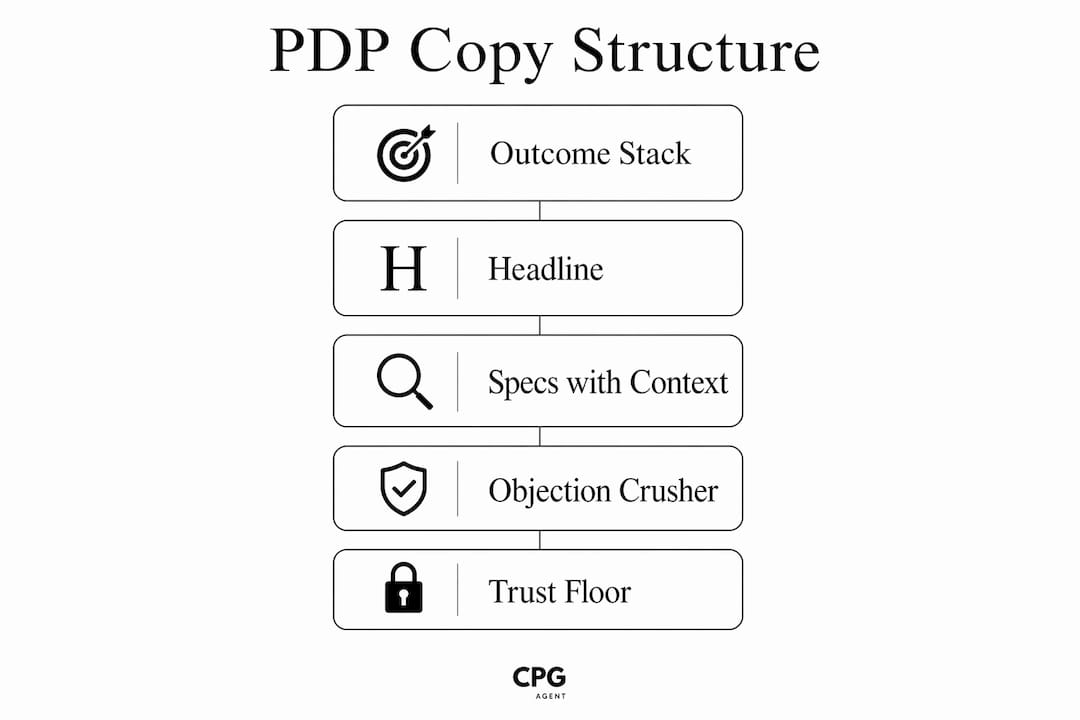
The five core blocks are the Headline, the Outcome Stack, Specs with Context, the Objection Crusher, and the Trust Floor. Each block answers a different shopper question. The Headline captures attention and states the product's primary benefit. The Outcome Stack lists the life improvements the shopper gets, written as benefit-first bullets rather than feature lists.
The difference between feature listing and benefit messaging is the difference between "100% organic cotton" and "softer on sensitive skin, retains shape after washing." The Specs with Context approach pairs every technical attribute with a "which means" statement. Shoppers validate their purchase with specs, but they decide with benefits. Giving them both in the same breath removes friction.
The Objection Crusher block pre-empts the top three reasons a shopper would leave without buying. The Trust Floor closes with social proof, certifications, and guarantees. Together, these five blocks form a complete argument for purchase.
| Block | Primary function | Shopper impact |
|---|---|---|
| Headline | States core benefit immediately | Captures attention, reduces bounce |
| Outcome Stack | Lists life improvements as benefit bullets | Builds desire and emotional connection |
| Specs with Context | Pairs features with "which means" benefits | Validates purchase rationally |
| Objection Crusher | Addresses top hesitations proactively | Reduces cart abandonment |
| Trust Floor | Social proof, certifications, guarantees | Builds confidence at decision point |
Pro Tip: Write your Outcome Stack before your Headline. Listing the benefits first forces you to identify the strongest one, which then becomes your lead.
How to adapt PDP copy for different retail channels and platforms?
Channel adaptation is the part most ecommerce teams skip, and it is where the most conversion is lost. Marketplace PDPs need concise, benefit-heavy copy near the top, while DTC sites allow longer storytelling. The reason is shopper behavior. A shopper on Amazon is scanning fast and comparing three tabs at once. A shopper on your brand site arrived with more intent and more patience.
The dual-audience problem makes this harder. Your PDP now serves two readers: the human shopper and the AI shopping agent. AI-friendly product descriptions require a leading 40–60 word definition block that AI can extract cleanly. That block goes first. Emotive brand storytelling follows it. This structure satisfies both audiences without sacrificing either. For teams building out their AI search visibility, this dual-layer approach is now a baseline requirement.
Channel-specific copy tweaks by platform type:
- Amazon and Walmart: Lead with the 40–60 word definition block. Use benefit-first bullets in the Outcome Stack. Keep the Headline under 200 characters. Place the Objection Crusher high on the page, not buried below the fold.
- DTC brand site: Extend the storytelling section. Add brand origin, ingredient sourcing, or mission narrative after the core five blocks. Longer copy works here because purchase intent is higher.
- Specialty retailers (Target, Whole Foods, Kroger): Match the retailer's category language. A Whole Foods shopper responds to "certified organic, cold-pressed" differently than a Walmart shopper. Adjust vocabulary to fit the platform's audience expectations.
- Club stores (Costco, Sam's Club): Emphasize value per unit and bulk-use scenarios. The Outcome Stack should reflect household-scale benefits, not single-use ones.
Pro Tip: Pull your last 30 customer support tickets before writing any marketplace PDP. The questions customers ask by email are the objections you need to answer on the page. Place the top three in your Objection Crusher block.
What tools and frameworks support writing retailer-specific PDP copy efficiently?
The right framework cuts production time and improves consistency across a large catalog. AI tools now enable large-scale PDP content generation that integrates brand voice, specifications, and benefit messaging. The key is using AI to generate the first draft of structured blocks, then editing for brand accuracy and channel fit.
LLM-friendly PDPs include definition leads, spec tables, use case lists, and short FAQs. This structure improves the chance that AI chatbots like ChatGPT and Google AI recommend your product in response to shopping queries. Structured data and schema markup reinforce this further by making attributes machine-readable at the page level.
The Shopify five-block PDP system, documented by practitioners like Michael Dishmon, provides a repeatable template that teams can apply across SKUs. It integrates well with AI generation tools because each block has a defined input type: benefit list, spec pairs, objection list, proof elements. Teams using AI marketing infrastructure can feed product data into these templates and generate channel-ready drafts at scale.
| Tool or framework | Primary use | Best for |
|---|---|---|
| Shopify five-block PDP system | Structured copy template | All channels, catalog-wide consistency |
| AI description generators | First-draft generation at scale | Large SKU counts, speed-to-market |
| Schema markup and structured data | Machine-readable attribute tagging | AI visibility, search indexing |
| Customer support ticket analysis | Objection mining for copy | Marketplace PDPs, high-return categories |
Step-by-step process to create and optimize retailer-specific PDP copy
The process starts before you write a single word. Preparation determines whether your copy converts or just fills a page.
Step 1: Research and align. Pull keyword data for the specific retailer's search environment. Amazon's A9 algorithm weights different terms than Google. Identify your buyer persona for that channel and note the vocabulary they use in reviews and questions. Confirm the character limits and content specs for the retailer's PDP template.
Step 2: Write the blocks in order. Follow this sequence: Outcome Stack first, then Headline, then Specs with Context, then Objection Crusher, then Trust Floor. Writing the Outcome Stack first keeps the copy benefit-led rather than feature-led. The order of PDP copy blocks impacts conversion more than individual sentence quality. Getting the sequence right matters more than polishing individual lines.
Step 3: Apply channel formatting. Trim or extend based on the platform. For Amazon, cut the storytelling section entirely. For a DTC site, add it back. Adjust bullet length to match the retailer's display rules. Some platforms truncate bullets after 80 characters.
Step 4: Test the Headline and Outcome Stack first. A/B testing the top two blocks delivers the fastest conversion signal. The Headline and Outcome Stack determine whether a shopper reads further. Test one variable at a time: Headline A vs. Headline B, then Outcome Stack version A vs. B. Do not test the full page simultaneously.
Step 5: Measure and iterate. Track add-to-cart rate, page exit rate, and return rate by SKU. A high return rate often signals that the Specs with Context block is inaccurate or missing. A high exit rate before add-to-cart points to a weak Headline or Outcome Stack.
"Reordering PDP copy blocks to follow a proven six-block sequence yields greater lift than minor copy edits. Order matters more than word choice." — Michael Dishmon's PDP Conversion Framework
Pro Tip: Do not edit for sentence quality until the block order is locked. A perfectly written Objection Crusher in the wrong position will underperform a rough one placed correctly.
Common pitfalls to avoid: writing specs without context, placing the Trust Floor above the Outcome Stack, using the same copy across all channels without adaptation, and ignoring the 40–60 word AI definition lead entirely. Each of these errors is fixable in a single revision pass once you know what to look for. Teams expanding into new retail channels can find additional channel-entry guidance through Cpgagent's retailer expansion resources.
Key takeaways
Retailer-specific PDP copy requires a structured five-block sequence, a dual-audience format for AI and human readers, and channel-specific adaptation to convert across Amazon, DTC, and specialty retail environments.
| Point | Details |
|---|---|
| Structure drives conversion | A five-block PDP sequence can lift conversion rates by 25% to 50% versus unstructured copy. |
| Block order beats word quality | Placing blocks in the correct sequence delivers more lift than editing individual sentences. |
| Dual-audience format is required | Lead with a 40–60 word AI-extractable definition, then follow with emotive storytelling for human shoppers. |
| Channel adaptation is non-negotiable | Marketplace copy must be concise and front-loaded; DTC copy can extend into brand narrative. |
| Objections belong near the top | Mining support tickets for buyer hesitations and placing answers early on the page reduces bounce. |
What I've learned writing PDP copy across retail channels
The biggest mistake I see ecommerce teams make is treating PDP copy as a one-time deliverable. They write it at launch, file it, and move on. Six months later, the product has a 3.2-star rating and a return rate that nobody can explain. The copy was never updated to reflect what actual buyers were confused about.
The channel fragmentation problem is real and getting worse. A brand selling on Amazon, Target.com, and its own DTC site needs three meaningfully different versions of every PDP. Not three slightly reworded versions. Three structurally different documents, each calibrated to the platform's shopper behavior and layout constraints. Most teams do not have the bandwidth for that without a repeatable system.
The AI extraction challenge is the newest pressure point. Shoppers increasingly ask ChatGPT or Perplexity which product to buy before they ever visit a retailer page. If your PDP does not have a clean 40–60 word definition block at the top, AI agents cannot extract a useful answer about your product. You lose the recommendation before the shopper even arrives. That is a distribution problem disguised as a copy problem.
The fastest improvement I have seen teams make is mining customer support tickets for objections and rewriting the Objection Crusher block based on real data. It takes one afternoon. The conversion lift shows up within two weeks. No A/B test required. The data was already there. Nobody was reading it.
— Matthew
Cpgagent's platform for managing retailer-specific PDP content
Retail marketing professionals managing PDPs across multiple channels know the production burden well. Writing, adapting, and testing copy for Amazon, Walmart, DTC, and specialty retailers simultaneously requires a system, not just a spreadsheet.
Cpgagent's platform is built for exactly this workflow. It combines AI-driven content generation, structured product data management, and channel-specific formatting tools so ecommerce teams can produce and update retailer product copy at scale. The platform connects brand strategy to execution without agency overhead or long discovery phases. Teams working on catalog-wide PDP optimization can access the full Cpgagent platform to manage channel-adapted content, run copy experiments, and track performance across retail environments from a single system.
FAQ
What is retailer-specific PDP copy?
Retailer-specific PDP copy is product detail page content written and formatted for a specific retail channel, such as Amazon, Walmart, or a DTC site, to match that platform's layout, shopper behavior, and conversion requirements.
How does PDP copy structure affect conversion rates?
A consistent multi-block PDP structure can increase conversion rates by 25% to 50%, with block order having a greater impact on performance than the quality of individual sentences.
What is the dual-audience format for PDP copy?
The dual-audience format places a 40–60 word AI-extractable definition block at the top of the PDP for AI shopping agents, followed by emotive brand storytelling for human shoppers below.
How do I find the right objections to address in my PDP?
Pull your most recent customer support tickets and identify the top three recurring questions or hesitations. Place direct answers to those questions in the Objection Crusher block near the top of the page.
Does the same PDP copy work across Amazon, DTC, and specialty retailers?
No. Marketplace platforms like Amazon require concise, benefit-heavy copy front-loaded near the top. DTC sites support longer storytelling. Specialty retailers require vocabulary matched to their specific shopper audience.