

TL;DR:
- Channel-ready retail hooks are standardized fixtures used to display hanging products on pegboard, slatwall, and gridwall systems. Proper alignment of hook type and packaging design with the store system is essential to optimize shelf presence and reduce turnover issues. Integrating label holders and ensuring packaging compatibility before product launch enhances display effectiveness and prevents costly redesigns.
Channel-ready retail hooks are standardized display fixtures designed to hang product packaging on pegboard, slatwall, and gridwall systems at the point of sale. For CPG marketing and product teams, these fixtures are not an afterthought. They are the physical connection between your packaging investment and the shopper's hand. The peg-ready packaging market is projected to grow at a 12.70% CAGR through 2036, which tells you that retailers are demanding more vertical display formats, not fewer. Getting your hook strategy right now means your brand is positioned for that shift before your competitors catch up.
1. what are channel-ready retail hooks?
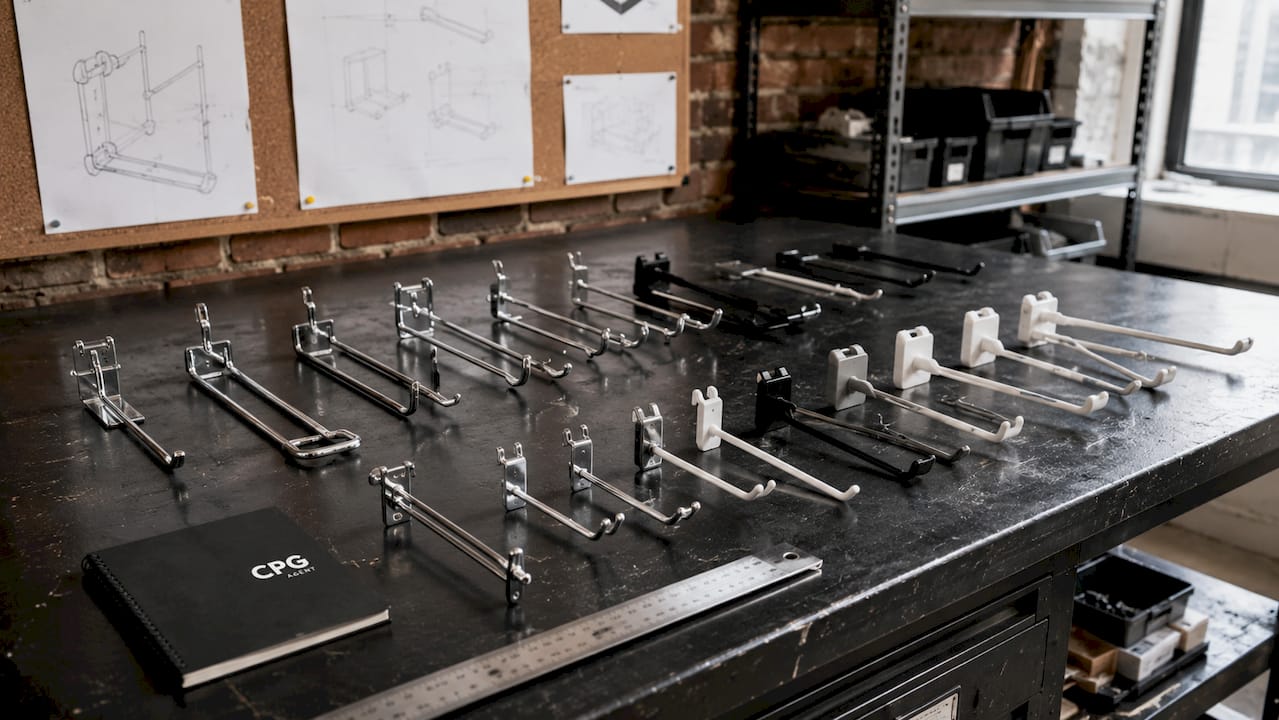
Channel-ready retail hooks are metal or plastic fixtures that mount to wall display systems and hold hanging product packaging at eye level. The term "channel-ready" is the SEO shorthand for what the industry calls peg hooks or display hooks for retail, and both terms describe the same category of point of sale hooks used across mass, grocery, drug, and specialty retail. The core function is simple: suspend a product so shoppers can see it, grab it, and buy it without assistance. The execution, however, requires precision in fixture selection, packaging compatibility, and store system alignment.
2. key types of display hooks and their best uses
Choosing the wrong hook type for your wall system wastes money and creates execution failures at the store level. The four primary categories each serve a distinct retail scenario.
- Pegboard hooks mount into drilled holes on a flat board. They are the most common fixture in hardware, home improvement, and general merchandise aisles. The standard peg hole diameter in US retail is 1/4 inch, and your packaging must match this spec to avoid loose or falling product.
- Slatwall hooks slide into horizontal grooves cut into wall panels. They lock more firmly under downward force than pegboard hooks, making them the preferred choice for beauty, electronics, and any high-traffic or high-theft category.
- Gridwall hooks attach to wire grid panels. They are lightweight, easy to reposition, and ideal for seasonal or promotional displays where the fixture layout changes frequently.
- Double beam hooks with label holders combine a reinforced load-bearing arm with an integrated pricing display. These are covered in detail in section 4.
Pro Tip: Match your hook type to the wall system before you finalize your packaging spec. A product designed only for pegboard will fail in a slatwall beauty aisle, and a reprint or hang tab retrofit costs more than getting it right the first time.
3. why packaging compatibility is the foundation of channel readiness
Your packaging design and your hook selection must be decided together, not in sequence. Most CPG teams finalize packaging first and then discover the product cannot hang properly in the retail environment. That gap costs you shelf space and sales.
The standard peg hole size for US retail is 1/4 inch in diameter, though some older fixtures use 1/8 inch. Designing your hang tab or euro slot to the 1/4 inch standard covers the majority of US retail environments. Retailers often segment their stores with pegboard for healthcare aisles, slatwall for beauty, and gridwall for seasonal displays, so cross-system compatibility is not optional for brands selling into multiple departments or multiple banners.
- Design euro slots or hang tabs to the 1/4 inch standard from the start.
- Test your packaging on all three wall systems before finalizing the die line.
- Confirm hang tab placement does not obscure the UPC or front-of-pack branding.
- Work with your structural packaging partner to verify load-bearing capacity at the hang point.
Pro Tip: If you have existing SKUs not designed for hanging display, hang tabs are a retrofit solution that avoids a full packaging redesign. They add a peg-ready hang point to almost any package format and can be applied during fulfillment.
For more on how packaging decisions affect shelf placement, the CPG brand differentiation guide covers real examples of brands that won and lost shelf space based on structural packaging choices.
4. how integrated scan plates and label holders improve the shopper experience
Modern retail hooks do more than hold product. The best fixtures combine merchandise display and pricing information in a single unit, reducing the number of accessories a retailer needs to install and maintain.
Integrated scan plates on retail hooks typically measure 1.375 inches high by 2.125 inches wide. That dimension is sized to hold a standard price label or UPC scan strip directly on the hook arm, so the shopper sees the price at the exact point of product contact. This matters because fixture clutter is one of the top reasons shoppers abandon a category without purchasing.
| Feature | Standard Hook | Hook with Scan Plate | Double Beam with Label Holder |
|---|---|---|---|
| Merchandise display | Yes | Yes | Yes |
| Integrated pricing | No | Yes | Yes |
| Load capacity | Standard | Standard | Increased |
| Accessories needed | Price strip separate | Built in | Built in |
| Best use | Basic pegboard | Mid-tier general retail | High-volume or branded displays |
Double beam hooks with iron brand label holders take this further by combining a reinforced dual-arm structure with a branded label channel. The result is a single fixture that handles heavier products, displays pricing, and carries brand identity at the shelf edge. These are particularly effective in corrugated power panel displays where the entire fixture is a brand statement.
5. pegboard vs. slatwall vs. gridwall: which system fits your channel?
The wall system your retail partner uses determines which hook type you need. This comparison gives your team a fast reference for channel planning.
| Criteria | Pegboard | Slatwall | Gridwall |
|---|---|---|---|
| Mounting method | Drilled holes | Horizontal grooves | Wire grid clips |
| Repositioning ease | Moderate | Easy | Very easy |
| Load capacity | Moderate | High | Low to moderate |
| Anti-theft security | Low | High | Low |
| Typical retail environment | Hardware, general merchandise | Beauty, electronics, specialty | Seasonal, promotional |
| Cross-system compatibility | Limited | Limited | Limited |
Slatwall provides a clear security advantage. Slatwall hooks lock into groove channels, which means a shopper pulling a product down actually tightens the hook's grip rather than dislodging it. For CPG brands in beauty or personal care, this reduces product loss and keeps the display intact longer between resets.
Gridwall is underused by most CPG teams. Its repositioning speed makes it the right choice for limited-time offers or seasonal SKUs where the display layout changes every four to eight weeks.
Pro Tip: If you are expanding into a new retail banner, ask the category manager which wall systems are used in each department before you submit your planogram. Brands that expand into new retailers without this information often submit planograms that cannot be executed at store level.
6. top 7 retail hooks that maximize shelf appeal and drive conversion
These are the fixtures most commonly used by CPG brands to achieve consistent, high-visibility shelf presentation across retail channels.
- Standard metal pegboard hook. The workhorse of general merchandise retail. Available in lengths from 3 to 12 inches. Best for lightweight products in hardware, home goods, or grocery. Low cost and universally available.
- Slatwall metal hook with locking tab. The preferred fixture for beauty and personal care. The locking tab prevents the hook from pulling out under product weight or shopper contact. Durable and reusable across resets.
- Double beam hook with iron brand label holder. Handles heavier products and carries integrated pricing. Ideal for branded power panels or endcap displays where fixture consistency is part of the brand presentation.
- Scan plate hook for general retail. Combines a standard hook arm with a built-in label channel measuring 1.375 by 2.125 inches. Reduces the need for separate price strips and keeps the shelf face clean.
- Gridwall J-hook. A J-shaped wire hook that clips directly to gridwall panels. Fast to install and reposition. Best for seasonal or promotional SKUs with short display windows.
- Power panel hook with scan plate. Designed for corrugated freestanding displays. Combines the structural support of a power panel with integrated pricing at the product face. Strong choice for new item launches or promotional features.
- Hang tab retrofit hook system. Not a wall-mounted hook, but a packaging-level solution. Hang tabs attach to existing packaging and allow non-hanging products to be merchandised on any peg system. The retrofit approach avoids costly packaging redesigns and can be deployed quickly across existing inventory.
Each of these fixtures serves a specific retail scenario. The best retail hook strategy is not picking one and applying it everywhere. It is mapping each fixture to the wall system, product weight, category security risk, and pricing display requirement of each retail channel you serve.
Key takeaways
Channel-ready retail hooks deliver shelf performance only when fixture type, packaging compatibility, and wall system requirements are aligned before a product reaches the store floor.
| Point | Details |
|---|---|
| Match hook to wall system | Pegboard, slatwall, and gridwall each require a different fixture type and packaging spec. |
| Design packaging to the 1/4 inch standard | The US retail standard peg hole is 1/4 inch; designing to this spec covers the majority of retail environments. |
| Use integrated label holders | Scan plate and label holder hooks reduce fixture clutter and improve the shopper pricing experience. |
| Retrofit with hang tabs | Hang tabs adapt existing packaging for peg display without a full structural redesign. |
| Audit wall systems before planogram submission | Knowing which systems a retailer uses by department prevents execution failures at store level. |
The detail most CPG teams skip until it costs them
I have reviewed planograms from brands that spent six figures on packaging redesigns, only to discover their new euro slot did not fit the slatwall hooks in the beauty aisle they were targeting. The packaging team optimized for pegboard because that was the default. The retail team never flagged the wall system. Nobody connected the two decisions until the product was already on a truck.
The fix is not complicated. It requires one conversation between your packaging engineer and your retail execution team before the die line is finalized. What makes it hard is that most CPG organizations do not structure that conversation into the product launch process. Packaging and merchandising operate as separate workstreams, and the fixture spec falls into the gap between them.
The brands I have seen execute this well treat the hook selection as part of the packaging brief, not a post-launch detail. They know which wall systems their top five retail partners use by department. They test hang tab placement on physical fixtures before approving the final print. They also use AI-enabled shelf monitoring to verify planogram adherence after launch, catching hook type mismatches before they become a sales problem.
Merchandising success depends on closing the gap between corporate brand standards and store-level fixture execution. That gap is wider than most teams realize, and it shows up directly in out-of-stock rates, facing counts, and conversion.
— Matthew
How Cpgagent helps you execute at the shelf
Cpgagent is built for CPG and FMCG brands that need to move fast without losing execution quality. The platform connects merchandising strategy, packaging decisions, and retail channel data in one place, so your team is not making fixture decisions in a vacuum.
If your team is preparing a retail expansion or a new item launch, the Cpgagent platform gives you the tools to align packaging specs, planogram requirements, and channel-specific fixture data before you submit to a buyer. You get data-backed insights without the overhead of a traditional agency, and you can deploy faster because the strategy and execution layers are connected from day one. For CPG teams that want to stay ahead on the shelf, that speed is the advantage.
FAQ
What are channel-ready retail hooks?
Channel-ready retail hooks are standardized display fixtures, commonly called peg hooks or display hooks for retail, that mount to pegboard, slatwall, or gridwall systems and hold hanging product packaging at the point of sale.
What is the standard peg hole size for US retail?
The standard peg hole diameter in US retail is 1/4 inch. Designing your packaging euro slot or hang tab to this spec covers the majority of US retail environments.
Which hook type is best for high-theft retail categories?
Slatwall hooks are the best choice for high-theft or high-traffic categories. They lock into horizontal groove channels and grip more firmly when pulled downward, reducing product loss and display disruption.
How do integrated scan plate hooks benefit CPG brands?
Hooks with integrated scan plates combine merchandise display and pricing in one fixture, reducing shelf clutter and making it easier for shoppers to find price information at the exact point of product contact.
Can existing packaging be adapted for peg display without a redesign?
Yes. Hang tabs are a retrofit solution that adds a peg-ready hang point to almost any existing package format, avoiding a full structural redesign and allowing faster deployment across current inventory.