

TL;DR:
- Nano-creator seeding and connected on-pack QR codes offer rapid, measurable growth opportunities for FMCG brands. Implementing small-scale experiments with clear KPIs can lead to significant drops in acquisition costs and increased purchase frequency. Accelerating pre-launch testing through specialized tools compresses timelines and enhances the chances of scalable success.
The six highest-impact growth hacking tactics FMCG brands should run this quarter are:
- AI-matched nano-creator seeding with unique promo codes and automated FTC disclosure
- Connected on-pack QR codes tied to a loyalty or gamified challenge program
- Rapid retail sampling and shelf takeovers in 10–20 test stores with POS measurement
- Targeted DTC flash trials via paid social with Meta Conversions API attribution
- Trade-promotion micro-experiments testing price or display mechanics in a single retailer
- On-shelf visibility micro-optimizations (shelf-height tests, secondary placement, POS signage)
Your 48-hour action: pull your last 90 days of paid search CPA, then brief three to five nano-creators this week with a unique promo code each. You'll have a real cost-per-acquisition benchmark to beat before your pilot even launches.
Table of Contents
- The tactical playbook: what to run and how to test it fast
- How to design and measure rapid FMCG growth experiments
- Which tools actually speed up FMCG experiments?
- How to prioritize which experiments to run first
- What real experiments looked like: before and after
- Key Takeaways
- What the deployment-first approach actually means in practice
- Cpgagent gets your pilots live faster than a traditional agency
- FAQ
- Useful sources
The tactical playbook: what to run and how to test it fast
Nano-creator seeding
Nano-creators (1K–50K followers) outperform broad paid prospecting on cold acquisition for FMCG when attribution is tight. A mid-market snack brand cut blended CPA by 41% versus paid search, dropping from $31.20 to $18.40 per acquisition using roughly 180 AI-matched creators per month. The key is matching creators by audience overlap and purchase-intent signals, not follower count.

MVP test (1–2 weeks): Seed 20–30 creators with product plus a unique promo code. Wire those codes to your analytics stack via Meta Conversions API. Primary KPI: blended CPA versus your current paid search baseline.
Pro Tip: At 100+ creators per month, manual disclosure review breaks down. FTC endorsement guidelines apply regardless of whether money changed hands, so automate #ad/#gifted scanning from day one.
Connected on-pack codes and QR loyalty
On-pack codes turn a supermarket SKU into a direct data channel. A dairy brand running gamified on-pack challenges saw 3X ROI versus traditional advertising and doubled purchase frequency among active loyalty members. That shift from reach-based to retention-based ROI is exactly what FMCG brands selling through third-party retail need.
MVP test (2 weeks): Print a 50K run of one SKU with single-use alphanumeric codes. Integrate the code-validation API with a lightweight loyalty platform. Primary KPI: redemption rate and 30-day repeat purchase rate among redeemers.
Retail sampling and shelf takeovers
Sampling at the shelf converts browsers into trialists faster than any digital ad for low-consideration purchases. Pair a 2-week shelf takeover in 10 stores with a secondary display and a QR code linking to a post-trial survey. Define your success threshold before you start: for example, +15% trial units sold versus control stores measured by distributor scans or store-level POS.
MVP test: 10 stores, 2 weeks, POS scan data. Primary KPI: trial lift percentage versus matched control stores.
DTC flash trials
A 72-hour "try before you buy" offer via paid social, fulfilled through your own site or a DTC partner, generates first-party purchase data that retail never gives you. Channel-specific assortments matter here: online grocery in North America grew 14.1% year over year, and brands with tailored DTC SKUs convert better than those pushing retail pack sizes online.
MVP test (1 week): Run a $2,000–$5,000 paid social spend to a dedicated landing page with a single offer. Primary KPI: trial conversion rate and 30-day reorder rate.
Trade-promotion micro-experiments
72% of trade spending before the pandemic produced no measurable ROI, largely because brands ran promotions without a control group or a pre-defined success threshold. Fix that by treating every trade promotion as an experiment: one variable, one retailer, one measurement window.
MVP test (2 weeks): Test one price point or display mechanic in five stores versus five matched controls. Primary KPI: distribution velocity (units per store per week).
Packaging and price micro-experiments
Small improvements in price can translate into significant improvements in margins. Small pack-format changes can also move the needle fast in fresh categories. iD Fresh's patented standing pouch improved shelf behavior and convenience without changing the product, showing that operational and packaging changes are legitimate growth levers.
MVP test: A/B test two price points or two pack formats in adjacent zip codes using matched retail accounts. Primary KPI: margin per unit and trial rate.
How to design and measure rapid FMCG growth experiments
The recommended framework is design, run, measure, scale. Apply it to every tactic above before committing budget beyond the MVP.
- Design: Define one hypothesis, one primary KPI, and a pre-set success threshold. No threshold set in advance means no decision rule at the end.
- Run: Keep the MVP to 1–4 weeks and limit variables. One change per test.
- Measure: Use store-level POS, unique promo codes, or Meta Conversions API. Avoid last-click attribution for FMCG.
- Scale: If the success threshold is met, expand to 5–10X the original footprint over 8–12 weeks.
| Tactic | Recommended sample | Baseline threshold | Success gate | MVP timeline |
|---|---|---|---|---|
| Nano-creator seeding | 20–50 creators | Current paid search CPA | CPA reduction of 20%+ | 4–6 weeks |
| On-pack codes | 50K units, 1 SKU | Current repeat rate | Redemption rate 5%+ | 4–8 weeks |
| Retail sampling | 10 stores + 10 controls | Category velocity | +15% trial units vs. control | 2 weeks |
| DTC flash trial | $2K–$5K media spend | Category conversion rate | Trial-to-reorder 15%+ | 1–2 weeks |
| Trade promo test | 5 stores + 5 controls | Units per store per week | +10% distribution velocity | 2 weeks |
Regulatory note: U.S. FMCG brands must comply with FDA labeling rules for any claims made on packaging or in creator content, and all creator posts must carry FTC-required disclosures (#ad or #gifted) regardless of payment structure.
Which tools actually speed up FMCG experiments?
The minimum stack for running this playbook: an audience modeler, a creator-matching tool, UTM and promo-code attribution, a connected-pack code system, and a distribution metrics dashboard.
Cpgagent's PersonaForge and Launch Validator compress the pre-launch phase that typically burns 4–6 weeks. PersonaForge builds rapid audience segments from first-party and behavioral data so you brief creators and retailers with precision, not guesswork. Launch Validator stress-tests your concept against real purchase signals before you print a single label or book a single store.
For creator programs, you need disclosure automation (automated hashtag scanning) and Meta Conversions API or server-side event tracking to close the attribution loop. For connected-pack programs, a code-generation and validation API that integrates with your loyalty platform is non-negotiable. Manual code management at 50K+ units fails fast.
AI matching cut creator vetting time from roughly six weeks to four days in one documented case, surfacing 400 qualified nano-creators in the first pass. That speed difference is the gap between a Q3 pilot and a Q1 pilot.
For brands building without full agency support, a lean CPG strategy guide covers how to wire the ops stack without enterprise overhead.
How to prioritize which experiments to run first
Prioritize tactics that reduce acquisition friction given your current stage. Startups should lead with DTC flash trials and retail sampling. Mid-market brands get the fastest ROI from nano-creator seeding and connected-pack codes. National brands should focus on retail visibility and trade-promotion micro-tests where distribution is already wide but velocity is flat.
| Brand stage | Distribution reach | Top tactic 1 | Top tactic 2 |
|---|---|---|---|
| Startup | Local / regional | DTC flash trial | Retail sampling (5–10 stores) |
| Mid-market | Regional / multi-state | Nano-creator seeding | Connected on-pack codes |
| National | Broad national | Retail visibility test | Trade-promo micro-experiment |
Three prioritization rules:
- Expected ROI first: run the tactic with the clearest cost-per-unit-of-learning.
- Operational readiness second: a tactic you can execute in two weeks beats a theoretically better one that needs three months of setup.
- Retailer friction third: avoid experiments that require buyer approval unless you already have the relationship.
Ballpark MVP costs: nano-creator pilot $3K–$8K; on-pack code print run $5K–$15K; retail sampling activation $2K–$6K per market; DTC flash trial $2K–$5K media plus fulfillment. Scaled rollouts typically run 5–10X those figures over 8–12 weeks. For more budget framing, see growing a CPG brand on a limited budget.
What real experiments looked like: before and after
Case 1: Nano-creator pilot, mid-market snack brand
Challenge: paid search CPA was $31.20 and rising. Action: 180 AI-matched nano-creators per month, unique promo codes per cohort, Conversions API attribution. Result: blended CPA dropped to $18.40, a 41% reduction. Attribution method: unique promo codes plus server-side event tracking.
Case 2: Connected-pack loyalty, dairy brand
Challenge: no direct consumer data from supermarket sales. Action: on-pack codes tied to gamified challenges; program revamp drove a 51% increase in redemptions. Result: 3X ROI versus traditional advertising; active members bought twice as much as non-members. Attribution: code-level redemption tracking via loyalty platform.
| Case | Before | After | Attribution method |
|---|---|---|---|
| Nano-creator pilot | $31.20 blended CPA | $18.40 blended CPA | Unique promo codes + Conversions API |
| Connected-pack loyalty | No first-party data | 3X ROI, 2X purchase frequency | Code-level redemption tracking |
Lesson from Case 2: the integration cost for code-validation APIs is front-loaded, but the downstream data asset (first-party purchase behavior at the individual level) compounds every quarter.
Key Takeaways
The fastest path to measurable FMCG growth is running two or three tightly instrumented experiments simultaneously, each with a pre-defined success threshold and a clear owner.
| Point | Details |
|---|---|
| Nano-creator CPA advantage | AI-matched nano-creators delivered a 41% lower CPA than paid search in a documented CPG pilot (blended CPA lowered from $31.20 to $18.40). |
| Connected-pack ROI | On-pack code loyalty programs can produce 3X ROI versus traditional advertising and double purchase frequency among active loyalty members. |
| Experiment discipline | Define a success threshold before launch; 72% of trade spend historically produced no ROI without measurement guardrails. |
| Prioritize by stage | Startups lead with DTC trials and sampling; mid-market brands get fastest returns from creator seeding and on-pack codes. |
| Cpgagent as execution layer | Cpgagent's PersonaForge and Launch Validator compress pre-launch planning from weeks to days for FMCG pilots. |
What the deployment-first approach actually means in practice
Most FMCG growth programs stall in planning. The smarter move is to deploy a minimum viable experiment, instrument it properly, and let the data decide whether to scale. That is the lens Cpgagent applies: ship fast, measure everything, scale the winners.
Cpgagent pairs PersonaForge for rapid audience segmentation with Launch Validator for pre-launch signal checks, then layers in fractional marketing leadership to run the experiment cadence. That combination means a brand can go from hypothesis to live pilot in days rather than the typical agency discovery cycle of six to eight weeks. When experiments hit their success thresholds, the fractional CMO layer handles retailer conversations and scaled media planning so momentum does not stall at the handoff.
One governance note worth flagging: as experiments scale into national retail, retailer relationships and compliance documentation become load-bearing. Build those early, not after your first successful pilot.
Cpgagent gets your pilots live faster than a traditional agency
Brands that run the tactics above without the right tooling spend most of their time on setup, not learning. Cpgagent cuts that setup time by giving you AI-powered persona models, nano-creator matching, connected-pack code generation, and campaign attribution wiring in one platform, backed by fractional CMO support when you need a senior hand on execution.
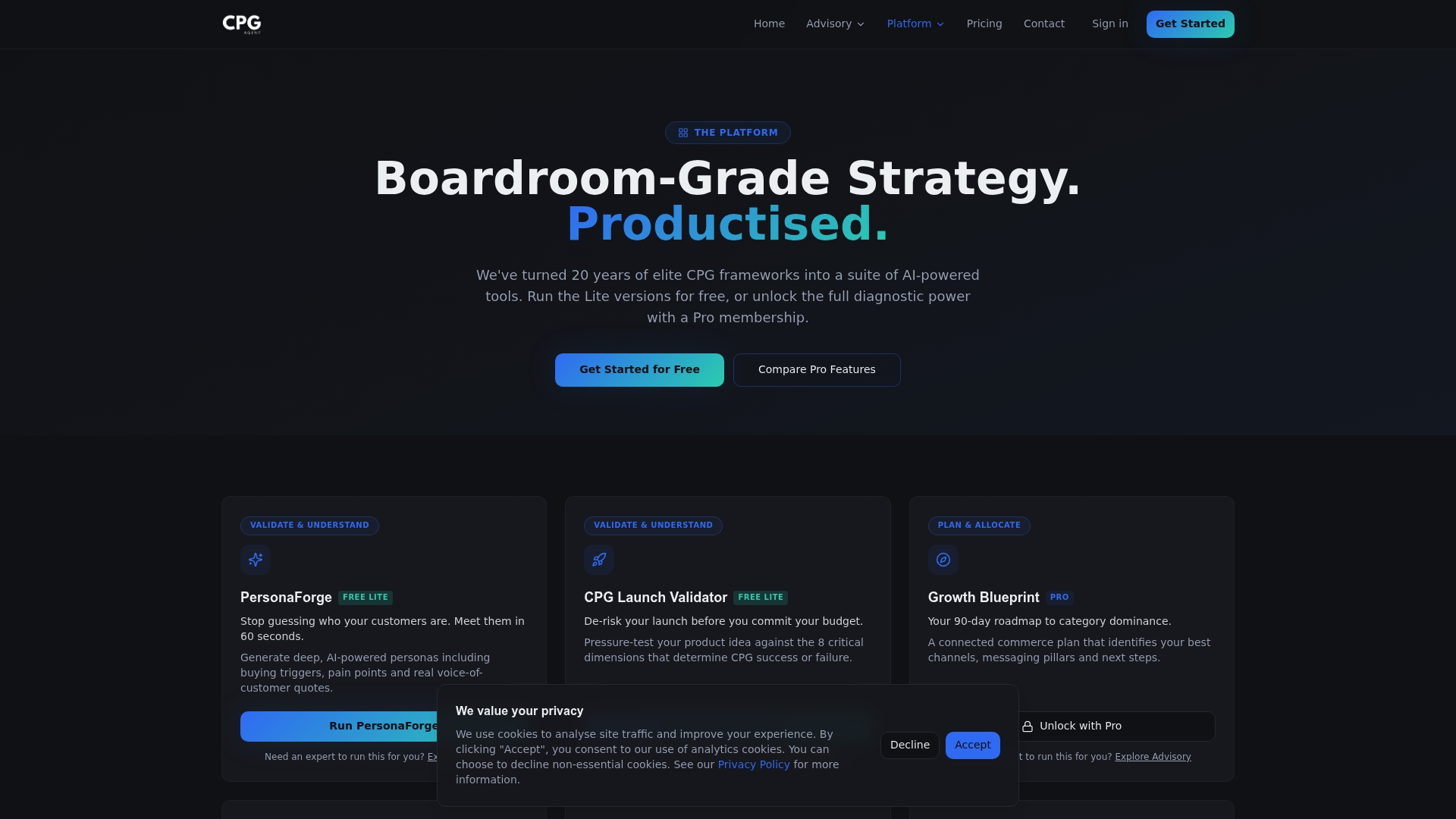
In the first 30 days on the Cpgagent platform, you get persona segments built from real purchase-intent data, a validated launch concept, creator briefs with disclosure automation, and attribution wiring for your first pilot. No six-week discovery phase. No agency retainer. Just a running experiment with a KPI on the board.
Book a 30-minute pilot discovery call at cpgagent.com to scope your first experiment this quarter.
Pro Tip: Before your first call, pull your current paid search CPA and your 90-day repeat purchase rate. Those two numbers set the baseline every experiment will be measured against, and having them ready cuts your scoping session in half.
FAQ
What are the fastest growth hacking tactics for FMCG brands?
Nano-creator seeding with unique promo codes and connected on-pack QR loyalty programs deliver measurable results in 2–6 weeks and require no major retail negotiation to launch.
How do you measure a nano-creator pilot for a CPG brand?
Use unique promo codes per creator cohort wired to Meta Conversions API; compare blended CPA against your current paid search baseline as the primary success gate.
What does a connected-pack code program cost to launch?
A 50K-unit print run with code integration typically runs $5K–$15K upfront; the downstream ROI from first-party data and repeat purchase lift can reach 3X versus traditional advertising and double purchase frequency among active loyalty members.
How long should an FMCG growth experiment run before you call it?
MVP experiments run 1–4 weeks with a pre-defined success threshold; scaled rollouts require 8–12 weeks to generate statistically reliable distribution and repeat-purchase data.
How does Cpgagent help FMCG brands run experiments faster?
Cpgagent's PersonaForge and Launch Validator compress pre-launch planning from weeks to days, and its fractional CMO layer handles retailer relationships and media scaling when pilots hit their success thresholds.
Useful sources
| Source | Why it matters |
|---|---|
| Nano-Creators Beat Paid Search CPA: CPG Case Study | Documents the 41% CPA reduction and AI-matching methodology for nano-creator pilots |
| Connected Packaging 3X ROI: Dairy Brand Case Study | Primary source for on-pack code loyalty ROI and redemption data |
| Revenue Optimization Strategies for FMCG Brands, NIQ | Source for trade-spend ROI data and online grocery growth figures |
| How iD Fresh grows | Packaging and ops innovation as a growth lever in fresh FMCG |
| Cpgagent platform | PersonaForge and Launch Validator tool documentation for experiment planning |
| CPG Growth Frameworks That Scale Brands | Repeatable growth frameworks for FMCG experiment prioritization |
| Concept Testing in FMCG: A 2026 Guide | MVP concept testing methodology for pre-launch validation |