

TL;DR:
- Concept testing in FMCG involves validating product ideas, packaging, and messaging with verified consumers before launch to reduce failure risks. The process follows a four-stage pipeline of rapid screening, evaluation, refinement, and validation, delivering insights quickly and effectively. It is essential for identifying weak concepts early, ensuring shelf readiness, and aligning messaging with consumer needs.
Concept testing in FMCG is defined as the structured process of validating product ideas, packaging, and messaging with real consumers before launch to minimize risk and maximize commercial success. Product managers who skip this step face costly market failures that rarely show up cleanly in financial reports. The modern approach to concept testing in consumer goods follows a four-stage pipeline: rapid screening, deep evaluation, proposition refinement, and pre-launch validation. Each stage uses verified category purchasers, not general population panels, to generate data that actually predicts shelf performance. Monadic testing and AI-moderated interviews have replaced traditional six-to-eight-week agency cycles, compressing timelines without sacrificing depth.
What is concept testing in FMCG, and how does it work?
Concept testing is a market research method that exposes a product idea to real consumers at the pre-launch stage to measure appeal, relevance, and purchase intent. The industry term is "concept evaluation," though "concept testing" is the widely accepted shorthand across FMCG teams. The goal is not to forecast demand. The goal is to rank concepts, identify gaps, and refine positioning before a single unit hits a shelf.

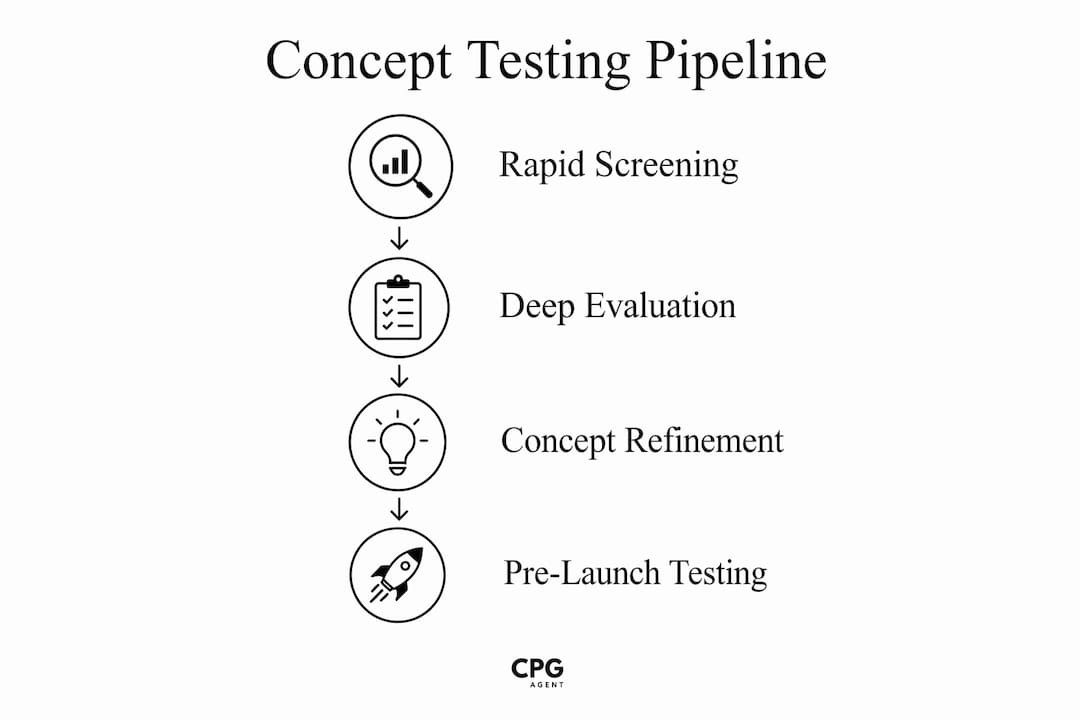
The four-stage pipeline used by leading FMCG teams in 2026 runs as follows. Rapid screening filters a broad set of ideas down to the strongest two or three candidates. Deep evaluation then puts those candidates through rigorous consumer interviews. Proposition refinement adjusts language, claims, and packaging based on feedback. Pre-launch validation confirms the final concept with a larger sample before production commitments are made.
Full-sequence testing typically costs $15,000–$25,000 and completes in four to five business days. That timeline is a fraction of what traditional agency research required. Speed matters in FMCG because category windows close fast and competitors move constantly.
Pro Tip: Set your success thresholds before you field a single interview. Deciding what "good" looks like after you see the data introduces confirmation bias and undermines the entire exercise.
The four-stage pipeline at a glance
| Stage | Sample size | Primary focus | Typical duration |
|---|---|---|---|
| Rapid screening | 30–50 per concept | Idea viability and initial appeal | 1 day |
| Deep evaluation | 100+ per concept | Claims, packaging, occasion-fit | 2–3 days |
| Proposition refinement | 30–50 per concept | Language, messaging, price sensitivity | 1 day |
| Pre-launch validation | 50–75 per concept | Final confirmation before production | 1 day |
Why is concept testing crucial for FMCG product success?
Concept testing identifies weak ideas early, before production costs and retail commitments make pivoting expensive. Skipping testing often results in costly market failures that never appear cleanly in financial reports. By the time a failed product is delisted, the brand has absorbed distribution fees, promotional spend, and retailer relationship damage that no post-mortem fully captures.
The benefits of running structured concept testing in consumer goods extend well beyond failure avoidance:
- Shelf readiness: Testing reveals whether packaging communicates the right cues at the point of purchase, where most FMCG decisions are made.
- Messaging accuracy: Consumers tell you which claims resonate and which ones create confusion or skepticism.
- Price sensitivity mapping: You learn where the acceptable price range sits before you lock in a retail price.
- Unmet need discovery: Consistent concept testing uncovers consumer behaviors and needs that internal teams cannot see from inside the building.
- Brand equity protection: A concept that fails in testing costs a fraction of a concept that fails in market.
One critical distinction separates strong FMCG teams from average ones. Quantitative scores serve for comparative ranking and identifying performance gaps. They are not demand forecasts or revenue predictions. A concept that scores well on purchase intent does not guarantee volume. It signals relative strength against alternatives. Pairing those scores with qualitative insights is what reveals the consumer motivation behind the number.
How does concept testing integrate with product development in FMCG?
The most effective integration model is the Parallel Validation Model, where concept testing runs alongside formulation development rather than after it. Traditional pipelines tested a finished product. The parallel model tests the concept while R&D is still working on the formula, which means consumer feedback shapes the product rather than reacting to it.
The phases in this model map directly to product development milestones:
- Occasion and need mapping: Identify the specific consumption moment the product targets. A snack positioned for "afternoon energy" needs a different concept than one positioned for "post-workout recovery," even if the formula is identical.
- Concept screening: Run rapid monadic tests to eliminate weak positioning early.
- Proposition refinement: Use consumer language research to align the words on pack with the words consumers actually use. This is the sensory language bridge technique, where R&D and marketing align on terminology before finalizing claims.
- Pre-launch confirmation: Validate the final concept with a larger sample that mirrors the target retail channel's shopper profile.
Occasion-fit testing embeds concepts in real consumption scenarios rather than abstract survey environments. A respondent who evaluates a beverage concept while imagining a specific moment gives richer, more predictive data than one answering generic appeal questions.
Pro Tip: Combine concept testing with sensory testing at the proposition refinement stage. When the language consumers use to describe the concept matches the language they use to describe the product experience, you have a winning brief for both marketing and R&D.
For teams working with tight budgets, validating concepts early reduces the risk of expensive late-stage pivots. The cost of a concept test is always lower than the cost of a reformulation after launch.
What are common pitfalls in FMCG concept testing?
Most concept testing failures trace back to process errors, not bad products. The mistakes are predictable, which means they are also preventable.
- No predefined success thresholds. Failing to set thresholds before testing leads to biased interpretations that favor emotional investment over objective results. Define what score constitutes a "pass" before you field the study.
- Treating purchase intent as a demand forecast. Purchase intent scores rank concepts against each other. They do not predict volume. Teams that build revenue models on intent scores consistently overshoot their projections.
- Using general population panels. Testing with consumers who do not buy in your category produces noise, not signal. Verified category purchasers are non-negotiable for valid results.
- Skipping qualitative depth. A score tells you what consumers think. A laddering interview tells you why. AI-moderated laddering techniques using five to seven levels probe consumer motivations beyond surface-level likes or dislikes, replacing traditional six-to-eight-week agency cycles with 24-hour turnarounds.
- Testing too late. Concept testing done after packaging is finalized and formulation is locked is not concept testing. It is damage assessment.
| Common pitfall | Recommended practice |
|---|---|
| No success thresholds set in advance | Define pass/fail criteria before fieldwork begins |
| Purchase intent used as volume forecast | Use intent scores for ranking only; pair with qualitative data |
| General population sample | Recruit verified category purchasers only |
| Quantitative data only | Always pair scores with laddering interviews |
| Testing after production decisions | Integrate testing into early development phases |
The underlying principle across all five mistakes is the same. Concept testing builds a culture of evidence-based decisions. That culture only functions when the process is designed to surface truth, not confirm what the team already believes.
Key Takeaways
Concept testing in FMCG is a structured, multi-stage research process that validates product ideas with verified category purchasers before launch, reducing failure risk and protecting brand equity.
| Point | Details |
|---|---|
| Four-stage pipeline | Run rapid screening, deep evaluation, refinement, and pre-launch validation in sequence. |
| Monadic testing prevents bias | Present one concept at a time to avoid halo effects that distort scores. |
| Intent scores rank, not forecast | Use purchase intent to compare concepts, never to predict sales volume. |
| Parallel Validation Model | Run concept testing alongside formulation development, not after it. |
| Predefined thresholds are non-negotiable | Set pass/fail criteria before fieldwork to eliminate confirmation bias. |
What I've learned from watching teams get concept testing wrong
The most common mistake I see FMCG product managers make is not skipping concept testing entirely. It is running concept testing and then ignoring the qualitative layer. Teams collect scores, build a ranking, and declare a winner. They never ask why the winning concept won or what specific language drove the appeal score.
Occasion-fit is the most consistently overlooked dimension. A concept that scores well in the abstract often collapses when you embed it in a real consumption moment. I have watched teams launch products with strong aggregate scores that failed because the occasion they were targeting did not match how consumers actually lived their lives. The quantitative data looked clean. The qualitative data, had anyone looked, would have flagged the disconnect immediately.
The other thing I would push every cross-functional team to do is agree on success criteria in a room together before the study launches. When marketing, R&D, and commercial all define "good" differently, the results become a negotiation rather than a decision. Concept testing works best when it is treated as a shared standard, not a marketing department deliverable.
The brands that build real competitive advantage from concept testing are the ones that run it fast, run it often, and treat every result as a learning rather than a verdict. That mindset shift is harder than any methodology change.
— Matthew
How Cpgagent supports faster concept validation for FMCG teams
FMCG product managers need research infrastructure that moves at the speed of the category. Cpgagent's AI-driven platform gives product and marketing teams the tools to run rapid, consumer-driven validation without the overhead of a traditional agency engagement.
The platform includes tools like Launch Validator, which is built specifically for FMCG teams who need structured concept evaluation with fast turnaround. Whether you are screening ten ideas or confirming a final proposition before a retail pitch, Cpgagent integrates directly into your existing workflow. For teams looking to connect go-to-market validation with concept testing outputs, the platform provides a single environment for both. Speed and evidence together, without the six-week wait.
FAQ
What is concept testing in FMCG?
Concept testing in FMCG is a structured research process that validates product ideas, packaging, and messaging with verified category purchasers before launch. Its purpose is to rank concepts, identify gaps, and refine positioning to reduce market failure risk.
How many consumers are needed for a valid concept test?
Early-stage rapid screening typically uses 30–50 respondents per concept, while deep evaluation stages require 100 or more. Sample sizes depend on the stage and the level of statistical confidence required.
Is purchase intent a reliable demand forecast?
Purchase intent scores are not demand forecasts. They indicate relative concept strength and help rank options against each other, but they should always be paired with qualitative insights to understand the consumer motivation behind the score.
How long does FMCG concept testing take?
A full four-stage concept testing sequence completes in four to five business days using AI-moderated research methods. This replaces traditional agency timelines of six to eight weeks.
What is monadic testing and why does it matter?
Monadic testing presents one concept at a time to each respondent, eliminating the comparative bias known as the halo effect. This approach produces cleaner, more reliable scores in early FMCG concept testing stages.