

TL;DR:
- Shopper mission mapping identifies the specific intent behind each shopping session and tailors product content accordingly. Amazon's AI assistant Rufus interprets PDP content as a structured knowledge system, making mission-specific optimization crucial for engagement and conversions in 2026. Aligning PDP elements with the three main missions—Quick Trip, Stock-Up, and Discovery—enhances AI understanding, improves recommendation rates, and future-proofs listings against algorithm changes.
Shopper mission mapping is the practice of identifying the specific intent a buyer carries into a shopping session and then structuring product content to satisfy that intent directly. For Amazon product managers, this framework is no longer optional. Amazon's AI shopping assistant Rufus now interprets PDP content to answer shopper questions in natural language, which means your listing must function as a structured knowledge system, not a keyword container. Mapping shopper missions to your product detail pages is the most direct path to improving engagement, conversion, and AI recommendation rates in 2026.
Mapping shopper missions: the core framework for Amazon PDP optimization
Shopper mission mapping, known in retail strategy as purchase occasion segmentation, groups buyers by the goal driving their session rather than by demographics or category. Three missions dominate both UK grocery retail and Amazon e-commerce: The Quick Trip, The Stock-Up, and The Discovery Mission. Each carries distinct behavioral traits, decision speeds, and information needs that your PDP must address.

The Quick Trip is a fast, goal-oriented shopping session. The buyer already knows what they want and is scanning for confirmation that your product matches their need. Decision speed is high, tolerance for ambiguity is low, and the primary question is "Does this fit my exact requirement right now?" In physical retail, this is the Tesco Express shopper grabbing a specific item on the way home. On Amazon, it is the buyer who types a precise search term, opens two or three listings, and converts within minutes.
The Stock-Up Mission is habitual and bulk-oriented. The buyer is replenishing known products, often purchasing multipacks or subscription quantities. ASDA's large-format stores are built around this mission, and Amazon's Subscribe & Save program mirrors it directly. These shoppers need reassurance on value, pack size clarity, and delivery reliability. They are not discovering; they are confirming.
The Discovery Mission is exploratory and comparison-driven. The buyer is researching a category, evaluating options, and forming a preference. This mission generates the most browsing behavior, the most review reading, and the most Q&A engagement. It is the mission most influenced by A+ Content, lifestyle imagery, and narrative product descriptions.
The behavioral contrasts between these missions matter for PDP strategy:
- Quick Trip shoppers need specs, compatibility data, and fit information in the first two bullet points. They will not scroll.
- Stock-Up shoppers need pack size options, subscription savings callouts, and clear unit pricing. They respond to value signals.
- Discovery Mission shoppers need use-case storytelling, comparison modules, and social proof. They read everything.
- All three missions are now filtered through Rufus, which means your content must answer the questions each mission generates in plain, direct language.
How to optimize Amazon PDPs for each shopper mission
Adapting your product detail page to serve multiple missions simultaneously requires a layered content architecture. The structure below addresses each mission type while satisfying both Amazon's A9/A10 algorithm and Rufus's semantic interpretation layer.
-
Optimize bullet points for The Quick Trip. Each bullet should answer a distinct buyer concern with measurable specs, compatibility details, or fit data. Bullets should not repeat each other or the description but answer different buyer concerns explicitly. A Quick Trip shopper for a USB-C cable needs to know wattage, length, and device compatibility in the first two bullets. If that information is buried in the description, you lose the conversion.
-
Build multipack and subscription signals for The Stock-Up Mission. Your title and first bullet should reference pack quantity and unit count clearly. Use the description's 2,000-character limit to provide contextual depth on value, including secondary use cases and objection handling around shelf life, storage, or bulk purchase rationale. Stock-Up shoppers are price-sensitive and logic-driven.
-
Use the description and A+ Content for The Discovery Mission. Discovery shoppers read the full listing. Your product description should avoid repeating bullet content and instead deliver contextual depth, design rationale, and use-case scenarios that Rufus can extract for recommendation responses. A+ Content comparison chart modules and FAQ modules effectively support AI understanding and help answer mission-specific questions, improving recommendation rates.
-
Seed the Customer Q&A section with natural language answers. Proactively seeding Q&A with verifiable answers supports Rufus's ability to cite real user feedback and fill intent coverage gaps. Write Q&A entries the way a Discovery Mission shopper would ask them: "Does this work with a gas stove?" not "Is this product compatible with gas cooking appliances?"
-
Optimize images and video for mobile-first Discovery and Quick Trip shoppers. Images with context-rich alt text and product demo videos increase AI trust signals and improve interaction in mobile-first shopping environments. Amazon's AI processes alt text and video data as part of PDP knowledge extraction, so treat every image as a content asset, not decoration.
-
Balance keyword indexing with natural language for Rufus. Modern listings must satisfy lexical matching and semantic intent simultaneously for discovery and conversion. Keyword-stuffed bullets confuse Rufus and reduce recommendation confidence. Use your primary keywords in the title and first bullet, then write the remaining content in the natural language a shopper would use when asking Rufus a question.
Pro Tip: Write your product description as if you are answering the question "Why should I buy this instead of the alternative?" That framing forces contextual depth and objection handling, which are exactly the signals Rufus prioritizes when generating recommendations.
Practical checklist for mapping missions to your Amazon PDP
This six-step process gives e-commerce teams a repeatable workflow for aligning PDP content with shopper missions.
-
Analyze search terms and browsing behavior. Use Helium 10's keyword research tools to identify the exact phrases shoppers use when entering your category. Combining Helium 10 with narrative-driven copywriting enables listings to satisfy multiple Amazon discovery layers. Segment search terms by mission type: precise, spec-driven queries signal Quick Trip intent; category-level or "best X for Y" queries signal Discovery intent.
-
Map discovered questions and intents to missions. Group your keyword and search data into the three mission buckets. This mapping reveals which mission is dominant for your product and which missions are underserved by your current PDP. For most CPG products, the Stock-Up mission is underserved because teams focus on acquisition copy rather than retention signals.
-
Audit your existing PDP against Rufus AI guidelines. Rufus prioritizes Tier 1 content including description, A+ Content, and structured attributes for answer generation. Vague or incomplete Tier 1 content forces Rufus to rely on reviews, which you cannot control. Score each PDP element: does it directly answer a question a shopper in each mission would ask?
-
Update bullets, descriptions, and Q&A to fill content gaps. Rewrite any bullet that repeats information from another bullet. Add Q&A entries for the top five questions your Discovery Mission shoppers ask. Expand your description to cover secondary use cases and design rationale that your bullets do not address.
-
Optimize visual assets for mission-specific engagement. Quick Trip shoppers need a hero image that confirms product identity instantly. Stock-Up shoppers need pack-size comparison images. Discovery shoppers need lifestyle imagery and a product demo video. Assign each image a specific mission it serves, then write alt text that answers the question that mission generates.
-
Track performance and iterate. Monitor conversion rate by traffic source, review velocity, and Rufus-driven session data where available. Use AI-recommended brand strategies to refine your content based on what Rufus surfaces in response to category queries. Treat your PDP as a living document, not a one-time build.
Keyword-led search vs. visual shelf discovery: what changes on your PDP
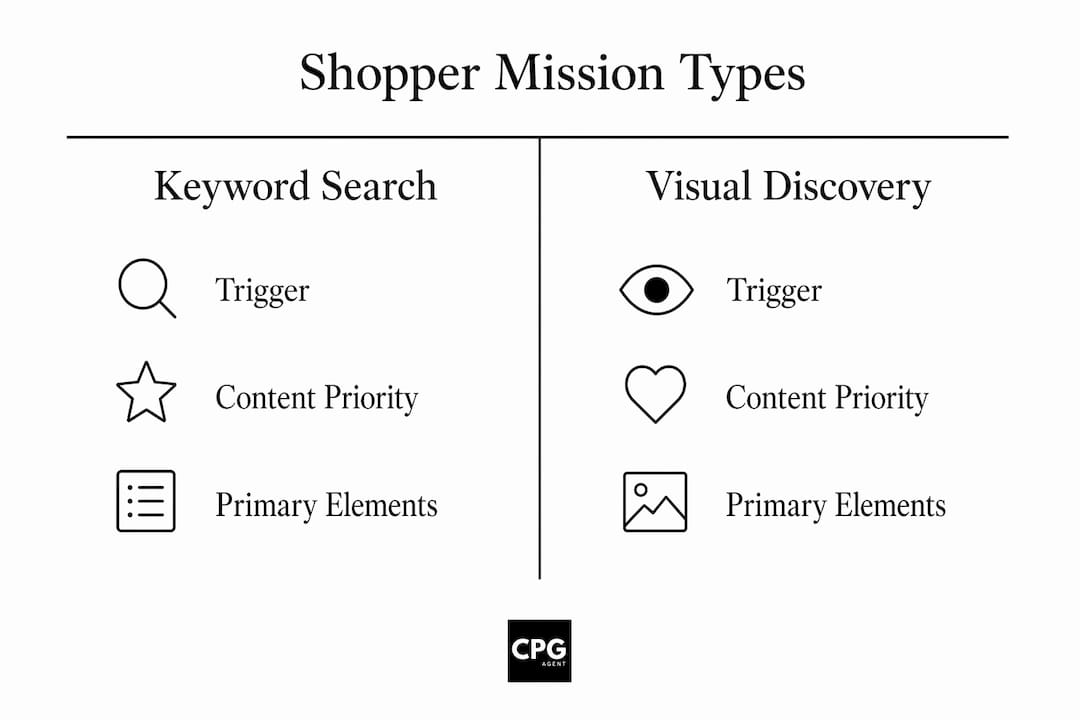
The table below contrasts the two primary discovery behaviors on Amazon and their direct implications for product detail page strategy.
| Behavior | Trigger | Primary PDP element | Content priority | Shopper mission served |
|---|---|---|---|---|
| Keyword-led search | Typed query in Amazon search bar | Title and first bullet point | Spec accuracy, keyword match, compatibility data | Quick Trip, Stock-Up |
| Visual shelf discovery | Sponsored ad, category browse, Rufus recommendation | Hero image, A+ Content, lifestyle imagery | Brand story, use-case clarity, emotional resonance | Discovery Mission |
| Hybrid AI-assisted | Rufus conversational query | Full listing content, Q&A, reviews | Answer completeness, natural language clarity | All three missions |
| Mobile browse | Sponsored product scroll | Hero image, star rating, price | Immediate visual trust, value signal | Quick Trip, Discovery |
The practical implication is that keyword-led and visual-led shoppers need different things from the same page. A listing optimized only for keyword indexing will convert Quick Trip shoppers but lose Discovery Mission shoppers who need narrative and context. A listing built only for visual appeal will attract Discovery browsers but fail to convert Quick Trip shoppers who need immediate spec confirmation. The structured knowledge system approach treats listings as multi-layer content assets that serve all discovery behaviors simultaneously. This is the architecture that future-proofs your PDP against algorithm changes and AI agent evolution.
Key takeaways
Effective Amazon PDP optimization requires matching content architecture to the specific shopper mission driving each session, not optimizing for a single generic buyer.
| Point | Details |
|---|---|
| Define your dominant mission | Segment search terms by Quick Trip, Stock-Up, or Discovery intent before writing a single word of copy. |
| Layer content by mission | Use bullets for Quick Trip specs, descriptions for Discovery depth, and Q&A for Stock-Up reassurance. |
| Optimize for Rufus Tier 1 | Keep description, A+ Content, and structured attributes complete and direct to control AI recommendation output. |
| Balance keywords with natural language | Use primary keywords in the title and first bullet, then write remaining content in conversational, question-answering prose. |
| Treat images as content assets | Assign each visual a specific mission it serves and write alt text that answers the question that mission generates. |
Why most teams get shopper mission mapping wrong
Most e-commerce teams I have worked with treat Amazon PDP optimization as a keyword exercise. They pull a Helium 10 report, stuff the highest-volume terms into their bullets, and call it done. The conversion rate stays flat, and they blame the algorithm. The real problem is that they have built a page for a search engine, not for a person with a specific goal in mind.
The shift that changes everything is recognizing that the same product serves three completely different shoppers. A protein powder listing needs to convert the Quick Trip buyer who already knows the brand and just needs to confirm the flavor is in stock. It also needs to convert the Discovery Mission shopper who is comparing five brands and reading every word of the description. And it needs to retain the Stock-Up buyer who is deciding whether to subscribe. Those three people need different things from the same 2,000 characters.
What I find most teams miss is the Q&A section. Proactively seeding it with natural language answers is one of the highest-leverage moves available on Amazon right now, precisely because Rufus draws on it directly. Most brands leave it empty or let it fill with unverified customer questions. That is a missed opportunity to control the narrative Rufus builds around your product.
The emergence of conversational AI on Amazon changes the optimization game permanently. Treating listings as structured knowledge systems rather than keyword containers aligns with what AI shopping assistants need and positions your PDP to perform well regardless of how the algorithm evolves. The brands that adopt this mindset now will be significantly harder to displace in 12 months.
— Matthew
How Cpgagent helps you optimize PDPs with mission-driven intelligence
Cpgagent is built for CPG and FMCG brands that need to move faster than a traditional agency allows. The platform's AI-driven tools help e-commerce teams map shopper intent, audit listing content against Rufus optimization standards, and generate mission-specific copy at scale. Instead of spending weeks in discovery, you get data-backed PDP recommendations within hours.
If your team is managing multiple Amazon listings across different shopper missions, the Cpgagent platform gives you the workflow infrastructure to audit, rewrite, and track PDP performance without the overhead of a full agency retainer. From AI listing analysis to fractional CMO support, Cpgagent deploys the tools your brand needs to stay competitive on the digital shelf in 2026.
FAQ
What is a shopper mission in e-commerce?
A shopper mission is the specific goal or intent driving a buyer's session, such as a quick restock, a bulk purchase, or a new product discovery. Identifying the dominant mission for your product category determines which PDP elements to prioritize for conversion.
How does Rufus AI affect Amazon PDP optimization?
Rufus interprets your listing's Tier 1 content, including description, A+ Content, and structured attributes, to generate natural language answers for shoppers. Incomplete or vague content forces Rufus to rely on reviews, reducing your control over how your product is recommended.
Which PDP elements matter most for The Quick Trip mission?
The title and first two bullet points are the critical elements for Quick Trip shoppers. These buyers need immediate confirmation of specs, compatibility, and fit data and will not scroll further before making a decision.
How do I balance keyword SEO with AI-friendly content on Amazon?
Use primary keywords in the title and first bullet for A9/A10 indexing, then write the remaining bullets, description, and Q&A in natural, question-answering language that Rufus can extract for recommendation responses. The two approaches compound rather than compete.
What is the fastest way to audit my PDP for shopper mission gaps?
Map your existing bullets and description content to the three mission types. Quick Trip gaps appear as missing specs or compatibility data. Stock-Up gaps show up as unclear pack sizing or absent value signals. Discovery gaps are visible when your description repeats bullet content instead of adding contextual depth and use-case storytelling.