

TL;DR:
- A five-step process ensures a validated CPG brand name, including internal screening, USPTO clearance, and consumer testing. Automating these steps with Cpgagent's tools accelerates decision-making and creates a defendable evidence pack. Teams avoid risks by following thorough checks before finalizing and launching the brand.
A solid CPG brand naming validation process runs five steps: internal screening, iterative USPTO clearance, a Google/domain/social reality check, monadic market testing, and attorney-led full clearance with a go/no-go scoring rubric. Run them in that order and you'll walk into launch with a documented evidence pack, not a gut feeling.
Here's the checklist you can drop straight into a project brief:
- Internal screen: Eliminate names with obvious legal, cultural, or category conflicts before spending a dollar on research.
- USPTO iterative clearance: Run multiple search passes using basic and expert mode; document every query.
- Google/domain/social reality check: Search the name alone and with category terms; check domain and handle availability.
- Monadic market testing: Expose each respondent to one name only, using tools like SurveyMonkey or Koji, and measure recall, fit, and purchase intent.
- Attorney-led clearance and go/no-go rubric: Escalate to counsel when live conflicting marks appear; score finalists against a weighted rubric before filing.
Cpgagent's Launch Validator maps directly to this workflow, automating test setup and evidence-pack generation so teams move faster without cutting corners.
Table of Contents
- What does the CPG brand naming validation process look like step by step?
- How do you design name tests that actually predict CPG market performance?
- How do you use USPTO TMsearch to clear a CPG brand name?
- How do you score candidate names and make a go/no-go call?
- What do you do immediately after picking a name?
- Cpgagent cuts weeks off the validation workflow
- Key Takeaways
- The part most teams get wrong
- Useful sources and tools for U.S. CPG name validation
- FAQ
What does the CPG brand naming validation process look like step by step?
Step 1: Internal screening
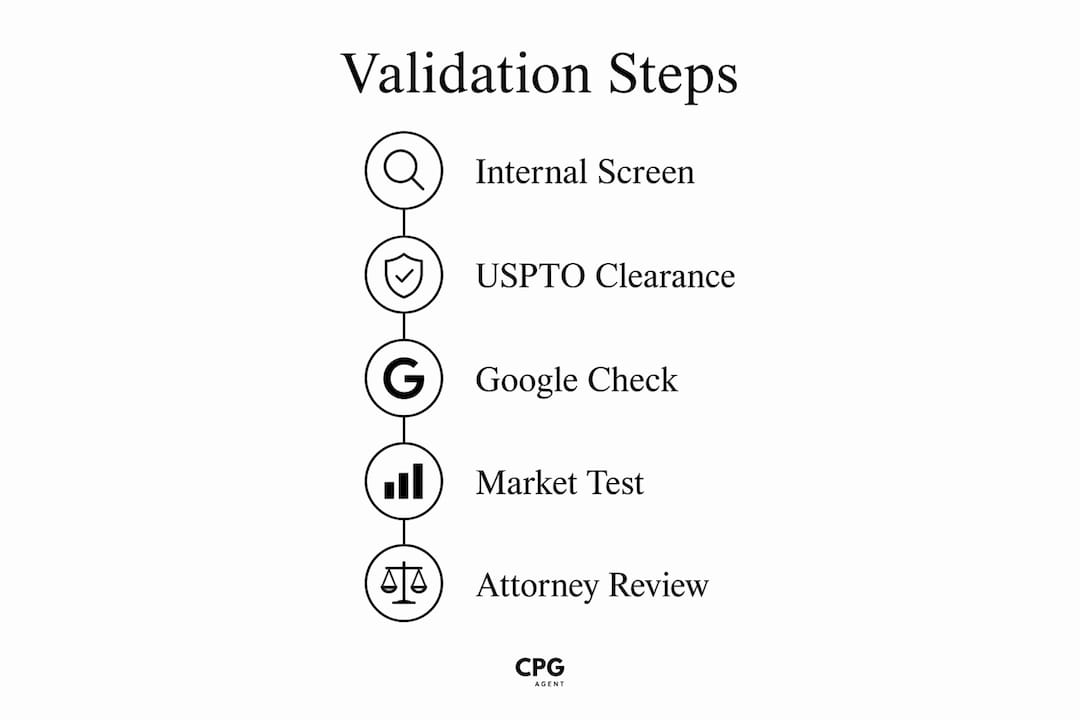
The brand team runs this. Pull your longlist (aim for 10–20 names), then eliminate anything with an obvious trademark conflict, a negative cultural connotation, or a pronunciation problem a five-year-old would flag. The output is a shortlist of 3–8 names ready for external checks.
Pro Tip: While the shortlist is being finalized, run a quick phone-a-friend pronunciation test. Text three names to five colleagues outside the project and ask them to read each one aloud on a voice note. Friction shows up immediately, and it costs nothing.
Step 2: Iterative USPTO clearance
This is a risk-reduction loop, not a one-and-done query. USPTO guidance is explicit: no single search uncovers all potential conflicts. Run multiple passes per name, varying term combinations each time. Use expert mode for field-tag searches (more on that in the legal section below). Log every query and its results.
Step 3: Google/domain/social reality check
Search each name alone, then paired with your category ("oat bar," "protein drink," etc.). A crowded SERP with established brands is a real-world confusion risk even when the trademark database looks clear. Check .com availability, then Instagram, TikTok, and LinkedIn handles. Grab anything available immediately with a domain parking service.
Step 4: Monadic market testing
Send one name per respondent. Monadic testing removes comparison bias so you learn whether a name can stand on its own. The output is a scored dataset covering recall, perceived fit, associations, and purchase intent.

Step 5: Attorney-led clearance and go/no-go decision
When testing surfaces a finalist, hand the evidence pack to trademark counsel for a full clearance opinion before filing. The go/no-go rubric (see Section 5) synthesizes legal and market scores into a single recommendation.
Timeline estimate: A low-lift run (internal screen + basic USPTO + Google check + 150-person survey) takes roughly two weeks. A comprehensive run with full attorney clearance and a 400-person panel adds two to three more weeks.
How do you design name tests that actually predict CPG market performance?
Monadic testing is the right starting point because participants evaluate a name without the distortion of seeing alternatives side-by-side. Once you've eliminated weak names monadically, sequential monadic or paired testing can help rank your top two or three finalists.
Core metrics and question types
| Metric | Question type | Strong result | Weak result |
|---|---|---|---|
| Appeal | 5-point scale ("How appealing is this name?") | — | — |
| Perceived category fit | 5-point scale ("How well does this name fit a [category] product?") | — | — |
| Recall | Yes/no after 60-second distractor task | 75%+ unaided recall | — |
| Spelling accuracy | Open-text after audio exposure | — | — |
| Emotional associations | Open-ended ("What three words come to mind?") | Positive, on-brand clusters | Negative or off-category clusters |
| Purchase intent | 5-point scale ("How likely are you to buy a product with this name?") | — | — |
Sample question set (Koji/SurveyMonkey structure)
Following Koji's recommended structure and SurveyMonkey LaunchPad best practice, a compact name-test survey runs in this order:
- Show the name (text or audio). Ask: "How appealing do you find this name?" (1–5 scale)
- Ask: "How well does this name fit a [category] product?" (1–5 scale)
- 60-second distractor question. Then: "Please type the name you just saw." (Recall + spelling)
- "What three words or phrases come to mind when you see this name?" (Open-ended associations)
- "How likely are you to purchase a [category] product with this name?" (1–5 scale)
Pro Tip: After audio exposure, ask respondents to type the name they heard. High spelling error rates predict downstream word-of-mouth friction and customer-service headaches before you ever hit retail.
For U.S. CPG categories, a 200-person nationally representative panel is a workable minimum. If your distribution is regional or targets a specific demographic (e.g., Hispanic shoppers, Gen Z), add a quota layer to match your actual buyer profile. Concept testing guidance for FMCG teams covers quota design in more detail.
How do you use USPTO TMsearch to clear a CPG brand name?
USPTO's TMsearch has two modes. Basic mode uses dropdown filters and works for a first pass. Expert mode lets you write field-tag queries, combine terms with AND/OR/AND NOT operators, and use the combined mark field tag (CM:) to catch variant spellings and phonetic equivalents. For a CPG name, expert mode is where the real work happens.
Practical USPTO clearance checklist
- Run a basic clearance search on the exact name. Filter to live marks only.
- Switch to expert mode. Use CM: to search phonetic variants and common misspellings.
- Run an owner search on any conflicting registrant to see their full portfolio.
- Search by serial or registration number for any mark that looks close.
- Repeat with category-specific terms combined (e.g., "oat AND bar").
- Save and export your search history after every pass.
Common pitfalls to avoid:
- Relying on a single query and calling it clear.
- Ignoring dead marks. A cancelled registration can still signal a crowded space.
- Skipping phonetic variants. A name that sounds like an existing mark is a conflict even when the spelling differs.
- Forgetting state trademark databases and common-law use (social profiles, domain registrations).
When to escalate to counsel
Stop the in-house search and call a trademark attorney when you find: a live mark in the same International Class with a similar sound or meaning; a mark owned by a large CPG company with enforcement history; or any result where the likelihood-of-confusion factors feel genuinely ambiguous. Attorney-led full clearance typically runs $1,500–$3,500 depending on the number of classes searched. A USPTO intent-to-use application adds roughly $250–$350 per class in filing fees. That cost is trivial compared to a rebrand after launch.
How do you score candidate names and make a go/no-go call?
Score each finalist on seven dimensions, weighted by your brand's priorities. A typical CPG weighting looks like this:
Scoring rubric (100-point scale): Memorability/recall (20 pts) + Perceived category fit (20 pts) + Distinctiveness/trademark risk (20 pts) + Searchability/domain availability (15 pts) + Pronunciation/clarity (10 pts) + Purchase-intent lift (10 pts) + Cost and timeline to register (5 pts) = 100. A score of 75+ is a go. A score of 60–74 is a hold pending legal opinion. Below 60 is a stop. Any automatic veto (an active conflicting live registration in the same class, or consistent negative associations in 30%+ of target respondents) overrides the score entirely.
The evidence pack that accompanies your recommendation must include: USPTO search logs from all passes, survey data summary (means, recall rates, top associations), domain and social handle availability screenshots, and counsel's written opinion if escalated. Brand naming research that synthesizes qual, quant, and legal inputs produces decisions that hold up to stakeholder scrutiny.
What do you do immediately after picking a name?
The 30 days after selection are where validated names get lost to slow execution. Move fast on these:
- Days 1–3: Register the .com domain and key variants (.net, .co). Secure Instagram, TikTok, LinkedIn, and X handles. Use a domain parking service for anything you can't build yet.
- Days 3–7: File an intent-to-use trademark application with USPTO (or a use-based application if you're already in commerce). Do not wait for packaging to be finalized.
- Days 7–14: Run FDA labeling and FTC claims screens. For CPG, the name itself can imply a health claim. "Pure," "natural," "clean," and similar terms trigger FDA scrutiny. Confirm your name doesn't create an implied claim your product can't substantiate.
- Days 14–21: Build a verbal selling script: correct pronunciation, spelling guide, and a one-sentence brand story. Train sales and customer-service teams before any trade or retailer conversations.
- Days 21–30: Set up trademark monitoring alerts (USPTO's TESS alert or a third-party service). Check retailer and distributor name databases to confirm no conflicts at the trade level.
For a low-budget version of this workflow, validating a CPG launch concept on a tight budget covers cost-effective mitigations at each stage.
Cpgagent cuts weeks off the validation workflow
Most brand teams spend more time organizing research than interpreting it. Cpgagent's platform tools change that ratio. PersonaForge simulates target audience responses so you can stress-test name candidates before a single survey goes live. Launch Validator structures the full evidence pack automatically: survey templates, USPTO search log formats, domain and social availability snapshots, and a scoring rubric output ready for stakeholder review.
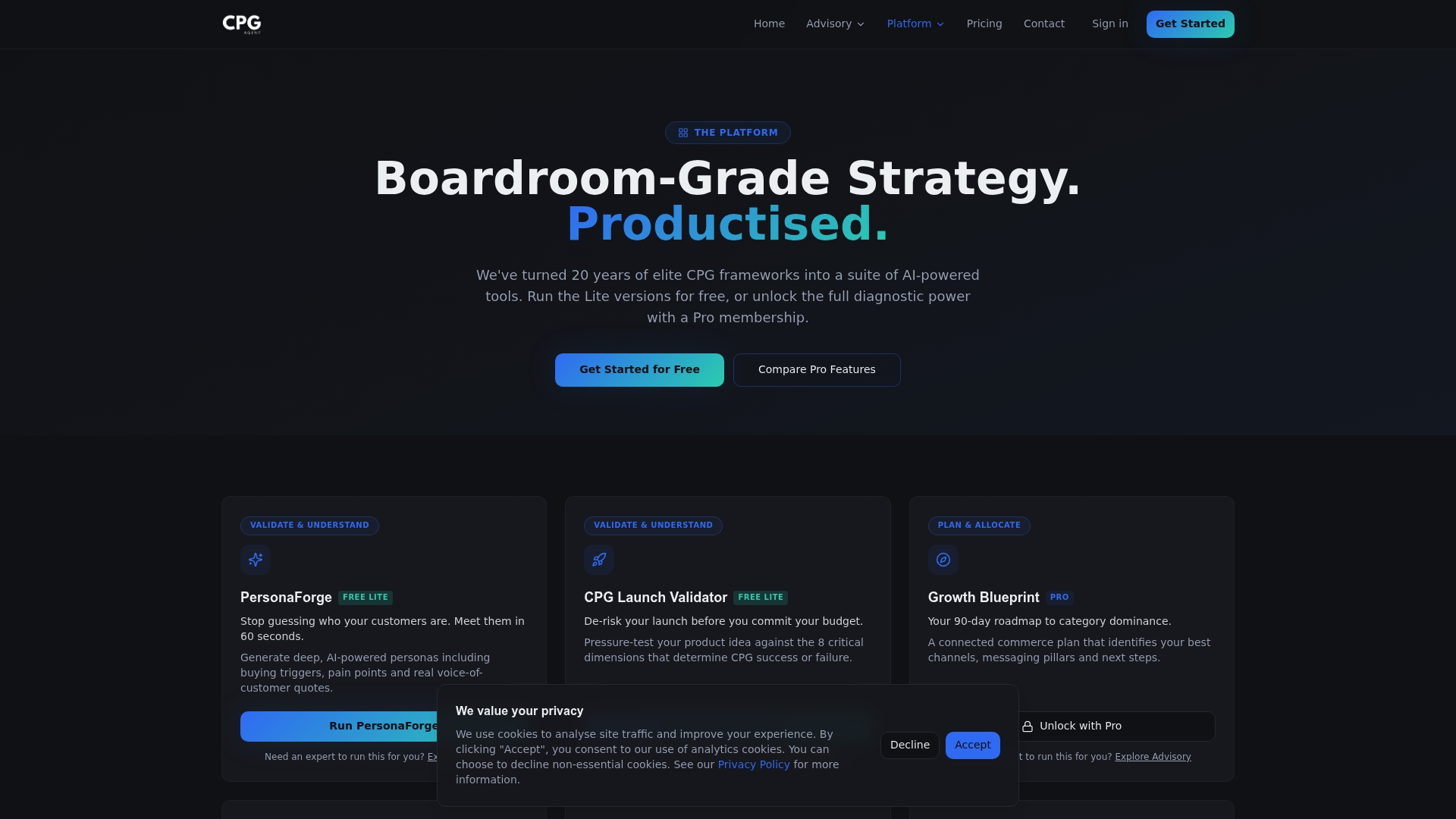
The platform maps to every step in the five-step workflow, from automated test setup through result synthesis and counsel liaison. For product teams running on tight timelines, that means fewer coordination emails and faster decisions. If you're heading into a naming sprint or a portfolio refresh, explore the Cpgagent platform to see how the tools fit your process.
Key Takeaways
A defensible CPG brand name requires legal clearance, consumer evidence, and a documented scoring rubric before any stakeholder approves the final choice.
| Point | Details |
|---|---|
| Run five steps in sequence | Internal screen → USPTO iterative clearance → Google/domain/social check → monadic testing → attorney clearance and go/no-go rubric. |
| Treat USPTO as a loop | Run multiple expert-mode passes with field-tag queries; document every search before escalating to counsel. |
| Use monadic testing first | Expose one name per respondent to get clean recall, fit, and purchase-intent signals free of comparison bias. |
| Score with a rubric | Apply a 100-point weighted rubric; any live conflicting mark or 30%+ negative associations is an automatic veto regardless of score. |
| Cpgagent automates the evidence pack | PersonaForge and Launch Validator handle test setup, result synthesis, and scoring output so teams move from shortlist to decision faster. |
The part most teams get wrong
The biggest failure mode in CPG naming isn't picking a bad name. It's picking a name through a process that can't be defended when a retailer, investor, or legal team asks how you got there.
Teams that skip monadic testing and go straight to a preference vote are measuring which name wins a beauty contest, not which name a shopper will remember in aisle 7. Those are different questions. A name that wins by comparison often loses in isolation, and isolation is exactly where it will live on shelf.
The single-query trademark check is the other recurring mistake. One clean result in TMsearch does not mean a name is clear. Phonetic variants, dead marks that signal a crowded space, and common-law use on social profiles all require separate passes. Teams that skip those steps don't discover the problem until counsel flags it, usually after packaging has been designed.
Running parallel micro-tests accelerates decisions without sacrificing rigor. A 150-person monadic survey, a USPTO basic pass, and a Google reality check can all run simultaneously in week one. You don't need to finish legal before starting consumer research. You need both inputs before making a final call.
The goal isn't a perfect name. It's a name you can defend with a documented evidence pack: search logs, survey data, domain screenshots, and a counsel opinion. That pack is what separates a validated launch from a creative vote dressed up as a process.
Useful sources and tools for U.S. CPG name validation
- USPTO TMsearch: Primary federal trademark database. Use for iterative clearance searches in basic and expert mode. Start here before any other legal check.
- USPTO Getting Started handout: Step-by-step guide to basic vs. expert mode, field-tag syntax, and export features.
- SurveyMonkey LaunchPad: Monadic name-testing templates with built-in panel access. Good for teams running their first structured name test.
- Koji name-testing docs: Question structure guidance covering comprehension, recall, and association capture in sequence.
- Tanj market-check guide: Practitioner walkthrough of Google, domain, and social reality checks alongside trademark searches.
- Marketful naming strategy: Covers pronunciation and spelling friction testing, including the audio-exposure recall method.
- SmashBrand naming research overview: Frames name research as concept testing with qual + quant + legal synthesis.
- Voxco brand name testing guide: Survey design options (monadic, sequential monadic) and panel sourcing for representative U.S. audiences.
- Domain checkers: Namecheap, GoDaddy, or Google Domains for .com and variant availability.
- Social handle trackers: Namecheckr or Knowem for bulk handle availability across platforms.
- Cpgagent platform: Automated test setup, evidence-pack generation, and scoring output for CPG naming sprints.
FAQ
What is the first step in a CPG brand naming validation process?
Internal screening. The brand team eliminates names with obvious legal, cultural, or pronunciation problems before spending budget on research or legal clearance.
How many USPTO search passes do you need to clear a name?
At least three passes per name, using different term combinations and both basic and expert mode. USPTO guidance states no single query uncovers all potential conflicts.
What sample size works for CPG name testing in the U.S.?
A nationally representative panel is a workable minimum for most CPG categories. Add demographic quotas if your buyer skews toward a specific region or segment.
When should you hire a trademark attorney instead of searching yourself?
Escalate when you find a live mark in the same International Class with a similar sound or meaning, or when likelihood-of-confusion factors feel genuinely ambiguous after multiple search passes.
Can Cpgagent help automate the naming validation workflow?
Yes. Cpgagent's Launch Validator and PersonaForge tools handle test setup, result synthesis, and evidence-pack generation, mapping directly to the five-step validation workflow.