

TL;DR:
- A brand growth roadmap guides marketing teams through strategic initiatives to build recognition and loyalty. Effective roadmaps include clear purpose, audience segmentation, messaging, asset governance, milestones, and budget principles. Regular reviews and governance prevent fragmentation and ensure the roadmap remains aligned with market and brand shifts.
A brand growth roadmap is a strategic framework that guides marketing leaders through phased initiatives to build recognition, customer loyalty, and sustained revenue growth. Unlike a campaign calendar or task list, a true roadmap defines which opportunities your brand will pursue and, critically, which it will reject. Brands maintaining consistent brand presentation across platforms can increase revenue by up to 23%. That number signals one thing: strategic clarity pays. The brand growth roadmap examples in this article give you concrete structures to adopt, adapt, and execute.
1. What key elements should a brand growth roadmap include?
A brand growth roadmap requires six core components to function as a strategic tool rather than a wish list.
- Purpose, vision, and values. These form the strategic foundation. Every campaign decision should trace back to them.
- Audience definition and segmentation. Map your buyers by situation, not just demographics. A first-time buyer needs different messaging than a repeat purchaser.
- Messaging frameworks and proof points. Define your brand promise and the evidence that supports it. Proof points prevent vague claims from diluting your positioning.
- Visual identity and asset governance. Specify which assets are approved, where they live, and who can modify them. This is not a design exercise. It is a consistency system.
- Phased milestones and review triggers. Break the roadmap into 90-day blocks with defined checkpoints. Reviews should ask whether to kill, scale, or hold each initiative.
- Budget allocation principles. Align spend to growth stage. Early-stage brands weight toward awareness; scaling brands shift toward demand capture and owned assets.
Pro Tip: Write your roadmap's "not-doing" list alongside your priorities. The deliberate rejections are what separate a real roadmap from a backlog.
A lean brand strategy treats these elements as a system, not a checklist. Each component connects to the next. Removing one creates a gap that shows up in execution.

2. What are top brand growth roadmap examples used by successful brands?
The following four examples represent structures that brand leaders use across CPG, DTC, and FMCG categories. Each one addresses a different strategic priority.
Example 1: Phased messaging and proof-building
This roadmap structure runs in three phases. Phase one builds awareness through upper-funnel video and content. Phase two introduces proof points through reviews, case studies, and earned media. Phase three converts that credibility into purchase intent through targeted demand capture campaigns. The key discipline here is measurement. Upper-funnel video campaigns should be measured with brand lift metrics, not direct ROAS. Brands that apply ROAS to awareness spend consistently undervalue it and cut too early.
Example 2: Budget allocation roadmap
"Enterprise marketing budget allocations for brand growth typically run 30–40% toward demand creation, 40–50% toward demand capture, and 20–25% toward owned growth assets. That split balances near-term revenue with long-term brand equity."
This budget distribution model gives brand leaders a starting ratio to pressure-test against their own revenue stage. A brand in year one of a new category will weight more toward creation. A brand defending shelf space in a mature category will weight toward capture. The owned assets bucket, which includes email, loyalty programs, and content libraries, compounds over time and reduces future acquisition costs.
Example 3: Customer journey and retention roadmap
DTC brands with repeat purchase rates below 40% are advised to focus their roadmaps on the post-purchase customer journey within the first 90 days. This example structures the roadmap around three post-purchase moments: the unboxing experience, the day-14 re-engagement, and the day-60 loyalty offer. Each moment has a defined owner, a message, and a success metric. The 90-day window is not arbitrary. It reflects the point at which a customer either becomes a repeat buyer or churns permanently.
Example 4: Centralized asset governance roadmap
This structure maps every brand asset to an approval workflow. New creative goes through a defined review chain before publication. Retired assets are archived, not deleted. The roadmap includes a quarterly audit to identify assets that no longer reflect current brand positioning. Centralizing brand assets with governance workflows prevents fragmentation as the brand scales across channels and markets. Without this structure, regional teams and agency partners produce off-brand work that erodes recognition over time.
3. How to build your own brand growth roadmap
Building a roadmap starts with strategic priorities, not tactics. Before you write a single campaign brief, define the two or three growth bets your brand is making this year. Everything else is subordinate.
- Start with trade-offs. A real roadmap guides what your brand deliberately rejects, not just what it pursues. List the opportunities you are choosing not to pursue and document why.
- Map audience buying situations. Go beyond personas. Identify the specific moments when your buyer is most open to your brand. Build your messaging framework around those moments.
- Define measurable milestones. Each phase of your roadmap needs a numeric target. "Increase awareness" is not a milestone. "Achieve 15% aided brand recall in the 25–44 female segment by Q3" is.
- Set budget distribution by phase. Use the 30-40-30 budget model as a starting point: roughly 30% toward creation, 40% toward capture, and 30% toward owned assets. Adjust based on your category maturity and competitive pressure.
- Build in kill/scale triggers. At every quarterly review, define in advance what result would cause you to kill an initiative versus scale it. This prevents emotional attachment from overriding data.
- Incorporate asset governance from day one. Assign ownership of every asset type before you launch. Governance added after the fact is always harder to enforce.
Pro Tip: Treat your roadmap as a living system, not a document. Schedule a 30-minute monthly review to update assumptions based on market signals. Static roadmaps become irrelevant within one quarter.
A 90-day category dominance roadmap applies this structure specifically to CPG brands competing for shelf position. The principles transfer directly to any brand in a fast-moving category.
4. What tools and techniques help maintain and scale brand roadmaps?
Maintaining a brand growth roadmap at scale requires operational infrastructure, not just strategic intent. The table below compares four functional areas and the practices that keep each one working.
| Functional area | Weak practice | Strong practice |
|---|---|---|
| Asset management | Files stored in shared drives with no version control | Centralized digital asset library with approval workflows |
| Performance measurement | ROAS applied to all campaign types | Brand lift metrics for awareness, ROAS for conversion |
| Roadmap reviews | Annual planning cycle only | Quarterly reviews with kill/scale decision triggers |
| Governance | Ad hoc approvals via email | Defined review chain with role-based access |
Brand development managed as a long-term system requires distinctive asset management to keep branding recognizable during scale. That means your logo, color palette, tone of voice, and key visual elements must be governed, not just documented. Documentation without enforcement produces inconsistency.
Publishing systems and workflow automation reduce the friction between strategy and execution. When creative teams spend less time chasing approvals, they produce more on-brand work faster. Platform-based brand management tools centralize this infrastructure so that governance does not depend on individual discipline.
Regular audits close the loop. A quarterly brand audit should check three things: whether published assets match current brand standards, whether messaging aligns with the current roadmap phase, and whether performance data supports continuing each active initiative. Brands that skip audits accumulate drift. Drift compounds. After 18 months, the brand a customer encounters on social media no longer matches the brand on the shelf.
Key takeaways
A brand growth roadmap is only as effective as the strategic trade-offs it forces you to make and the governance systems that keep it consistent over time.
| Point | Details |
|---|---|
| Consistency drives revenue | Brands with consistent presentation across platforms can increase revenue by up to 23%. |
| Budget ratios matter | A 30–40% creation, 40–50% capture, 20–25% owned assets split balances short and long-term growth. |
| Retention is a roadmap priority | DTC brands with repeat purchase rates below 40% should focus roadmaps on the first 90 days post-purchase. |
| Governance prevents fragmentation | Centralized asset workflows protect brand integrity as teams and channels multiply. |
| Roadmaps must be living systems | Quarterly reviews with kill/scale triggers keep roadmaps relevant as markets shift. |
Why most brand roadmaps fail before they reach market
The brands I see struggle most with roadmaps are not the ones that lack ambition. They are the ones that confuse a roadmap with a content calendar. The document looks strategic. The execution is entirely tactical. Every initiative gets approved because nothing is ever rejected.
The most effective roadmaps I have worked with share one uncomfortable feature: they make people angry. Someone's pet project gets cut. A channel that the team loves gets deprioritized because the data does not support it. That friction is the roadmap working correctly. Strategic tensions are what prevent roadmaps from becoming generic wish lists.
The second failure mode is treating the roadmap as a one-time planning artifact. Brand leaders who revisit their roadmap only at annual planning are flying blind for 10 months of the year. Markets move. Competitors respond. Consumer behavior shifts. A roadmap that does not incorporate those signals becomes a liability, not an asset.
My advice to brand leaders is to build the review cadence before you build the roadmap. Decide how often you will meet, what data you will review, and what decisions you are empowered to make. Then build the roadmap to feed that process. The CPG growth frameworks that scale brands treat planning as an ongoing operation, not an annual event. That mindset is the difference between a roadmap that drives growth and one that collects dust.
— Matthew
How Cpgagent supports brand leaders building growth roadmaps
Brand leaders who need to move from roadmap planning to execution without losing strategic alignment use Cpgagent's brand growth platform to close that gap.
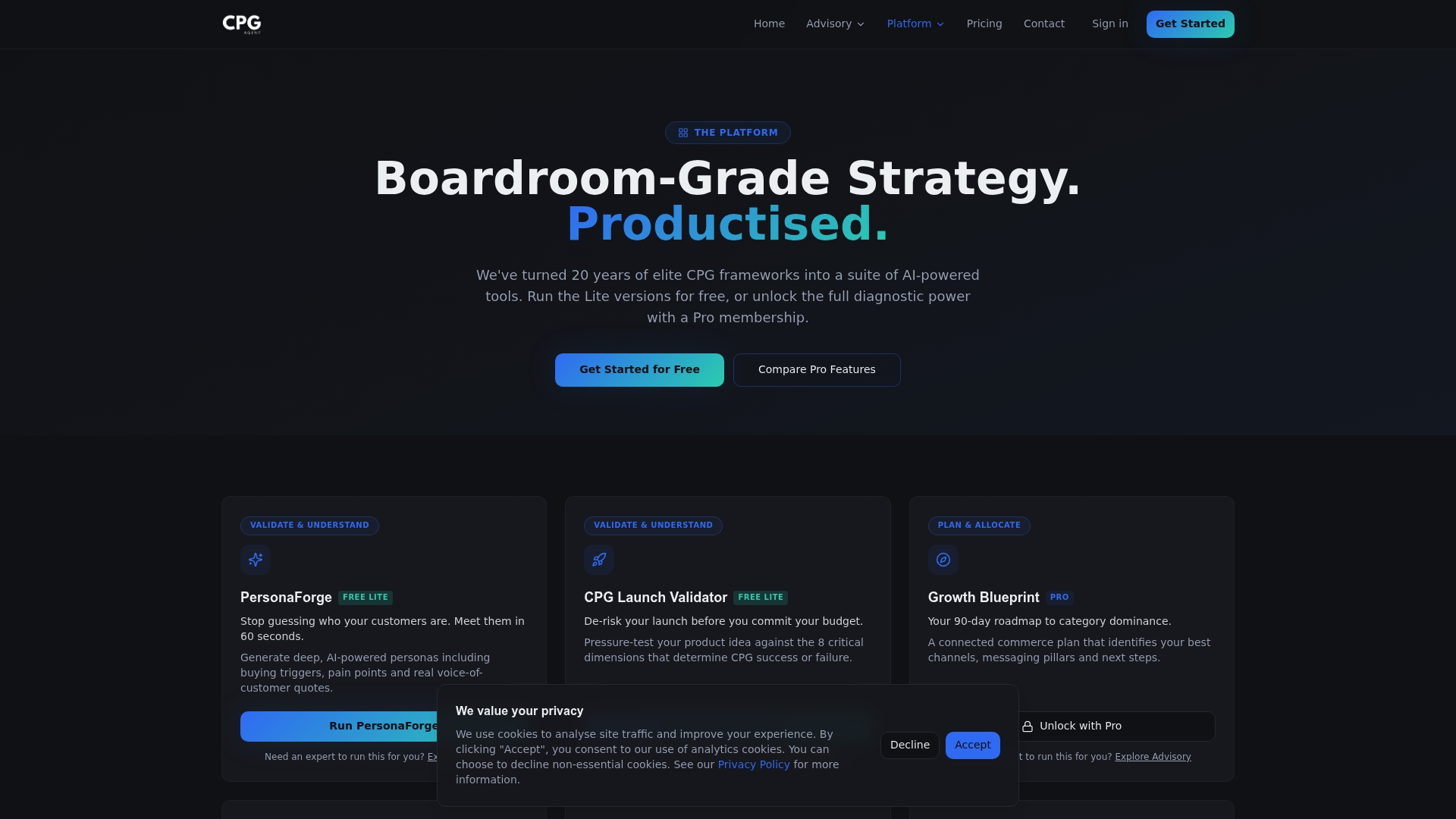
Cpgagent combines AI-driven strategy tools, automated workflows, and fractional CMO advisory to give CPG and FMCG brands the infrastructure to execute roadmaps at speed. The platform covers asset governance, campaign sequencing, and performance measurement in one place. Tools like PersonaForge and Launch Validator replace months of agency discovery with data-backed decisions in days. For brand leaders who need to stay ahead on the shelf without adding headcount, Cpgagent delivers the operational backbone that makes a roadmap real.
FAQ
What is a brand growth roadmap?
A brand growth roadmap is a strategic framework that sequences phased initiatives to build brand recognition, customer loyalty, and revenue. It differs from a campaign plan by defining which opportunities a brand will reject, not just pursue.
How long should a brand growth roadmap cover?
Most effective roadmaps operate on a 12-month horizon with 90-day execution blocks and quarterly reviews. Longer horizons lose relevance as market conditions shift.
What budget split works best for brand growth?
Enterprise brands typically allocate 30–40% to demand creation, 40–50% to demand capture, and 20–25% to owned growth assets. The right split depends on category maturity and competitive intensity.
How do you measure a brand growth roadmap's success?
Measure awareness phases with brand lift metrics and conversion phases with ROAS. Retention phases track repeat purchase rates, with 40% as the benchmark threshold for DTC brands.
What is the most common brand roadmap mistake?
The most common mistake is treating a roadmap as a to-do list rather than a strategic hierarchy. Real roadmaps guide deliberate trade-offs and include explicit decisions about what the brand will not do.