

TL;DR:
- A 90-day category dominance roadmap guides CPG brands to capture market leadership by focusing on category design and AI visibility. Success depends on establishing a clear point of view, cleaning data, and setting three non-negotiable goals from the start. Continuous weekly reviews and disciplined goal limiting are essential for sustained leadership beyond the initial quarter.
A 90-day category dominance roadmap is a structured quarterly plan that enables CPG brand leaders to capture market leadership by executing category design, AI visibility, and growth initiatives within a single focused sprint. Category leaders capture 76% of total market value, leaving the remaining 24% split among every other competitor in the space. That math alone makes the case for moving first and moving fast. This article breaks down the exact phases, prerequisites, and pitfalls of a category leadership roadmap built specifically for consumer packaged goods brands competing for shelf space and AI search visibility in 2026.
What foundational elements must be in place before starting a 90-day category dominance roadmap?
Category dominance is a structural business strategy, not a marketing campaign. Category design rewrites market rules by defining new buying criteria rather than competing inside existing ones. Before your 90-day sprint begins, three foundational elements must be locked in: your Category Point of View, your data infrastructure, and your internal alignment.

Building your Category Point of View
Your Category Point of View is a written strategic narrative that defines the problem your brand solves, why existing solutions fail, and why your product is the only logical answer. This is not a tagline. It is a 1–2 page document that drives every piece of content, every retail pitch, and every AI citation you will build over the next 90 days. Brands that skip this step produce inconsistent messaging that AI search models cannot consolidate into a single authoritative reference. For concrete examples of how category narratives translate to shelf differentiation, CPG brand differentiation case studies show what separates winners from noise.
Data hygiene and AI citation readiness
AI search models prioritize canonical references over content volume. Clean data, schema markup, and consistent brand positioning across every digital touchpoint are prerequisites for AI citation dominance. That means your product catalog must be accurate, your schema markup must be implemented, and your brand description must read identically across your website, retail partner pages, and press coverage. Inconsistency at this stage costs you citations that competitors will claim instead.
Internal alignment and goal prioritization
Before day one, your leadership team must agree on no more than three non-negotiable goals for the sprint. Every stakeholder must know which three outcomes define success. Anything outside those three gets deprioritized without debate.
Key prerequisites to confirm before launch:
- Written Category Point of View approved by leadership
- Product catalog accuracy verified across all retail and digital channels
- Schema markup implemented on brand and product pages
- Competitive landscape mapped with AI citation windows identified
- Three non-negotiable sprint goals documented and shared with the full team
- Content and AI optimization tools selected and access granted
Pro Tip: Run a quick AI search for your category right now. If your brand does not appear in the first response on ChatGPT, Perplexity, or Google AI Overviews, your citation baseline is zero. That is your starting point.
How do you execute the 90-day roadmap across three phases?
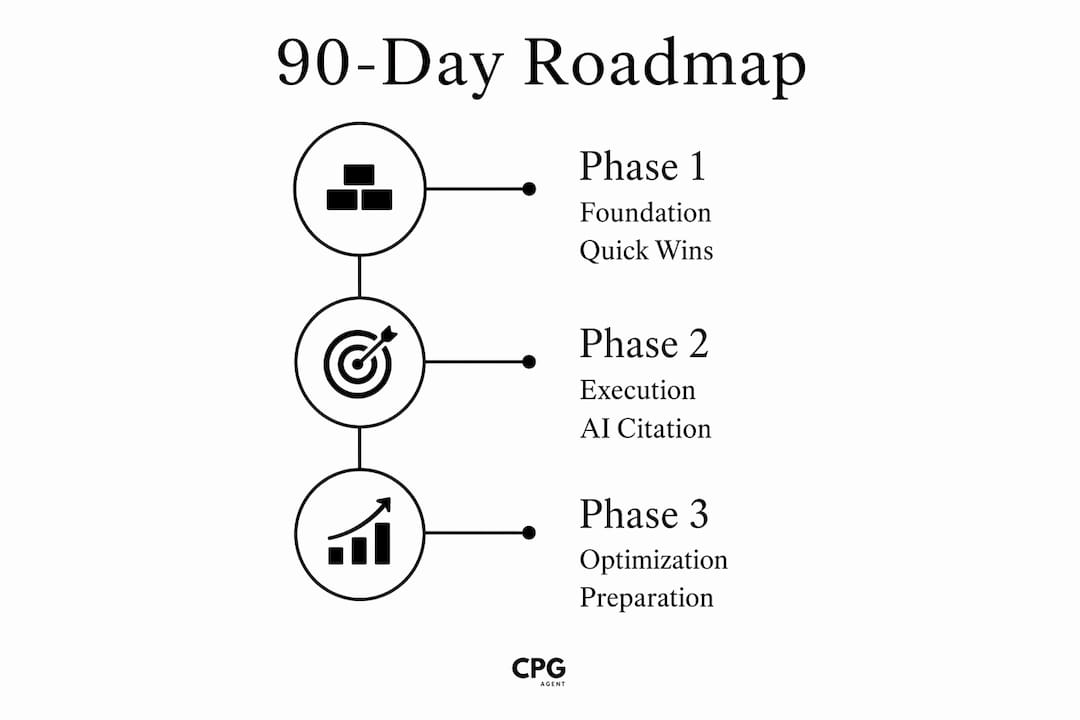
Effective 90-day plans operate in three phases: days 1–30 for foundation, days 31–60 for live execution, and days 61–90 for optimization and review. Each phase has distinct deliverables and a different primary focus. Blurring the phases is one of the most common execution failures in a 90-day business plan.
Phase 1: Days 1–30, foundation and quick wins
- Finalize your Category Point of View and distribute it to every team member and agency partner.
- Complete data hygiene across all digital and retail touchpoints.
- Identify three to five high-value keywords that define your category narrative and map them to AI search queries.
- Publish two to three authoritative pieces of content that establish your brand as the canonical source on your category problem.
- Secure at least one third-party mention or press placement that references your brand in the context of the category you are defining.
The goal of this phase is not revenue. The goal is to build the citation infrastructure that the next 60 days will amplify. The first 90 days establish foundational ownership signals that competitors will find costly to displace later.
Phase 2: Days 31–60, active execution and AI citation building
| Week | Primary Focus | Key Outcome |
|---|---|---|
| Week 5–6 | Campaign launch and retail activation | First sales data and retailer feedback |
| Week 7 | AI citation verification | Brand appears in AI search responses |
| Week 8 | Influencer and media placements | Third-party citation volume increases |
Starting a 90-day sprint before product launch secures permanent AI citation consensus. Only 3–4 brands per AI search query receive recommendations. Early movers cement that position. During this phase, your team runs active campaigns, verifies AI platform appearances, and builds the external citation network that makes your brand the default answer in your category.
Phase 3: Days 61–90, optimization and cycle preparation
Cut anything that is not contributing to your three non-negotiable goals. Refine your messaging based on actual consumer response data. Prepare the next 90-day cycle with updated goals informed by what the first sprint revealed. The biggest differential in a 90-day sprint is weekly review rigor focused on revenue impact, not task completion. Frame every weekly milestone as an outcome: "We secured two new retail placements" beats "We sent 12 retailer emails."
Pro Tip: Hold a 30-minute weekly revenue review every monday. Ask one question: which activities this week moved money? Cut everything else.
What are the most common pitfalls in a 90-day category dominance sprint?
Action inflation is the single biggest threat to a 90-day category dominance sprint. Pursuing too many goals simultaneously undermines sprint success. Brand teams that enter a sprint with eight priorities exit with zero wins. The discipline of limiting goals to three non-negotiables is not a suggestion. It is the structural requirement that separates brands that dominate from brands that just stay busy.
The most damaging pitfalls to watch for:
- Goal sprawl. Adding new priorities mid-sprint because an opportunity looks attractive. Every addition dilutes focus on the three goals that actually matter.
- Data inconsistency. Allowing product descriptions, brand names, or positioning language to vary across channels. AI models cannot build a canonical citation from contradictory signals.
- Late AI entry. Waiting until after launch to pursue AI search visibility. The citation consensus window closes fast, and late entrants face exponentially higher difficulty.
- Task-based reviews. Measuring sprint success by activities completed rather than revenue outcomes. A team that sent 50 emails and closed zero deals had a bad week regardless of the task count.
- Skipping competitive mapping. Entering the sprint without knowing which brands currently own AI citations in your category. You cannot displace what you have not identified.
"A 90-day roadmap must balance intensive execution with focus. Too many goals dilute effectiveness and jeopardize success." — 90-Day Business Plan Framework
Course correction is straightforward when you catch problems early. If week three shows no AI citation progress, audit your schema markup and canonical content immediately. Do not wait for the phase two review. Structured weekly milestone reviews with outcome-based KPIs maintain momentum and catch drift before it becomes a lost sprint.
How do you sustain and scale category leadership beyond the initial 90 days?
The 90-day horizon balances enough time for structural change with the intensity needed to avoid burnout. The brands that sustain category leadership treat the first sprint as cycle one, not a one-time event. Each subsequent 90-day cycle builds on the citation infrastructure, consumer data, and retailer relationships established in the previous sprint.
Defensibility strategies to build into cycles two and three:
- Supply agreements. Lock in preferred supplier terms that competitors cannot easily replicate.
- Diversified product lines. Extend into adjacent SKUs that reinforce your category narrative and increase shelf footprint.
- Loyalty programs. Build direct consumer relationships that reduce dependence on retailer algorithms and AI search alone.
- Category education content. Publish ongoing content that defines the category problem on your terms, keeping your brand as the canonical reference.
Aligning each 90-day sprint with your annual strategic goals prevents the common failure of winning a quarter while losing the year. Your annual plan should contain four sprint cycles, each with its own three non-negotiable goals that ladder up to the annual revenue and market share targets.
| Sprint cycle | Primary focus | Annual contribution |
|---|---|---|
| Cycle 1 (Q1) | Foundation and AI citation establishment | Category narrative ownership |
| Cycle 2 (Q2) | Retail expansion and consumer acquisition | Revenue and distribution growth |
| Cycle 3 (Q3) | Product line extension and loyalty | Defensibility and repeat purchase |
| Cycle 4 (Q4) | Review, planning, and next-year positioning | Annual goal closure and cycle 1 prep |
AI-enhanced consumer insights are the fuel for ongoing category evolution. Brands that use AI tools to monitor category conversations, track competitor citation changes, and identify emerging consumer needs adapt faster than those relying on quarterly research reports. For a broader view of how automation fits into this cycle, automated CPG growth frameworks show how leading brands are building repeatable sprint systems at scale.
Key Takeaways
A 90-day category dominance roadmap works because it combines structural category design with AI citation building and disciplined weekly execution reviews, giving CPG brands a repeatable system for capturing outsized market value.
| Point | Details |
|---|---|
| Category leaders win big | Category leaders capture 76% of total market value, making early dominance the highest-leverage move. |
| Foundation before execution | Lock in your Category Point of View, data hygiene, and three sprint goals before day one. |
| Three phases, distinct focus | Days 1–30 build infrastructure; days 31–60 execute; days 61–90 optimize and prepare the next cycle. |
| Limit goals ruthlessly | Three non-negotiable goals per sprint is the maximum. More goals produce zero wins. |
| AI citations close fast | Only 3–4 brands per query get recommended. Early movers secure that position permanently. |
Why I think most CPG brands misread the 90-day window
Most brand leaders treat a 90-day sprint as a compressed version of their annual plan. They take the same 12 goals, divide by four, and call it a quarter. That is not a sprint. That is a slow annual plan with shorter reporting periods.
The brands I have seen win category leadership in 90 days do something different. They pick one category problem to own, build every piece of content and every retail conversation around that single problem, and measure every week by whether they moved closer to owning that narrative. The discipline is uncomfortable. Saying no to a good opportunity because it falls outside the three non-negotiables feels wrong in the moment. It is the right call every time.
AI search visibility has changed the stakes significantly. When ChatGPT or Perplexity recommends a product in your category, the brands that built authoritative canonical content early get cited. The brands that waited get ignored. That is not a content marketing problem. It is a structural first-mover problem, and the AI search visibility window is narrower than most teams realize.
My honest advice: commit to the three goals, run the weekly revenue review without skipping it, and treat the first sprint as the foundation for the next three. Category leadership is not a 90-day outcome. It is a 90-day start.
— Matthew
Cpgagent's platform for your 90-day category sprint
Cpgagent is built for exactly this kind of focused, fast-moving execution. The platform combines AI-driven strategy tools, automated workflows, and fractional leadership advisory to help CPG brands move from category narrative to active market presence without the overhead of a traditional agency.
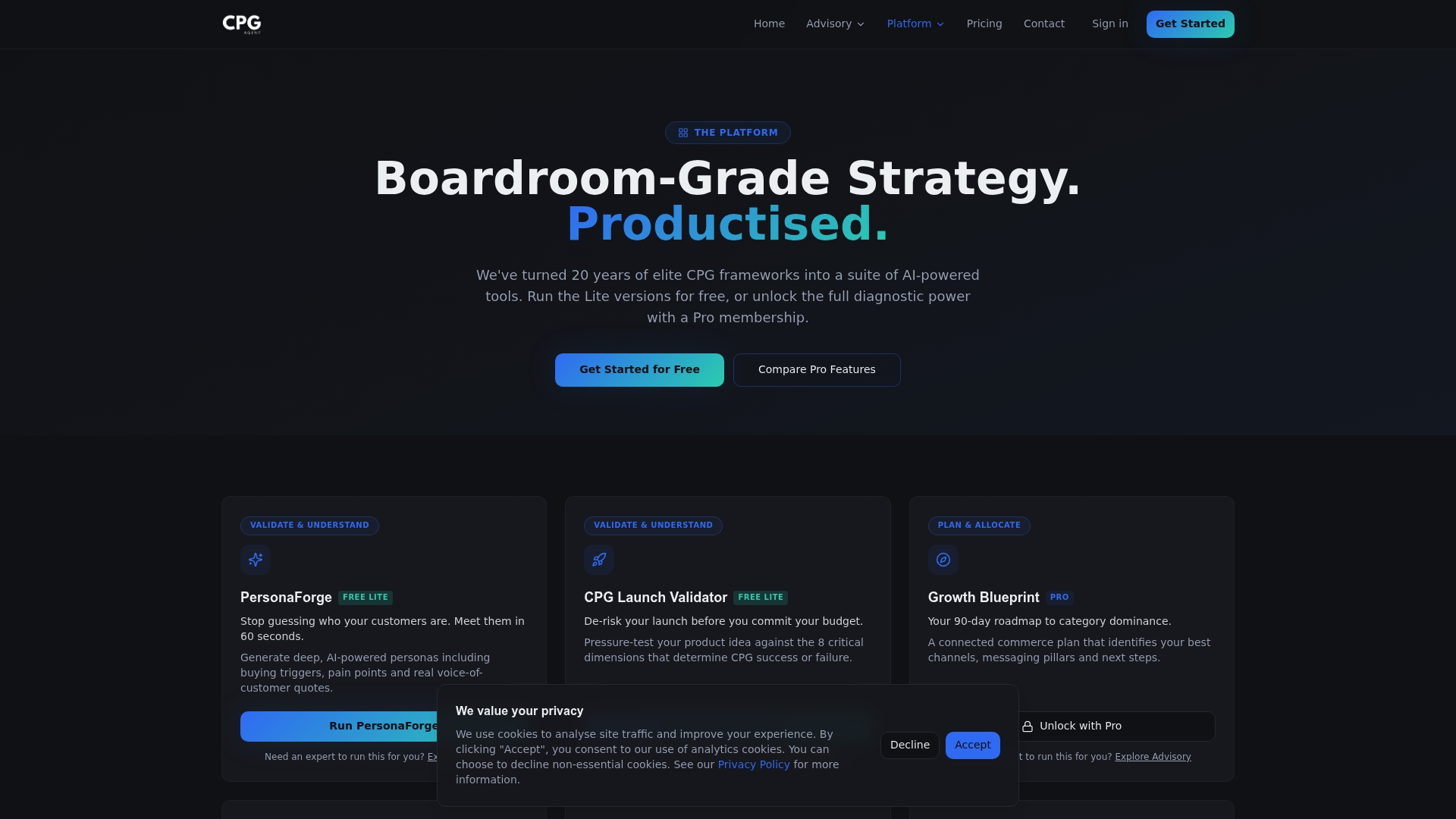
Tools like PersonaForge and Launch Validator give brand leaders data-backed inputs for category narrative building, product positioning, and citation readiness from day one of the sprint. The platform integrates directly into your existing tech stack, so your team spends time executing rather than configuring. If you are ready to run a structured 90-day sprint with the tools and expert support to back it, explore the Cpgagent platform and see how fast a focused quarter can move your brand.
FAQ
What is a 90-day category dominance roadmap?
A 90-day category dominance roadmap is a structured quarterly plan that guides CPG brands through foundation, execution, and optimization phases to capture market leadership within a single sprint cycle.
How many goals should a 90-day sprint include?
A maximum of three non-negotiable goals per sprint is the standard. Pursuing more goals simultaneously causes action inflation and produces zero meaningful wins.
Why does AI search visibility matter for category dominance?
AI search models recommend only 3–4 brands per query. Brands that build authoritative canonical citations early secure those positions, while late entrants face exponentially higher difficulty displacing them.
How do you measure success during a 90-day category sprint?
Measure success by revenue-focused outcomes at each weekly review, not by task completion. Milestones framed as results, such as new retail placements secured or AI citations confirmed, drive accountability.
What comes after the first 90-day sprint?
The first sprint establishes your category foundation. Subsequent quarterly cycles build defensibility through supply agreements, product line extensions, loyalty programs, and ongoing category education content.