

The best persona tools work as a stack, not a standalone purchase: an AI research and synthesis engine to pull evidence, a collaborative canvas to make personas visible to teams, and an activation workflow that pushes those insights into campaigns and product decisions. This combination beats any single tool because it covers the three things a persona actually needs to survive contact with a real marketing calendar: evidence, visibility, and a way to keep updating. Cpgagent builds its own persona research into exactly this kind of integrated stack.
TL;DR:
- Effective persona tools must integrate evidence sources, allowing traits to be traced back to actual data points like interviews or analytics.
- Connecting persona tools to existing platforms such as CRM, analytics, and content management systems ensures teams actually use and update the personas regularly.
- Regular, event-triggered reviews are essential to keep personas accurate, especially after major business changes, rather than relying on fixed quarterly schedules alone.
- Building a workflow that combines data ingestion, affinity mapping, validation, and campaign linking turns personas into active decision-making assets.
- Operational discipline, including evidence citations, assigned ownership, and scheduled reviews, is more critical than the choice of any specific tool or software.
Table of Contents
- What Makes a Persona Tool Actually Good? A Buying Checklist
- The Four Categories of Persona Creation Software
- How to Combine Persona Tools Into a Living Workflow
- Keeping Personas Alive: Validation Cadence and the Fiction Trap
- How Cpgagent Operationalizes Personas for CPG Brands
- The Gap Between Persona Software and Persona Practice
- Get an Integrated Persona Program With Cpgagent
- Sources
- FAQ
What Makes a Persona Tool Actually Good? A Buying Checklist
Most teams pick persona software the way they pick a font: on vibes. That's how you end up with a beautifully designed persona deck nobody opens after month one. The fix is a checklist that forces you to interrogate what a tool actually does with your data, not just how its dashboard looks in a sales demo.
Data sources and evidence traceability. A persona tool is only as good as what feeds it. Ask whether it pulls from your analytics platform, CRM, and voice-of-customer data, or whether it's built entirely on generic survey panels. Smaply's guidance on persona creation is blunt about this: the most common failure mode is the "fiction trap", where teams invent plausible-sounding traits that trace back to nothing. If a tool can't show you the data point behind a claim, treat that claim as a guess.
Integration with your existing stack. A persona that lives in an isolated tool is a persona nobody uses. Look for native or API-level connections to your CRM, analytics suite, campaign platforms, and CMS. Without this, someone on your team becomes the manual bridge between "what the persona says" and "what the campaign brief says," and that person eventually gets a new job.
Collaboration and discoverability. Where does the persona actually live? Figma's research on persona workflows found that collaborative templates and canvases placed inside tools teams already use speed up alignment dramatically compared to static documents buried in a shared drive. If your persona's home address is a PDF from 2024, it's already dead.
Automation and update cadence. Static personas rot. The Nielsen Norman Group frames this correctly: personas work best as living artifacts with scheduled review triggers, not one-time deliverables. Ask any tool you're evaluating how it handles updates. Does new CRM data automatically flag a persona for review, or does someone have to remember to rebuild it manually every year?
Research rigor and audit trails. Can you click on a persona trait and see the interview quote, survey response, or analytics segment that generated it? Tools without this feature are asking you to trust a black box.
Pricing shapes. Persona tools generally fall into three pricing patterns: flat-fee template libraries (cheap, limited), seat-based SaaS subscriptions (moderate cost, scales with team size), and usage-based AI synthesis platforms (variable cost tied to data volume and query frequency). Know which one you're buying before you commit budget.
Security, privacy, and governance. Any tool touching first-party customer data needs clear answers on data residency, retention, and who inside your org can access raw research versus synthesized outputs.
- Evidence traceability: can you trace every trait to a real data point?
- Integration depth: does it connect to your CRM, analytics, and CMS?
- Visibility: does the persona live where your team actually works?
- Update mechanics: is there a defined refresh trigger, or is it static?
- Audit trail: can you click through to source data?
- Pricing shape: flat fee, per-seat, or usage-based?
- Governance: who owns access to raw versus synthesized data?
Pro Tip: Before you demo a single tool, pull three real customer quotes and see if the platform can trace a persona trait back to language that actually resembles them. If it can't handle your own messy, real data in the demo, it won't handle it in production.
The Four Categories of Persona Creation Software
Vendors love to blur category lines because "we do everything" sounds better in a sales call. It isn't true, and it isn't useful. Every persona tool worth evaluating falls into one of four functional categories, and knowing which one you need before you shop saves months of buyer's remorse.
-
AI research and synthesis engines. These tools ingest raw data (support tickets, survey responses, interview transcripts, CRM notes) and use AI to cluster patterns into draft persona segments. They're powerful for teams sitting on a backlog of unstructured qualitative data nobody has time to code manually. The limitation is real: synthesis quality depends entirely on data volume and quality going in. Feed a synthesis engine 40 vague survey responses and you'll get a confident-sounding, evidence-thin persona. These engines work best for teams with genuine data infrastructure already in place, which is where AI-powered consumer research tools earn their keep.
-
Template and canvas builders. Think structured persona templates in Figma, FigJam, or Miro. These are the fastest, cheapest way to get a persona in front of stakeholders, and Figma's own resource library treats templates and canvases as the go-to starting point for teams that need alignment now, not a data pipeline. The tradeoff is obvious: templates accelerate agreement on structure but do nothing to validate whether the content inside that structure is true. They also lack automation, so updates are manual by design.
-
Journey-mapping platforms with persona storage. Tools like Smaply combine persona profiles with customer journey visualization, which matters most for CX and product teams tracking how a persona's needs shift across touchpoints. These platforms shine when the persona needs to connect directly to a journey stage, a friction point, or a specific product interaction, rather than sitting as a standalone demographic sketch.
-
Simulation and conversational personas. Newer AI chat-based personas let teams "interview" a synthetic customer to pressure-test messaging or generate creative briefs quickly. These are genuinely useful for hypothesis generation and early-stage creative exploration, but they are not a substitute for real customer data. Treat outputs as a starting hypothesis to validate, never as a finished insight.
A fifth, adjacent category worth naming: audience research platforms that supply the raw empirical evidence (survey panels, social listening, behavioral analytics) feeding all four of the above. Small teams with limited budget usually start with templates and manual interviews. Mid-size, data-rich teams graduate to synthesis engines paired with analytics connectors. Enterprise and agency teams typically run all four categories at once, each serving a different stage of the persona lifecycle.
How to Combine Persona Tools Into a Living Workflow
The category you pick matters less than how you chain categories together. A single tool, however good, only ever solves one piece of the persona problem. A stack solves the whole lifecycle.
The starter stack. If you're building your first real personas, combine a template builder (for structure), five to eight small-scale customer interviews (for real evidence), and a simple habit of logging insights inside your CRM's notes field so sales and marketing see the same picture. This costs almost nothing and beats an elaborate persona built on assumptions every time. The Interaction Design Foundation's guidance on triangulation, combining interviews, observation, and analytics, applies even at this small scale.
The scaling stack. Once you have real data volume, layer in a research-synthesis engine connected to your analytics and CRM, feeding a collaborative canvas that marketing, product, and sales can all edit. Then build an activation pipeline: a defined path where persona updates automatically flag related campaign briefs, ad targeting parameters, and product roadmap notes for review. This is where behavioral segmentation practices and JTBD framing turn a persona from a description into a decision-making tool.
The agency or multi-client stack. Agencies managing personas across multiple client accounts need version control, per-client governance rules, and branded deliverable exports on top of everything above. Without versioning, you risk a client seeing a competitor's persona template bleed through, or worse, acting on an outdated version nobody flagged as retired.
Here's what a full workflow looks like end to end:
- Ingest. Pull raw data: support tickets, survey exports, interview transcripts, CRM notes, and analytics segments.
- Affinity map. Run a workshop clustering raw quotes and data points into recurring themes. The Interaction Design Foundation's own practitioner approach starts exactly here, with an affinity mapping session generating persona hypotheses before any tool automates anything.
- Draft the persona. Build a minimal viable persona: a handful of decision-relevant fields tied directly to evidence points, not a twelve-section biography nobody reads.
- Validate. Cross-check the draft against a second data source. If the persona came from interviews, validate against analytics segmentation, or vice versa.
- Publish. Push the validated persona into the collaborative canvas where teams already work.
- Tie to campaigns. Link the persona directly to active campaign briefs, ad targeting sets, and product backlog items so it influences real decisions, not just a slide deck.
Pro Tip: Assign a single named owner to each persona, not a team. "Marketing owns this" means nobody updates it. "Sarah owns this and reviews it every quarter" means someone actually will.
Build in a governance checklist alongside the workflow: a named owner per persona, a defined performance metric (campaign lift, conversion rate by segment), and explicit review triggers tied to real events, not just a calendar reminder that gets snoozed for a year.
Keeping Personas Alive: Validation Cadence and the Fiction Trap
A persona is a hypothesis with a shelf life, and most teams treat it like a monument. Nielsen Norman Group's research on persona practice recommends scheduled validation as a built-in process, not a one-time exercise you do at kickoff and never revisit.
Set real review triggers. Quarterly reviews are a reasonable baseline for most consumer brands. But the calendar shouldn't be the only trigger: a major product launch, a pricing change, or a shift in your customer acquisition mix should all force an immediate persona check, whether or not it's the "scheduled" quarter.
Triangulate every update. Don't refresh a persona off a single data source. The Interaction Design Foundation's triangulation model, combining analytics, interviews, and observational data, exists specifically to catch the bias any single method introduces on its own.
Track usage, not just existence. Two metrics matter more than whether the persona document exists at all: how often teams actually reference it when making a campaign or product decision, and whether campaigns targeted using that persona outperform campaigns that weren't. If nobody can point to a decision the persona changed, it's decoration.
Watch for the fiction trap and the single-owner deck. Smaply's research names the fiction trap directly: invented details that feel plausible but trace to nothing real. The related failure is the single-owner deck, where one person builds a persona in isolation and it becomes gospel with zero cross-checking. Both get fixed the same way, by requiring every trait to link to a specific evidence source before it ships.
- Set quarterly reviews plus event-triggered checks (launches, pricing shifts, market changes).
- Require every persona trait to cite its evidence source.
- Use affinity mapping and JTBD framing to keep fields decision-focused rather than decorative.
- Track persona reference rate and campaign performance lift as your two core usage metrics.
- Rotate ownership review among at least two people to catch single-source bias.
NN/g and other practitioner guides converge on minimal viable personas: short, decision-focused artifacts instead of exhaustive dossiers. A two-page persona that gets checked every quarter beats a twenty-page persona nobody opens after the kickoff meeting.
How Cpgagent Operationalizes Personas for CPG Brands
Most persona advice stops at "build one, then keep it updated," without addressing the operational grind of actually doing that inside a CPG or FMCG marketing calendar. Cpgagent's own approach treats persona work as infrastructure rather than a one-off deliverable, combining AI synthesis, automated data connectors, and fractional marketing leadership so the persona stays tied to real shelf and campaign performance, not a static slide.
The practical model looks like this: define a small set of persona fields explicitly tied to evidence (a quote, a segment, an analytics snapshot) rather than demographic filler, assign a named internal owner even when Cpgagent's tools handle the synthesis layer, and set review triggers around actual business events, a new SKU launch, a retail placement shift, a pricing change, rather than an arbitrary date.
A typical lifecycle for a CPG brand might run like this: initial synthesis pulls from retail scan data, loyalty program behavior, and social listening; a draft persona gets validated against a small-scale customer survey; the validated version publishes into a canvas visible to the brand's media planning and packaging teams; and campaign performance data feeds back into the next quarterly review. This mirrors the broader guidance on generating data-backed consumer personas and the category-specific practices covered in brand persona work for FMCG companies.
- Tie every persona field to a traceable evidence source, never a demographic guess.
- Assign a named owner even inside automated workflows.
- Set review triggers around business events, not just a fixed calendar date.
- Feed campaign performance data back into the next persona review cycle.
The Gap Between Persona Software and Persona Practice
Here's what most vendor comparisons get wrong: they treat the tool selection as the hard part. It isn't. Any reasonably competent synthesis engine or canvas builder will produce a professional-looking persona. The hard part, the part that actually determines whether the persona changes a single marketing decision, is the governance layer nobody wants to build: named ownership, evidence citations, and review triggers tied to real business events.
Teams overinvest in choosing the "best" tool and underinvest in the discipline of triangulating data sources and revisiting personas on schedule. A mediocre tool with rigorous validation habits will outperform an excellent tool used once and forgotten. If you take one thing from this: pick a stack that matches your actual data maturity, then spend your real energy on the review cadence and evidence trail, not on finding one more feature comparison.
— Matthew
Get an Integrated Persona Program With Cpgagent
If you're a CPG or FMCG brand trying to piece together a template builder, a synthesis tool, and a separate campaign platform, you already know the seams show. Cpgagent replaces that patchwork with one integrated system: AI-driven persona research, automated data connectors, and activation workflows that push validated personas straight into media planning and creative briefs, backed by fractional CMO-level oversight when your team needs the judgment calls a tool alone can't make.
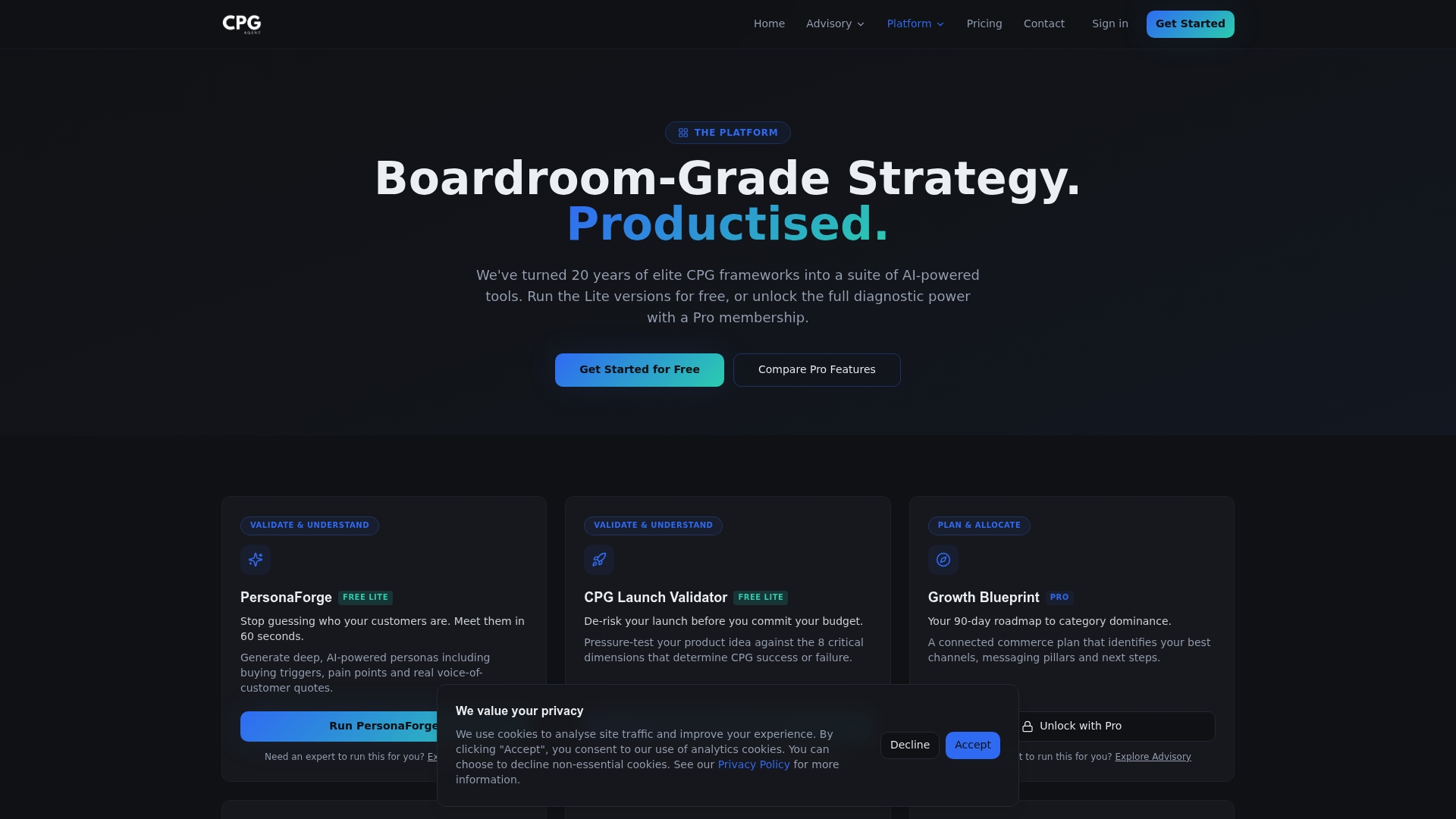
This fits brands that need speed without losing governance, growth teams juggling multiple SKUs or retail channels who don't have months for a discovery phase, and marketing leaders who want personas that actually move campaign performance instead of sitting in a shared drive. The platform automates the data synthesis and update triggers; your team still owns the judgment calls on positioning and creative direction. See how the Cpgagent platform fits your current stack, or start a conversation about where your persona program has the biggest gap right now.
Sources
For deeper research on the methods referenced throughout this guide, start with the Nielsen Norman Group's persona study guide on treating personas as living artifacts, Smaply's breakdown of how to create user personas and avoid the fiction trap, the Interaction Design Foundation's comprehensive user persona guide on triangulation and JTBD framing, and Figma's practical resource on persona creation for template and canvas workflows. For CPG-specific application, Cpgagent's own guides on AI-powered consumer research and behavioral segmentation add practitioner detail.
- How to create user personas (Smaply)
- Personas: Study guide (Nielsen Norman Group)
- User persona guide (Interaction Design Foundation)
- How to create a persona (Figma resource)
FAQ
What are the best persona tools for small marketing teams?
Small teams generally get the best results starting with a template or canvas builder combined with a handful of real customer interviews, since synthesis engines need more data volume than early-stage teams usually have.
How often should personas be updated?
Most practitioner guidance, including Nielsen Norman Group's, recommends quarterly reviews at minimum, plus immediate reviews after major launches, pricing changes, or market shifts.
What's the difference between a persona template and a persona tool?
A template gives you structure and speeds stakeholder alignment, while a full persona tool typically adds data integration, automated updates, and audit trails linking traits back to real evidence.
Can AI generate accurate personas on its own?
AI synthesis engines can accelerate pattern-finding across large datasets, but accuracy depends heavily on data volume and quality, and outputs still need validation against real interviews or analytics before teams act on them.
Does Cpgagent replace the need for manual persona validation?
No. Cpgagent automates data synthesis and update triggers, but human judgment on positioning, evidence review, and strategic fit remains essential to avoid the fiction trap.
What is the biggest mistake teams make with persona tools?
The most common error is treating a persona as a finished document instead of a living artifact, which leads directly into the fiction trap where invented traits go unchallenged for years.