

TL;DR:
- Data-backed consumer personas are built from real customer data and AI analysis, not assumptions. They improve targeting accuracy by reflecting actual buying triggers and objections, leading to higher marketing performance. Continuous validation and dynamic updates are essential for effective persona-driven strategies in consumer goods marketing.
Data-backed consumer personas are detailed profiles built from real customer data and AI analysis, not invented assumptions or generic demographics. CPG and FMCG marketers who generate data-backed consumer personas consistently outperform those relying on gut instinct, because the profiles reflect actual buying triggers, objections, and decision criteria. Techniques like identity resolution, behavioral segmentation, and AI pattern recognition are now standard practice for brands that want precision targeting. Cpgagent's PersonaForge tool applies these methods directly to CPG brand data, compressing weeks of manual research into a fraction of the time.
What data sources do you need to generate reliable consumer personas?
The foundation of any credible persona is raw, unprocessed customer data collected over a meaningful time window. Six to 12 months of raw data from sources like sales call transcripts, support tickets, churn interviews, and purchase histories gives AI tools enough signal to identify recurring pain points, objections, and buying triggers. Shorter windows produce personas that reflect seasonal noise rather than stable behavior patterns. Longer windows dilute the relevance of recent shifts in consumer sentiment.

Not all data sources carry equal weight. Purchase histories reveal what customers actually buy, not what they say they will buy. Churn interviews expose the real reasons customers leave, which are often different from the reasons they give at the time. Sales call transcripts capture the exact language customers use to describe their problems, and that language matters when you write ad copy or product descriptions.
Metadata tagging makes the data far more useful. Labeling each record with attributes like customer role, purchase frequency, and outcome type lets AI tools segment patterns by group rather than treating all customers as one undifferentiated mass. A CPG brand selling both to retail buyers and direct-to-consumer shoppers needs separate tags for each channel, or the resulting personas will blur two very different audiences into one.
| Data type | Typical format | Value in persona building |
|---|---|---|
| Sales call transcripts | Audio or text, 30–90 minutes | Captures exact customer language and objections |
| Churn interviews | Text or video, 15–30 minutes | Reveals true exit reasons and unmet needs |
| Support tickets | Short text, high volume | Surfaces recurring friction points at scale |
| Purchase histories | Structured transaction records | Shows real buying behavior and frequency |
| Survey responses | Short text or ratings | Adds stated preferences and self-reported context |
The table above shows why diversity of data type matters. Each source captures a different layer of customer behavior. Relying on purchase histories alone tells you what customers buy but not why. Combining transaction data with churn interviews and call transcripts produces a three-dimensional picture that AI can analyze with far greater accuracy.
Pro Tip: Tag every data record with a segment label before you upload it. AI tools that receive labeled data produce personas with cleaner segment boundaries and fewer overlapping profiles.
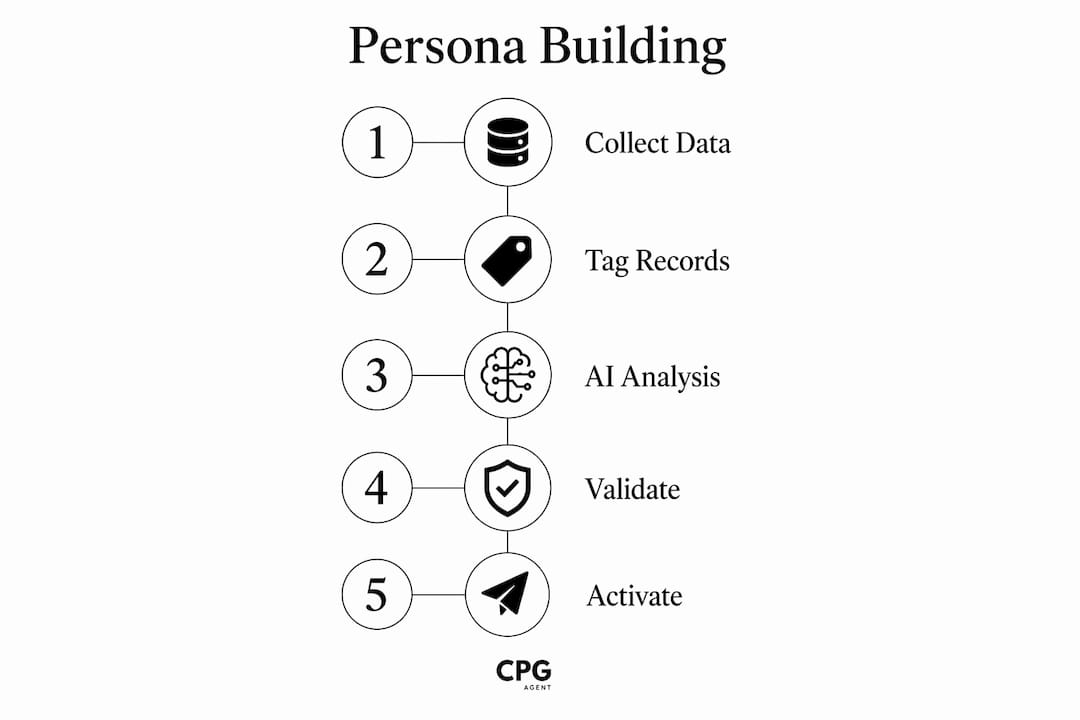
How does AI process raw customer data into detailed personas?
AI persona generation works best when you feed it raw, unprocessed text rather than summaries or cleaned-up reports. Feeding raw transcripts directly into the AI preserves the exact phrasing customers use, which is where the real diagnostic value lives. When you summarize first, you filter out the nuance the AI needs to distinguish one segment from another.
The process follows a clear sequence:
- Collect and label raw data. Pull transcripts, tickets, and purchase records from your CRM and tag each record with segment metadata such as customer type, channel, and outcome.
- Resolve identity fragments. Many brands hold customer data across multiple systems. Identity resolution stitches these fragmented records into a single unified profile per customer before analysis begins.
- Upload raw text to your AI tool. Avoid pre-summarizing. Let the AI read the original language.
- Run pattern recognition. The AI scans for recurring pain-point phrases, common objections, buying triggers, and decision criteria across the full dataset.
- Generate initial personas. The AI clusters patterns into distinct segments and produces a profile for each, including behavioral traits, motivations, and barriers.
- Review and refine. Check each persona against your CRM data to confirm the segment exists at meaningful scale before you invest in targeting it.
Identity resolution deserves particular attention. CPG brands often store customer data in separate systems: an e-commerce platform, a retail loyalty program, and a DTC subscription service. Without stitching those records together, the AI treats the same customer as three different people and produces distorted personas.
The most common mistake at this stage is casting too wide a net. Broad segments dilute targeting effectiveness and produce personas so generic they could describe almost anyone. Focus your analysis on the segments showing the highest lifetime value in your CRM data. Those are the customers worth understanding in depth.
Pro Tip: Ask your AI tool to output the three most frequent pain-point phrases and five most common objections for each persona. Those phrases belong directly in your ad copy and product messaging.
How do you validate and refine data-driven personas?
A persona is only as reliable as the data behind it. The quality and traceability of your source data is the single most important factor in persona accuracy. AI cannot compensate for biased, incomplete, or non-representative data. If your transcripts come exclusively from customers who renewed their contracts, your personas will systematically underrepresent the reasons people churn.
Validation requires checking personas against real customer behavior, not just internal assumptions. Practical validation methods include:
- CRM behavioral matching. Compare each persona's predicted behavior against actual purchase frequency, channel preference, and support ticket volume in your CRM. If the data does not match the persona, the persona needs revision.
- Sales team interviews. Ask your sales team whether each persona reflects the customers they actually talk to. Frontline reps catch demographic or motivational mismatches that data alone misses.
- A/B message testing. Write two versions of a headline or offer based on different persona assumptions. The version that performs better tells you which persona attribute is more accurate.
- Ongoing data refresh. Consumer behavior shifts. Personas built on data from 18 months ago may no longer reflect current buying patterns. Refresh your source data on a rolling basis.
The most powerful validation tool available to CPG marketers right now is the interactive AI persona. AI SmartPersonas transform static persona documents into dynamic decision-support tools that you can query in real time. You can ask a SmartPersona how it would respond to a new price point, a reformulated product, or a different retail channel. The persona answers based on the behavioral data it was built from, giving you a fast pressure test before you commit budget.
Pro Tip: Run your planned campaign messaging through an interactive persona before launch. If the persona's simulated response is flat or negative, revise the message before it reaches a real audience.
How do data-backed personas improve consumer goods marketing?
Validated personas change how you allocate every marketing dollar. Dynamic customer profiles that merge demographic traits with real-time behavioral data let you move from broad channel buys to precise segment targeting. The result is higher relevance, lower cost per acquisition, and better retention.
Practical applications for CPG and FMCG marketers include:
- Segmented ad targeting. Use persona behavioral attributes to build custom audiences in paid media platforms. A persona defined by high purchase frequency and price sensitivity gets a different offer than one defined by brand loyalty and premium willingness.
- Content development. Persona pain-point phrases become the headlines and body copy of your content. When your messaging mirrors the exact language your customers use, engagement rates rise.
- Pricing tier focus. Personas reveal which segments are price-driven and which are value-driven. That distinction determines where you position new SKUs and how you structure promotional offers.
- Channel strategy. A persona that shops primarily through retail loyalty programs needs a different touchpoint strategy than one that buys direct-to-consumer through subscription. Omnichannel planning becomes far more precise when it is persona-led.
- Product innovation. Persona data surfaces unmet needs that your current product range does not address. Those gaps are your next development priorities.
Integrating persona insights into your existing CRM and marketing automation workflows is where the real efficiency gain appears. When persona attributes live inside your CRM as segment tags, every campaign, email sequence, and sales outreach can be filtered by persona without manual intervention. Cpgagent's platform is built to connect AI-driven persona data directly to marketing activation workflows, so the insight does not sit in a slide deck. It drives actual campaign decisions.
Metrics worth tracking for persona-driven campaigns include cost per acquisition by segment, retention rate by persona, and revenue per customer cohort. Those three numbers tell you whether your personas are accurate enough to drive real business outcomes.
Key Takeaways
Generating data-backed consumer personas requires real customer data, AI pattern recognition, and continuous validation to produce profiles that actually improve targeting and revenue.
| Point | Details |
|---|---|
| Data volume and variety | Collect 6–12 months of raw transcripts, tickets, and purchase records before generating personas. |
| Feed raw text to AI | Unprocessed data preserves customer language and produces higher-fidelity personas than summaries do. |
| Validate against real behavior | Cross-check personas with CRM data, sales team input, and A/B message tests before activating them. |
| Use interactive personas | AI SmartPersonas let you pressure-test pricing and messaging in real time before committing budget. |
| Apply personas to workflows | Embed persona segment tags in your CRM so every campaign filters by persona automatically. |
Why I think most CPG brands are still building personas wrong
The industry has moved fast on AI tools, but the underlying data discipline has not kept pace. Most brands I see are feeding AI tools with summarized reports, cleaned-up survey data, or, worse, personas they built three years ago. The output looks polished. It is also largely fictional.
The brands getting real value from data-driven profiles are the ones that treat data quality as a non-negotiable constraint, not an afterthought. They invest time in AI-powered consumer research before they touch a persona template. They tag their CRM records with behavioral metadata. They run identity resolution before they run analysis. That groundwork is unglamorous, but it is what separates a persona that drives campaign decisions from one that decorates a strategy deck.
The other mistake I see constantly is treating personas as finished documents. A persona built on last year's data reflects last year's consumer. The brands winning on shelf right now treat personas as living models, updated on a rolling basis and queried interactively when a new product or campaign decision needs a fast read. That shift from static to dynamic is the single biggest unlock available to CPG marketers in 2026. The tools exist. The gap is in how brands choose to use them.
— Matthew
How Cpgagent helps you build and activate consumer personas faster
Cpgagent's platform is built specifically for CPG and FMCG brands that need to move from raw customer data to activated personas without a six-week research cycle. PersonaForge ingests your sales transcripts, CRM exports, and support data, then generates AI-backed consumer profiles that are ready to query and test immediately.
The platform connects persona outputs directly to your marketing workflows, so segment insights drive campaign targeting rather than sitting in a report. For brands that want to build consumer personas at speed without sacrificing data rigor, Cpgagent removes the manual steps that slow most teams down. Explore the platform to see how PersonaForge fits your current data stack and brand stage.
FAQ
What data do you need to generate data-backed consumer personas?
You need 6–12 months of raw customer data including sales call transcripts, churn interviews, support tickets, and purchase histories. Labeling each record with segment metadata improves the accuracy of AI pattern recognition.
How long does AI persona generation take?
AI-powered tools can generate an initial persona in under five minutes once your data is uploaded and labeled. Full validation against CRM behavioral data typically takes a few additional days.
What is an AI SmartPersona?
An AI SmartPersona is an interactive, always-on persona model that you can query in real time to test pricing, messaging, and product concepts. It replaces static persona documents with a dynamic decision-support tool.
How do you validate a data-driven persona?
Compare each persona's predicted behavior against actual CRM data, run A/B message tests based on persona assumptions, and interview your sales team to confirm the profile reflects real customers they encounter.
What is the biggest mistake in consumer persona development?
Assigning fictional traits not supported by data is the most damaging error. Effective personas are diagnostic tools built on real behavior patterns and decision criteria, not invented demographic details or lifestyle assumptions.