

TL;DR:
- A brand audit systematically evaluates a company's visual identity, messaging, and market perception to identify gaps and opportunities. It captures internal, external, and customer experience insights, revealing discrepancies between brand intent and reality. Regular, honest assessments guide strategic improvements, ensuring brand consistency, differentiation, and long-term growth.
A brand audit process is a systematic evaluation of your brand's current health, market positioning, and internal alignment to identify gaps and opportunities that inform future strategy. Unlike a marketing performance review, which focuses on campaign metrics, a brand audit examines the full picture: visual identity, messaging consistency, audience perception, competitive standing, and employee culture. For CPG and FMCG brands competing for shelf space and consumer attention, this distinction matters enormously. The audit gives you a documented baseline from which every strategic decision can be measured.
What is a brand audit process and what does it cover?
A brand audit evaluates internal branding, external branding, and customer experience to understand overall brand health. Internal branding covers how well your team understands and lives the brand. External branding covers every consumer-facing touchpoint, from packaging to paid media. Customer experience captures how people actually feel when they interact with your product or service. Together, these three dimensions give you a 360-degree view that no single analytics dashboard can replicate.

The brand assessment process also surfaces the gap between brand intent and brand reality. A brand audit can reveal discrepancies between how a brand thinks it performs and how the market actually perceives it. That gap is where the most valuable strategic work happens. Brands that skip this step often invest in the wrong areas, reinforcing messaging that customers have already tuned out.
A typical brand audit reviews visual identity consistency, messaging clarity, market positioning, and customer engagement metrics. These are not abstract categories. They translate directly to whether a new retail buyer trusts your brand enough to stock it, or whether a first-time consumer picks your product over a competitor on the same shelf.
Key components every brand audit checklist should include
A thorough brand audit checklist covers six core categories. Each one reveals a different layer of brand performance.
- Visual identity: Logo usage, color palette consistency, typography, and packaging design across every channel. Inconsistency here signals a lack of brand discipline to both consumers and retail partners.
- Brand voice and messaging: Tone of voice, tagline clarity, and whether your copy communicates a distinct point of view or blends into category noise.
- Content alignment: Whether your website, social media, email, and in-store materials tell the same story. Misalignment across platforms confuses buyers and dilutes brand equity.
- Audience perception: What customers actually think, gathered through reviews, surveys, and social listening. This is the most honest signal you have.
- Competitive positioning: Where your brand sits relative to direct and indirect competitors on price, values, and product claims. A lean brand strategy depends on knowing exactly where you stand.
- Internal brand alignment: Whether your team, from sales to operations, understands and communicates the brand consistently. Internal misalignment leaks out into every customer interaction.
Pro Tip: Run your brand audit checklist against your three most direct competitors at the same time. Scoring yourself in isolation creates blind spots. Scoring yourself against real alternatives reveals where you are genuinely differentiated and where you are not.
How to conduct a brand audit step by step
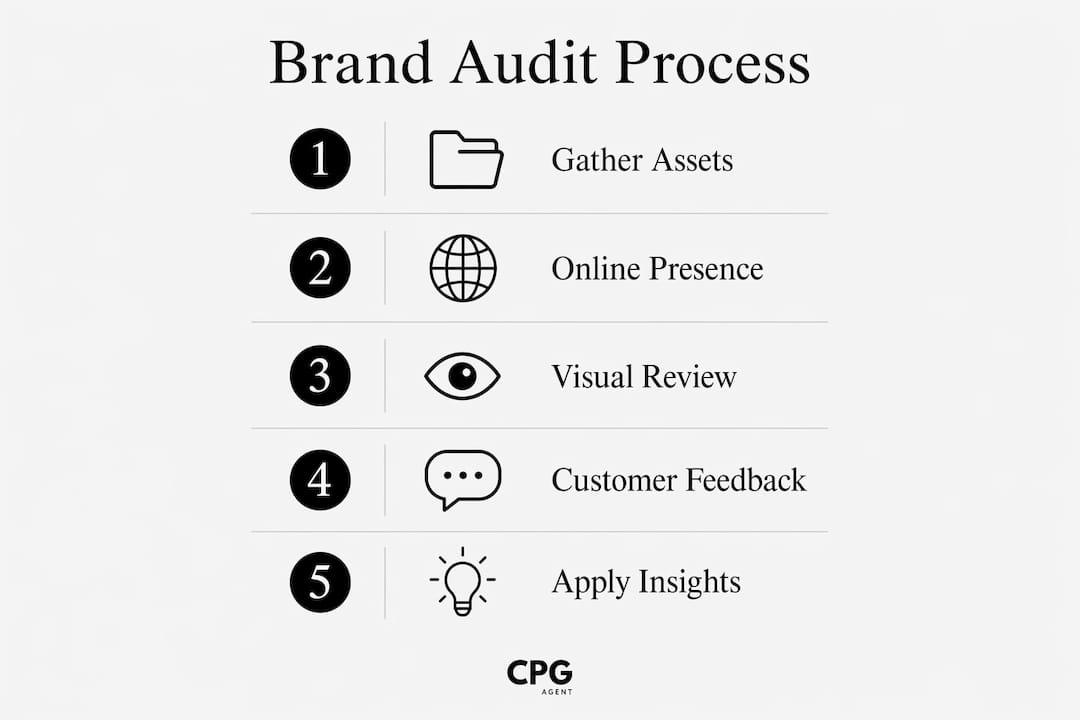
The steps for a brand audit follow a logical sequence: gather, assess, score, and act. Skipping any stage reduces the audit from a strategic tool to a surface-level exercise.
-
Set objectives and scope. Define what you want to learn. Are you preparing for a retail expansion, a rebrand, or an annual performance review? Scope determines which data sources you prioritize and how deep you go.
-
Gather all brand assets. Collect every brand touchpoint: logo files, brand guidelines, packaging, website pages, social profiles, sales decks, and email templates. Most brands discover inconsistencies at this stage before the formal assessment even begins.
-
Audit your online presence. Review your website for messaging clarity, SEO alignment, and visual consistency. Audit each social media platform for tone, posting frequency, and engagement quality. Check whether your brand is recommended by AI search engines, since AI-driven discovery is now a real distribution channel for CPG brands.
-
Collect customer and stakeholder feedback. Surveys, interviews, and social listening tools help gather honest customer and audience feedback for the audit. Direct audience insights validate or challenge your internal assumptions. Use tools like Typeform for surveys and Brandwatch or Sprout Social for social listening.
-
Analyze your competitive landscape. Map your positioning against three to five direct competitors across price tier, brand values, visual identity, and key claims. This step often reveals white space that your current messaging fails to occupy.
-
Score and document findings systematically. Documenting scores and notes during the audit guides the creation of an actionable roadmap for brand improvement. Use a spreadsheet or a structured template to assign scores across each category. A comprehensive brand audit self-assessment typically takes 2 to 4 hours and covers 50 questions across six categories. That time investment is modest relative to the strategic clarity it produces.
-
Develop an improvement plan. Translate scores into prioritized actions. Separate quick wins, such as fixing inconsistent logo usage, from longer-term strategic shifts, such as repositioning against a new competitor set.
-
Schedule follow-up audits. Experts recommend conducting a full brand audit annually, with quarterly spot checks on digital and social platforms to monitor brand drift. Quarterly checks catch problems before they compound.
| Audit stage | Primary output |
|---|---|
| Asset gathering | Inventory of all brand touchpoints |
| Online presence review | Gap analysis across digital channels |
| Customer feedback collection | Perception data from surveys and social listening |
| Competitive analysis | Positioning map relative to key competitors |
| Scoring and documentation | Prioritized improvement roadmap |
Pro Tip: Do not wait until a brand crisis or a failed retail pitch to run your first audit. The brands that benefit most from the process are those that treat it as a scheduled operational rhythm, not a reactive measure.
Common challenges in brand audits and how to avoid them
The importance of brand evaluation is clear in theory. In practice, several recurring pitfalls reduce audit effectiveness.
- Biased self-assessment. Internal teams often score their own brand generously. Involve an external reviewer or use structured scoring rubrics that force honest ratings rather than subjective impressions.
- Incomplete data collection. Collecting data from customer surveys, social media analytics, website performance, and competitive research is critical for a thorough audit. Brands that rely only on internal data miss the market perception layer entirely.
- Ignoring internal perspectives. Sales teams, customer service staff, and retail field reps interact with your brand in ways that marketing leadership often does not see. Their feedback frequently surfaces the most actionable insights.
- Failing to act on findings. Many businesses fail to act on their audit results, risking wasted effort. An audit that produces a report no one reads is worse than no audit at all. It creates false confidence that the work is done.
- Treating the audit as a one-time event. Brand drift happens gradually. A single audit captures a moment in time. Without scheduled follow-ups, the gaps you closed will reopen as markets shift and competitors evolve.
The brands that extract the most value from the brand assessment process are those that build audit findings directly into their quarterly planning cycles. The audit stops being a project and becomes a management habit.
How to apply brand audit insights to drive brand growth
A brand growth audit produces value only when its findings change behavior. The application phase is where most brands either capitalize on the investment or let it stall.
Start with quick wins that have high visibility and low execution cost. Standardizing logo usage across all digital channels, updating an outdated tagline, or fixing inconsistent color usage on packaging are changes that take days, not quarters. They signal internal discipline and improve brand recognition immediately.
For longer-term strategic shifts, use audit data to realign your marketing and content calendar. If the audit reveals that your messaging over-indexes on product features and under-indexes on brand values, that finding should reshape your content strategy for the next six months. Brands that connect audit findings to a strategic brand roadmap create a living document that keeps the organization accountable.
Internal adoption is the most underrated application of audit results. Share findings with your full team, not just the marketing department. When sales, operations, and product development understand the brand's positioning gaps, they make better decisions at every customer touchpoint. Brand consistency is a cross-functional discipline, not a design team responsibility.
Set measurable benchmarks before your next audit cycle. Define what success looks like for each priority area: a target Net Promoter Score, a specific improvement in social engagement rate, or a measurable reduction in messaging inconsistencies across platforms. Without benchmarks, the next audit has no baseline for comparison.
Pro Tip: Assign ownership for each audit finding to a specific person with a deadline. Audit reports that list problems without owners become shelf documents. Accountability converts findings into results.
Key takeaways
A brand audit is only as valuable as the actions it generates. The process works when it is structured, honest, and tied directly to strategic planning cycles.
| Point | Details |
|---|---|
| Define scope before starting | Set clear objectives so the audit covers the right data sources and brand dimensions. |
| Use multiple data sources | Combine surveys, social listening, and competitive analysis for a complete picture of brand health. |
| Score and document systematically | Structured scoring creates an actionable roadmap and a benchmark for future audits. |
| Act on findings immediately | Assign owners and deadlines to each priority finding to prevent the audit from stalling. |
| Audit on a regular schedule | Run a full audit annually and quarterly spot checks to catch brand drift before it compounds. |
Why most brand audits fail before they even start
Most brand audits I have seen fail at the same point: the moment the team decides to assess itself without external input. The instinct is understandable. You know your brand better than anyone. But that familiarity is exactly the problem. You stop seeing what a first-time buyer, a skeptical retail buyer, or a lapsed customer sees.
The brands I have watched execute audits that actually changed their trajectory were the ones that treated uncomfortable findings as the most valuable output. One CPG founder I worked with discovered through customer surveys that her brand's premium positioning was invisible to consumers at the shelf level. Her packaging communicated value, not premium. That single finding redirected six months of packaging investment. No amount of internal review would have surfaced it.
The other pattern I see consistently is the audit that produces a beautiful report and then sits in a shared drive. The purpose of a brand audit is not documentation. It is decision-making. If your audit does not change at least three things about how you operate in the next 90 days, you did not take it seriously enough. The brands that treat the process as a genuine strategic tool, not a compliance exercise, are the ones that use it to differentiate on the shelf and build durable equity over time.
— Matthew
Run smarter brand audits with Cpgagent
Cpgagent is built for CPG and FMCG brands that need to move fast without sacrificing strategic rigor. The platform's AI-driven tools give you rapid, data-backed insights across brand positioning, audience perception, and competitive analysis, replacing the slow, expensive agency discovery process with automated workflows you can act on immediately.
Whether you are running your first brand audit or building a repeatable quarterly review process, Cpgagent's platform tools give your team the structure and data to turn findings into growth. From PersonaForge for audience insight to fractional CMO advisory for strategic direction, Cpgagent puts the full audit toolkit in one place. Explore Cpgagent to see how fast-moving brands are using it to stay ahead.
FAQ
What is the purpose of a brand audit?
The purpose of a brand audit is to evaluate your brand's current health, identify gaps between brand intent and market perception, and generate a prioritized roadmap for improvement. It aligns internal teams and external messaging with your actual business goals.
How often should you conduct a brand audit?
Experts recommend a full brand audit annually, with quarterly spot checks on digital and social platforms to monitor brand drift and catch issues before they compound.
What should you include in a brand audit?
A brand audit should include visual identity, brand voice and messaging, content alignment across platforms, audience perception data, competitive positioning, and internal brand alignment. Together these six areas provide a complete view of brand health.
How long does a brand audit take to complete?
A comprehensive brand audit self-assessment typically takes 2 to 4 hours and covers around 50 questions across six core categories. Larger organizations with more complex portfolios may require additional time for data collection and stakeholder interviews.
What is the difference between a brand audit and a brand growth audit?
A standard brand audit assesses current health and consistency. A brand growth audit extends that analysis to identify specific opportunities for market expansion, audience growth, and revenue contribution, making it a more forward-looking strategic tool.