

AI ad creative platforms let marketing teams generate images, short-form video, and copy at a volume no in-house team can match, and they do it in hours instead of weeks. The catch: unsupervised output drifts off-brand fast, so the winning approach pairs the platform with human curation, brand controls, and a measurement loop. For CPG and FMCG teams, the fastest path is a short pilot, run alongside fractional advisory like Cpgagent offers, rather than a full agency handoff.
TL;DR:
- AI ad creative platforms can generate batch assets rapidly but require human curation and brand controls to prevent off-brand drift.
- Connecting real product, persona, and performance data leads to more relevant, higher-converting outputs, especially for CPG brands.
- A structured pilot with clear KPIs and integrated workflow reduces risk and demonstrates measurable performance improvements before broader adoption.
- Human review and disclosure are critical to maintaining consumer trust and avoiding brand safety issues in AI-generated advertising.
- Combining AI speed with human judgment maximizes creative effectiveness and minimizes ethical, quality, and governance risks.
Table of Contents
- What Can AI Ad Creative Tools Actually Generate?
- How Do You Run a Generate, Curate, Publish, Measure Loop?
- How Should You Choose an AI Ad Creative Platform?
- How Cpgagent Deploys AI Creative for CPG and FMCG Brands
- What Are the Ethical Risks in AI-Generated Ad Creative?
- What Do Successful AI Ad Creative Campaigns Look Like?
- Is AI Ad Creative Better Than Human-Made Ads?
- Where Is AI Ad Creative Technology Heading?
- The Strategic Stakes for Marketing Leaders
- Ready to Pilot AI Creative Without the Agency Overhead?
- Sources
- FAQ
What Can AI Ad Creative Tools Actually Generate?
Modern platforms cover four output categories, and the gap between what they promised two years ago and what they deliver now is real. Image generation has moved past generic stock photo replacement into automated product shots that render a bottle or box on a dozen backgrounds and export in every size a media plan needs, from a 1:1 Instagram feed post to a 9:16 TikTok frame, without a second photo shoot.
Video is where the category has changed the most. Platforms now produce UGC-style clips that mimic a customer talking to camera, product demo videos that walk through a use case, and avatar or talking-head formats that deliver a script without hiring an actor or booking a studio. User reviews on G2 consistently rate these tools highly for production speed, though quality still varies by use case, and a beauty brand's demo needs look nothing like a snack brand's unboxing clip.
Copy generation rounds out the toolkit: headlines, primary text, and captions tuned to the character limits and tone of Meta, TikTok, and Google Ads respectively. None of this happens as one-off requests. The real value shows up in batch generation, where a single brief spins out dozens of variations, swapping hooks, visuals, or calls to action so a media team can run a real A/B test instead of guessing which version will land. StackAdapt's guidance on AI in advertising points to exactly this: platforms that automate resizing and templating across formats cut production time dramatically and let teams test more variables per cycle.
None of that scale means anything if the output looks nothing like your brand. That's why brand onboarding has become a core feature rather than an afterthought. A serious platform lets you import:
- Brand color codes and approved palettes so generated assets don't drift into off-brand hues
- Typography and font files so headlines match your packaging and site
- Tone-of-voice guardrails so copy generation doesn't default to generic marketing language
- Template libraries built from your best-performing past creative
- Product asset libraries (SKU images, packaging shots) so the AI has real reference material, not a text description alone
That last point matters more for CPG brands than almost any other category. Feeding a model structured SKU-level data, real consumer hook tests, and retail performance signals produces noticeably more relevant, higher-converting output than feeding it a plain product description and hoping for the best.
Creative scoring is the feature every vendor now advertises, and the feature most buyers misunderstand. A predictive score estimates how a piece of creative will likely perform before it runs, based on patterns the model has learned from prior ad performance. Useful, but not gospel. Scoring methodology varies widely between vendors, and StackAdapt's own analysis flags this directly: buyers should ask exactly how a score gets calculated and validated before treating it as a launch decision. Treat a creative score as a ranking signal to prioritize what gets tested first, not as a substitute for running the actual test.
How Do You Run a Generate, Curate, Publish, Measure Loop?
The teams getting real lift from AI ad creative aren't the ones generating the most assets. They're the ones running a tight, repeatable loop with a human checkpoint built into every stage.
- Write a tight brief first. Product, audience segment, the single core hook you want to test, and the KPI that defines success (CTR, CVR, or CPA delta). A vague brief produces vague variations, no matter how good the model is.
- Seed generation with real inputs. Pull from existing product pages, persona research, or past-performing creative rather than starting from a blank prompt. This is where a tool that already holds your persona work, like PersonaForge, saves a full cycle of back and forth.
- Curate before anything goes live. A human reviews every batch for brand fit, legal claims, and cultural fit. This step is not optional. Research reviewing generative AI in advertising found human-AI collaboration consistently outperforms AI-only output, and that undisclosed AI-generated ads can trigger consumer skepticism when something feels off.
- Publish through integrated ad-account connections. Platforms with native publishing to Meta and TikTok remove a manual export-upload step that otherwise eats a day per test cycle, according to StackAdapt's product analysis.
- Measure at the creative level, not just the campaign level. Identify which specific variant drove the lift, clone it into new variations, and feed what you learned back into the next brief.
Pro Tip: Build a searchable library of every winning creative and the brief that produced it. When a hook works, you want to clone the exact prompt structure that generated it, not reverse-engineer why it worked from memory three months later.
Governance belongs at every checkpoint, not as a final review before launch. CNBC's reporting on generative AI's rapid adoption across agencies notes that oversight is what prevents brand-safety incidents as adoption accelerates. Decide in advance when creative needs an AI-use disclosure, particularly for testimonial-style or influencer-mimicking formats where audiences assume a real person is speaking.
How Should You Choose an AI Ad Creative Platform?
Six evaluation axes separate a platform worth adopting from one that will frustrate your team by month two: output quality, throughput, integrations, measurement fidelity, governance controls, and pricing structure.
Before signing anything, ask vendors direct questions and expect direct answers:
- Can you export raw creative files, or does everything stay locked inside the platform?
- Which ad accounts does native publishing support, and does that include the platforms your media plan actually uses?
- How is the creative score calculated, and what data was it trained or validated on?
- What is the moderation service-level agreement if a generated asset needs a compliance review?
- Who owns the generated assets contractually, you or the platform?
Watch for a few red flags during any trial. A closed ecosystem that won't let you export finished creative is a serious constraint disguised as a convenience. An opaque scoring system that won't explain its methodology deserves the same skepticism you'd apply to any unverified performance claim. And if a vendor can't answer a basic question about data export on the first call, that's information too.
The smartest way to de-risk any of this is a defined 30-day pilot with fixed KPIs set in advance: a target CTR lift, a CVR range, and an acceptable CPA delta against your current creative baseline. BCG's analysis of AI-driven advertising recommends exactly this kind of small, measurable pilot before any broader rollout, treating early experimentation as the operational priority rather than a nice-to-have.
How Cpgagent Deploys AI Creative for CPG and FMCG Brands
Some platforms build creative workflows specifically around the constraints CPG marketing teams actually face: tight margins, shelf pressure, and no appetite for a six-month agency discovery phase. The platform connects persona and validation work directly to creative generation, so briefs start from real research instead of a guess.
- Tools like PersonaForge can build the audience and hook research that seeds every creative brief, so generation starts from validated consumer insight rather than assumption.
- Launch validation tools can stress-test concepts before creative spend scales behind them, catching a weak hook before it burns media budget.
- Fractional CMO and growth-hacking advisory services can replace the multi-week agency ramp-up with senior marketing leadership embedded directly into the workflow, deployed on a timeline measured in weeks, not quarters.
- The platform's tool suite integrates with existing tech stacks rather than requiring a rebuild, which matters for brands running lean marketing teams.
The outcome CPG teams should expect: faster iteration cycles between brief and live creative, sharper hooks grounded in actual persona data instead of internal guesswork, and a measurable lift tied to specific creative variants rather than a vague campaign-level bump.
What Are the Ethical Risks in AI-Generated Ad Creative?
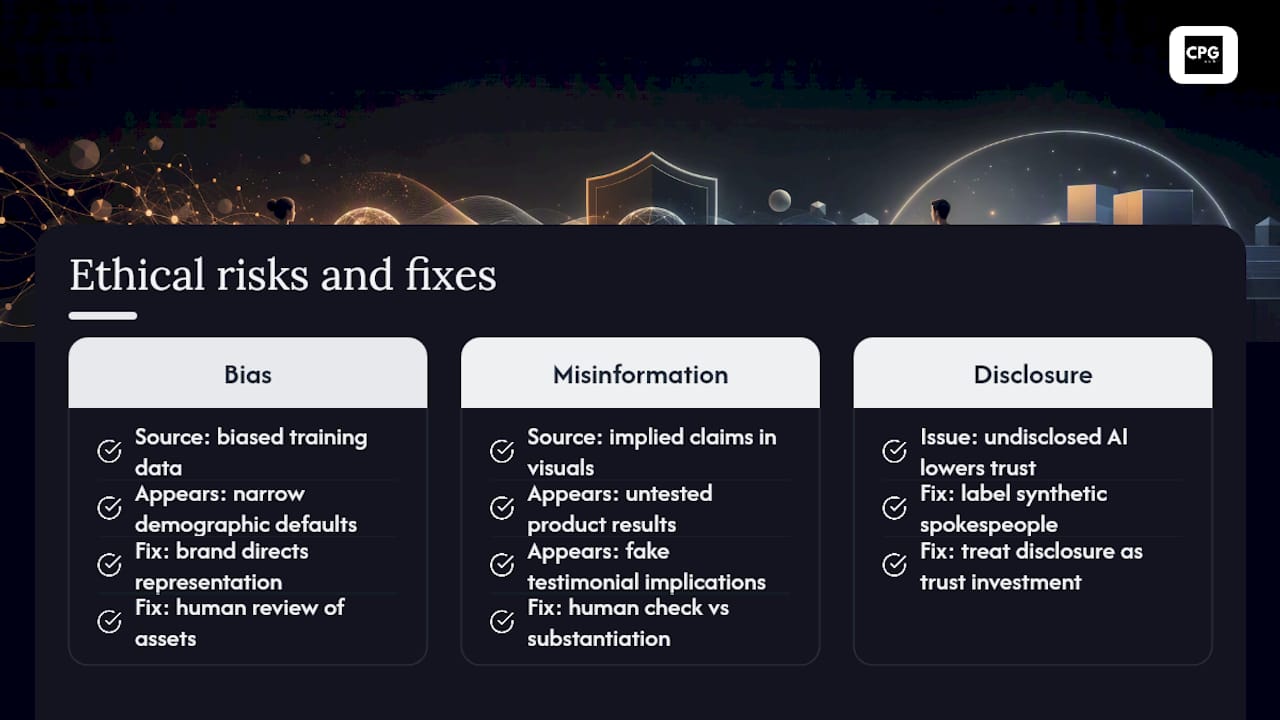
Bias and misinformation are the two risks that deserve the most scrutiny, and both stem from the same root cause: AI models learn patterns from training data, and that data carries the biases already present in the advertising it was trained on. An image generator asked for "a family enjoying breakfast" will default to whatever demographic pattern dominated its training set unless a brand actively directs otherwise. Left unchecked, that default quietly narrows who your ads represent.
Misinformation risk shows up differently in ad creative than in editorial content, mostly around implied claims. A generated product demo can visually suggest a result the product hasn't been tested to deliver, and a generated testimonial-style clip can imply a real customer experience that never happened. Neither requires malicious intent. Both require a human reviewer checking every claim against what the product can actually substantiate.
Disclosure is the piece brands underestimate most. Research on generative AI in advertising found that consumer trust drops when AI involvement in a testimonial-style ad goes undisclosed and later becomes apparent. The fix isn't complicated: label synthetic spokespeople clearly, keep human review on every claim-bearing asset, and treat disclosure as a trust investment rather than a legal formality.
What Do Successful AI Ad Creative Campaigns Look Like?
The pattern across effective campaigns is consistent: AI handles the volume, humans handle the judgment calls, and the brief stays specific instead of open-ended. A brand testing a new hook doesn't ask a platform to "make ads for this product." It asks for twelve variations of one specific claim, each with a different opening frame, then lets the data pick a winner within days rather than weeks.
The batch-and-clone pattern shows up repeatedly in vendor case studies. A team generates a wide first batch, identifies the two or three variants pulling real engagement, then clones those specific structures into a second, narrower batch instead of starting over. That second batch typically outperforms the first because it's built from evidence, not intuition. StackAdapt's guidance frames this as building a template library from what already worked rather than reinventing a brief every cycle.
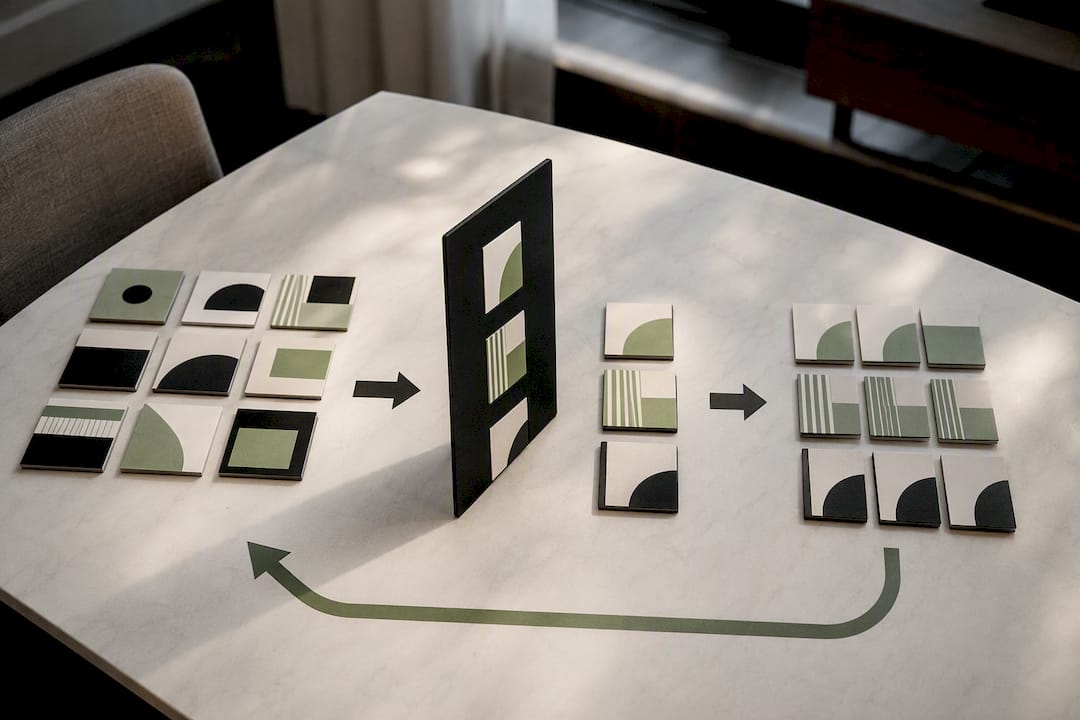
The common failure mode is the mirror image: teams that generate hundreds of assets, publish most of them with minimal review, and never build a feedback loop back into the next brief. Volume without curation produces noise, not lift. The campaigns that actually move a conversion rate treat AI as a production accelerant inside a disciplined testing process, not a replacement for having a strategy in the first place.
Is AI Ad Creative Better Than Human-Made Ads?
Neither wins outright, and framing it as a contest misses how the two actually perform together. AI-generated creative wins decisively on speed and volume: a platform can produce dozens of tested variations in the time a traditional production cycle takes to book one photo shoot. Where it struggles is nuance, cultural specificity, and the kind of unexpected creative leap that comes from a person who deeply understands a brand's category.
Human-made creative still tends to win on originality and emotional precision, particularly for hero brand campaigns where a single strong idea matters more than a hundred variations of an average one. The evidence points toward collaboration outperforming either extreme. Research on generative AI in advertising found human-AI collaboration consistently produces stronger results than AI-only output, and the gap doesn't close simply by adding more compute or a better model.
The practical split most CPG teams land on: use AI for the high-volume performance layer, testing hooks, formats, and variations at a scale humans can't match, and reserve human-led creative for brand-defining hero content where a single strong idea outweighs a hundred average ones. That division of labor, rather than an either-or choice, is where the real conversion lift shows up.
Where Is AI Ad Creative Technology Heading?
The next shift is toward AI-native discovery, where consumers increasingly find products through AI assistants and generative search rather than a traditional feed scroll. BCG describes this as an emerging "AI attention stack", and it changes what creative needs to do: assets need to work as inputs models can parse and recommend, not just as ads a human scrolls past.
Expect creative scoring to get more transparent as buyers push back on black-box methodologies, and expect predictive tools to incorporate real-time performance feedback rather than static historical training data. Video generation will keep closing the gap with produced content, particularly for UGC-style and demo formats where realism matters more than cinematic polish.
The bigger structural shift is organizational, not technical. Brands that unify their product data, creative libraries, and measurement systems now will move faster than competitors treating each as a separate workstream once model-mediated discovery becomes a larger share of how consumers shop. Preparing product data for AI-driven recommendation is quickly becoming as important as the creative itself.
The Strategic Stakes for Marketing Leaders
AI creative doesn't just speed up production. It changes how discovery works, and that's the part most marketing leaders are underestimating. Unify your product data, persona research, and creative library now, or you'll spend next year rebuilding pilots that should have been running in parallel from day one.
Trust is the operational risk hiding inside all of this speed. Consumers respond negatively to AI-generated content that feels deceptive, and research on generative AI in advertising backs that up directly. Governance and disclosure aren't compliance checkboxes. They're what keeps a fast creative engine from becoming a brand-safety problem.
The immediate move is a structured pilot, not a full platform rollout. Give it defined KPIs, integrate it into your actual media workflow rather than testing it in isolation, and treat your product data as an asset that needs AI-readiness the same way your creative does. Teams that build this discipline now will be the ones setting the pace when model-mediated discovery stops being a trend and becomes the default.
— Matthew
Ready to Pilot AI Creative Without the Agency Overhead?
Some providers replace the traditional agency ramp-up with a structured pilot that connects persona research, launch validation, and creative generation into one workflow, so a CPG team gets tested creative variants in weeks instead of waiting through a multi-month discovery phase.
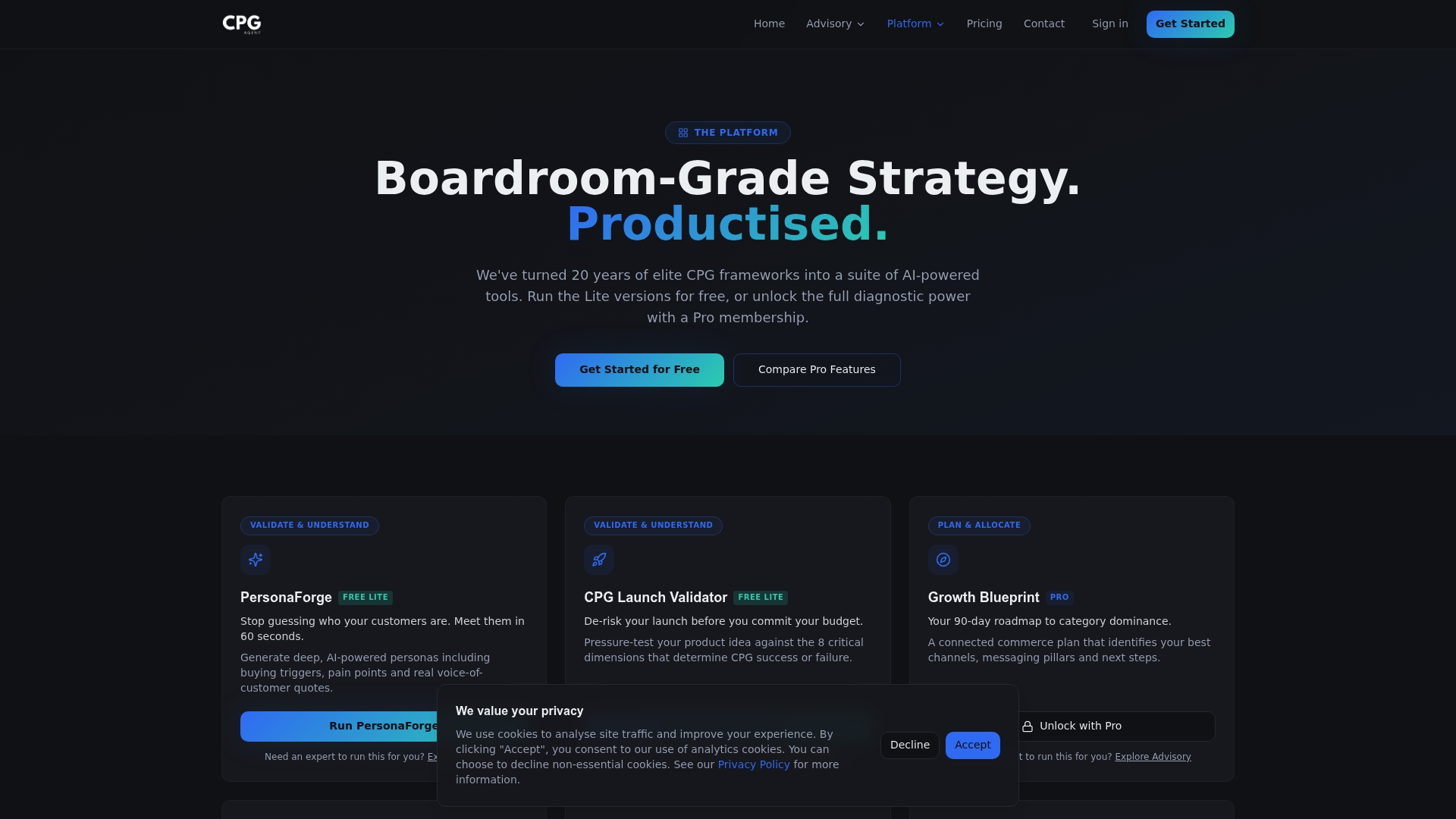
A typical pilot runs on a defined scope: a specific product line, a fixed set of KPIs (CTR, CVR, CPA delta against your current baseline), and a short timeline built for fast iteration rather than a long build-out. Brand inputs, colors, tone, and product assets feed directly into generation, and finished creative publishes through connected ad accounts so testing starts without a manual export step slowing things down. Explore the platform to see how the tools map to your current stack, or connect with the team to scope a pilot built around your next product launch or seasonal push.
Sources
For a deeper look at the strategic shifts driving AI adoption in advertising, BCG's analysis of the AI attention stack covers governance and workflow priorities. StackAdapt's practical guide breaks down creative scoring and platform integrations in more detail. For the research behind human-AI collaboration and disclosure effects, see the special issue on generative AI in advertising, and for adoption trends across agencies, CNBC's reporting is worth a full read.
- How AI is reshaping modern advertising — BCG X
- AI in advertising: How to use it the right way in 2026 — StackAdapt
- Selected studies on generative AI and advertising (special issue)
- How AI is disrupting the advertising industry — CNBC
FAQ
Is AI Ad Creative Legit?
Yes, when paired with human review. Platforms reliably produce usable images, video, and copy at scale, but Research reviewing generative AI in advertising found human-AI collaboration consistently outperforms AI-only output, so legitimacy depends on the workflow around the tool, not the tool alone.
What Is AI Ad Creative?
AI ad creative refers to images, short-form video, and ad copy generated by machine learning models trained on advertising and visual data, typically produced in batches for A/B testing across ad platforms like Meta and TikTok.
How Much Does AdCreative AI Cost?
Pricing varies by vendor and tier and isn't publicly standardized across the category, so request current pricing directly from any platform you're evaluating rather than relying on a generic figure.
What Is the Best AI Ad Creative Platform?
There's no single best platform. It depends on your format needs, ad-account integrations, and governance requirements. For CPG and FMCG brands specifically, a platform that connects persona research and launch validation directly to creative generation, the approach Cpgagent takes, tends to produce more relevant output than a generic creative tool used in isolation.
Do I Need to Disclose AI-Generated Ad Creative?
Disclosure isn't universally mandated, but it strongly affects trust. Research on generative AI in advertising found that consumer trust drops when AI involvement in a testimonial-style ad goes undisclosed and later becomes apparent, so disclosing synthetic content is the safer default for brand safety.