

Legacy CPG SKUs lose shelf relevance when declining store-level sell-through, supply failures, and portfolio complexity combine to make a brand less economically attractive to retailers than the alternatives filling the same slot. The fix starts before the next buyer meeting. Five actions to take now:
- Run a store-level audit this week. Pull POS data by store, not just by DC shipment. Identify which doors are underperforming and flag them for field visits. Success in 30 days: a ranked list of at-risk stores with root causes assigned.
- Fix your worst OTIF failures immediately. Retailers track on-time, in-full delivery and act on it. One chronic stockout can trigger a facing reduction faster than any sales conversation can reverse it. Success in 60 days: OTIF above your retailer's threshold, documented.
- Call your buyer before the scorecard does. Proactive outreach with corrective data beats a reactive conversation after a delisting notice. Success in 30 days: a remediation meeting booked with supporting sell-through data in hand.
- Run a packaging blink test in-store. Stand six feet from your facing and look for three seconds. If your SKU disappears into the shelf, shoppers are doing the same thing. Success in 60 days: a redesign brief or a shelf-blocking fix in market.
- Cut your tail SKUs from the conversation. If you can't defend a SKU's velocity to a buyer, retire it before the buyer does it for you. Success in 90 days: a rationalized assortment with transferable demand modeled before any cuts.
Key Takeaways
Legacy brands lose shelf relevance when store-level performance, supply reliability, and portfolio economics fail simultaneously, and the brands that recover fastest are the ones monitoring all three continuously.
| Point | Details |
|---|---|
| Delisting risk is continuous | NIQ's analysis shows vulnerability is persistent; treat it like customer churn, not an annual event. |
| Store-level data beats DC reporting | Pull POS by door weekly; a 10% week-over-week drop in top doors is your earliest delisting signal. |
| OTIF failures cost facings fast | Chronic supply misses register on retailer scorecards before your monthly report catches them. |
| SKU rationalization needs demand modeling | Tellius research shows 70–83% of SKUs in many categories contribute negligible sales; cut with data. |
| Cpgagent accelerates the defense | Real-time alerts, demand modeling, and fractional CMO advisory stop delistings before the scorecard arrives. |
Table of Contents
- Why do legacy brands lose shelf relevance?
- What metrics should you monitor to catch shelf risk early?
- What should you do in the first 90 days to stop delistings?
- What strategic moves rebuild shelf relevance over 6–24 months?
- How do modern data tools reduce your delisting risk?
- What do real failure cases teach you?
- Your operational checklist for this week
- Delisting churn is a continuous threat, not a one-time event
- How retailers decide which brands earn their shelf space
- How shifting consumer preferences erode legacy brand appeal
- Why legacy brands often lose the pricing battle against emerging competitors
- How to build retailer partnerships that survive line reviews
- How e-commerce and omnichannel shifts affect your in-store facings
- The shelf is a daily competition, not an annual negotiation
- Cpgagent gives you the shelf-defense infrastructure to act before the scorecard does
- Sources
- FAQ
Why do legacy brands lose shelf relevance?
NIQ's delisting analysis confirms that delisting vulnerability varies by category and SKU, and that the risk is persistent, not episodic. Six operational and market causes drive most of it.
-
Assortment bloat. Tellius research on assortment optimization shows that in many categories, 70–83% of SKUs contribute a negligible share of sales. Every low-velocity SKU occupies a slot a retailer could give to a faster mover. Diagnostic question: Can you defend each SKU's velocity in writing to your buyer today?
-
Supply and OTIF failures. Chronic stockouts and missed delivery windows register directly on retailer scorecards. Brands that wait for monthly reports to discover fill-rate problems are already behind. Diagnostic question: What is your OTIF rate by account, and is it above each retailer's stated threshold?
-
Packaging that fails the blink test. DesignX's packaging analysis makes the point plainly: design that works on a DTC website often disappears on a crowded retail shelf, where shoppers scan rather than read. Diagnostic question: Does your packaging communicate the product's benefit in under three seconds from six feet away?
-
Digital-native competitors breaking purchase habits. Wharton's reporting on legacy brand abandonment cites Gillette as a case study: Dollar Shave Club reached men directly, changed the replenishment habit, and eroded Gillette's in-store velocity before traditional tracking caught the shift. Diagnostic question: Which of your categories has a direct-to-consumer insurgent with a subscription model?
-
Retailer scorecard pressure and private-label growth. Improved private-label quality gives retailers a credible alternative to national brands in most categories. An underperforming legacy SKU is now competing against a house brand the retailer profits from more. Diagnostic question: What is your velocity premium over the private-label equivalent in each account?
-
Slow innovation and speed-to-market. Tighter VC funding and reduced new product launches, as tracked by Inc.'s reporting on supermarket shelf dynamics, have compressed the window brands have to respond to category shifts. Legacy brands that run annual innovation cycles are already a year behind.
What metrics should you monitor to catch shelf risk early?
The gap between ship-to-DC and in-aisle reality is where most legacy brands get surprised. Circana's guidance for lean teams recommends retailer-aligned, simplified reporting over exhaustive data libraries, because curated store-level signals materially improve a brand's ability to defend facings.
| Metric | Leading or Lagging | Recommended Cadence |
|---|---|---|
| Store-level sell-through | Leading | Daily sampled, weekly rollup |
| OTIF / fill rate by account | Leading | Weekly by DC lane |
| ACV distribution | Lagging | Monthly account review |
| Facings per store | Lagging | Monthly field audit |
| Promotional incrementality | Leading | Per event, within 2 weeks |
| Buyer scorecard score | Lagging | Per scorecard cycle |
| TDP (total distribution points) | Lagging | Monthly |
Weekly report template to implement now:
- Metric: Store-level sell-through for top 20 doors
- Delta vs. baseline: Week-over-week change, flagged if down more than 10%
- Action owner: Field sales or broker rep
- Next step: Store visit or buyer call within 48 hours
Buyer-facing metrics (sell-through, OTIF, incrementality) belong in every retailer conversation. Internal escalation metrics (fill rate by lane, DC receipts vs. in-aisle scans) belong in ops reviews.
What should you do in the first 90 days to stop delistings?
A time-ordered triage keeps commercial, supply, and brand teams from working in parallel without coordination.
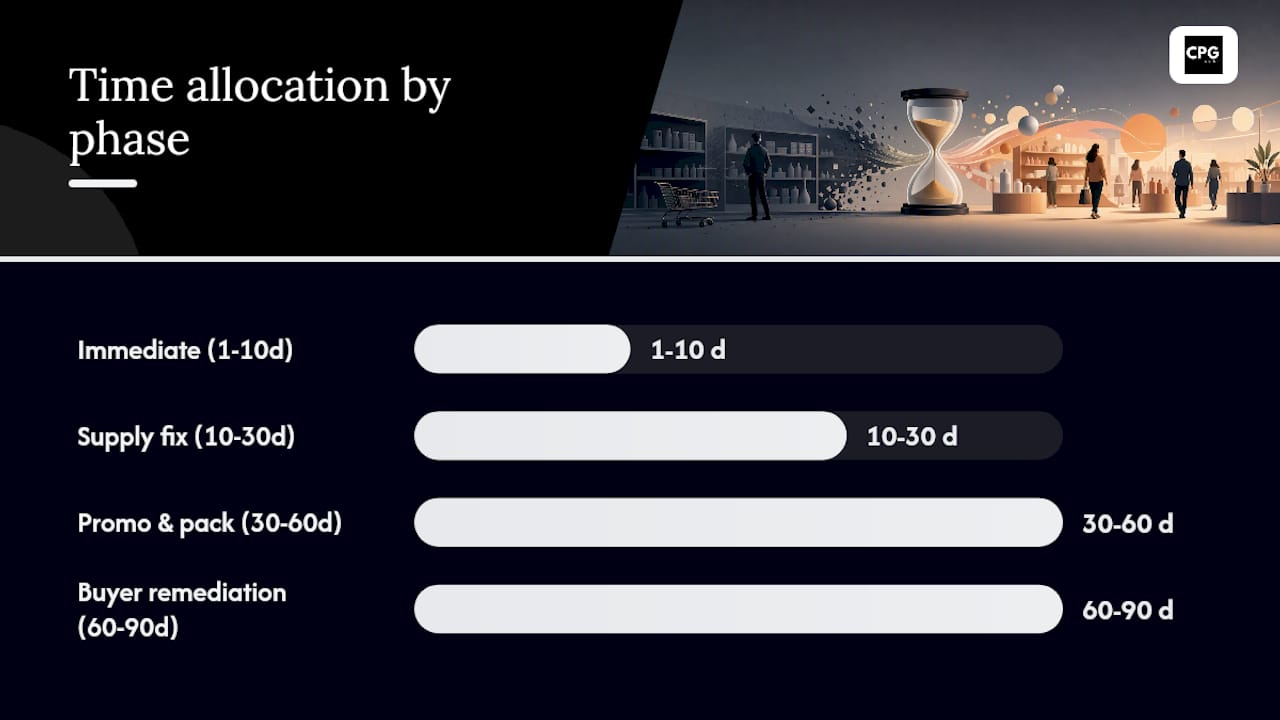
- Days 1–10 (Immediate): Pull store-level POS for your top 50 doors. Flag any store below 80% of baseline velocity. Schedule field visits. Owner: field sales / broker.
- Days 10–30 (Supply fix): Identify the three accounts with the worst OTIF scores. Assign a supply-chain owner to each. Commit to a corrective timeline in writing before the next scorecard cycle. Owner: supply chain.
- Days 30–60 (Promo and packaging): Run a targeted promotional window in your weakest doors. Simultaneously, run a packaging blink test in-store and brief design on any clarity fixes that can be executed without a full redesign. Owner: brand and commercial.
- Days 60–90 (Buyer remediation): Book a remediation meeting with each at-risk buyer. Bring store-level sell-through data, your corrective OTIF actions, and a short-term test proposal. Owner: commercial lead.
Buyer talking points for urgent conversations:
- Here is our store-level sell-through data for your banner, by door
- Here is what caused the OTIF gap and what we have already fixed
- Here is the promotional test we are proposing and the lift we expect
- Here is the SKU we are retiring to simplify your assortment
Trade spend reallocation: redirect funds from broad national promotions to targeted in-store support in your weakest doors. Frame the ROI to the buyer as velocity recovery per facing, not total brand spend.
Pro Tip: The single most effective thing you can bring to an emergency buyer meeting is store-level sell-through data the buyer does not already have. It shifts the conversation from defense to collaboration.
What strategic moves rebuild shelf relevance over 6–24 months?
Short-term triage stops the bleeding. These moves rebuild the position.
- Portfolio simplification with transferable demand modeling. Before retiring any SKU, model where its volume goes. Tellius's assortment analysis shows that traditional periodic reviews miss this step, and rationalization without it hands slots to private label.
- Packaging redesign for shelf blocking. A legacy brand identity refresh that accounts for in-aisle adjacency and lighting conditions outperforms a DTC-first redesign every time. Budget 6–9 months for a full redesign cycle.
- Innovation cadence. Commit to at least one new SKU test per year per category. Retailers reward brands that bring them news.
- Omnichannel alignment. Your DTC and e-commerce data should feed your retail strategy, not run separately. Shopper behavior online predicts in-store demand shifts 4–8 weeks out.
- Sustainability alignment where buyers require it. Several major U.S. retailers now score suppliers on sustainability commitments. Know your buyer's specific criteria before your next line review.
How do modern data tools reduce your delisting risk?
The brands that catch shelf risk earliest are the ones reading store-level signals, not DC receipts. The core data sources to integrate:
- Store-level POS (not just ship-to-DC)
- Syndicated POS from NIQ or Circana, retailer-aligned
- Retailer analytics portals (Walmart Luminate, Kroger 84.51°)
- DC receipts cross-referenced against in-aisle scan data
- Social and voice-of-consumer signals for early trend detection
Platform capabilities that materially reduce risk: real-time store-level alerts, OTIF dashboards by account, automated buyer-outreach playbooks, and trend-signal fusion across structured and unstructured data. Cpgagent's AI strategy platform maps directly to this checklist, with tools for store-level sell-through monitoring, transferable-demand modeling, and pitch-ready retail decks that compress the decision window from quarterly reviews to weekly intervention cycles.
Statistic to anchor your case internally: Circana's Liquid Data Essentials program demonstrates that retailer-aligned, curated reports give lean teams the same evidence base as enterprise brands, without the data-library overhead.
What do real failure cases teach you?
Gillette vs. Dollar Shave Club. Gillette's in-store velocity eroded before traditional monthly tracking flagged the shift. The lesson: monitor subscription and DTC competitors' growth rates as a leading indicator for your own in-store velocity. Next step: identify every DTC subscription brand in your category and track their estimated subscriber counts quarterly.
Sears and the curator role. Sears lost its position as a trusted retail curator by failing to rationalize its assortment as consumer expectations shifted. Retailers that curate win; brands that help them curate win too. Next step: bring your buyer a SKU rationalization proposal before they ask for one.
Kohl's adapting legacy advantages. Kohl's preserved relevance by leaning into its loyalty data and store footprint while adapting its assortment mix. The operational lesson: legacy assets (distribution, loyalty, store presence) are advantages only if the assortment and supply performance support them. Next step: audit which of your legacy distribution advantages are actively defended by current performance data.
Small CPG losing a regional account. A mid-size brand lost H-E-B placement after two consecutive quarters of OTIF failures. The buyer's scorecard flagged the issue; the brand's internal reporting did not. Next step: set up a weekly OTIF alert by account before your next scorecard cycle.
Your operational checklist for this week
- Store audits scheduled for bottom 20% of doors — Owner: field sales
- OTIF rate pulled by account and compared to each retailer's threshold — Owner: supply chain
- Top 10 at-risk SKUs flagged by velocity delta — Owner: analytics
- Packaging blink test completed in at least two store environments — Owner: brand
- Buyer outreach scheduled for each at-risk account — Owner: commercial lead
- SKU rationalization list drafted with transferable demand noted — Owner: analytics + commercial
Pro Tip: *If you can only watch one metric this week, watch store-level sell-through by door.
Delisting churn is a continuous threat, not a one-time event
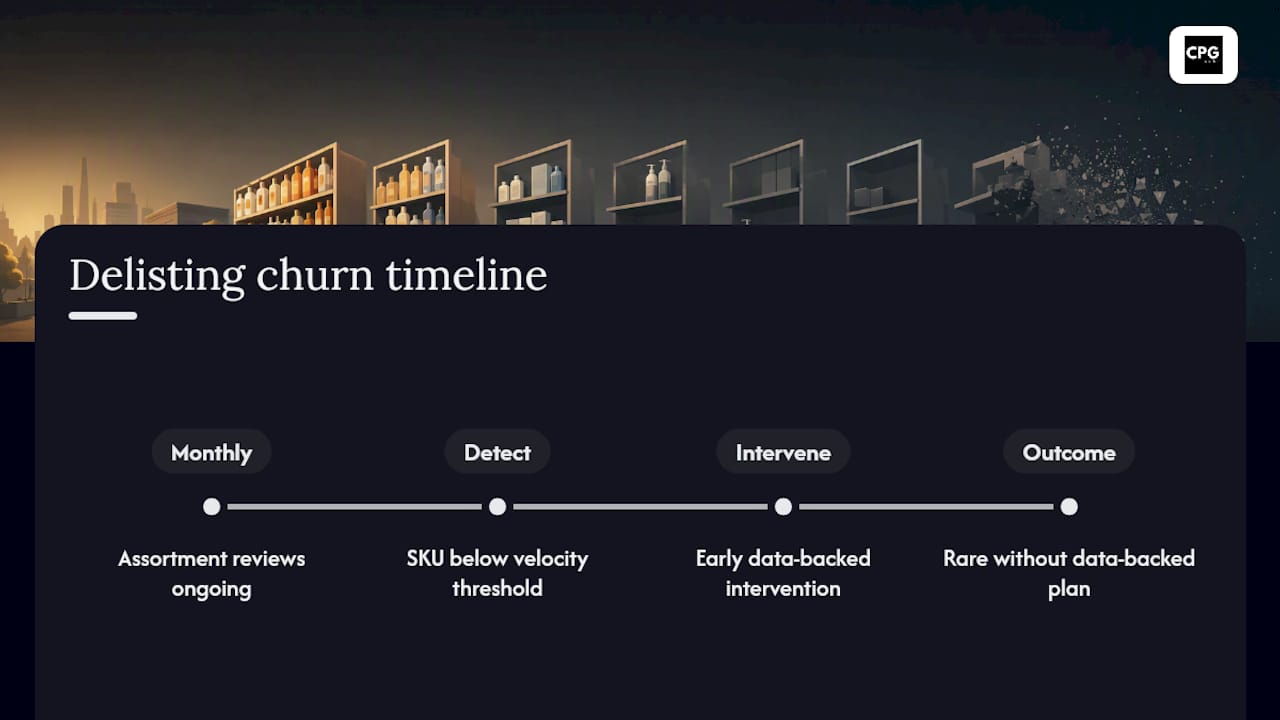
NIQ's category-level delisting analysis shows that vulnerability is structural and persistent across most CPG categories. Brands that treat delisting risk as something to address at annual line reviews are already behind the retailers who review assortment performance monthly or faster. The right mental model is customer churn: continuous monitoring, early intervention, and proactive remediation. A SKU that slips below a retailer's velocity threshold rarely recovers without a deliberate, data-backed intervention plan.
How retailers decide which brands earn their shelf space
Retailers are curators, not warehouses. Every facing represents a capital allocation decision, and buyers are evaluated on category velocity, margin, and assortment freshness. A legacy brand that cannot demonstrate store-level velocity growth, reliable supply, and a credible innovation pipeline is competing against private-label alternatives that deliver higher margin with less complexity. The brands that win long-term buyer relationships bring evidence: store-level sell-through by banner, pilot results, and a clear SKU architecture that makes the buyer's job easier, not harder.
How shifting consumer preferences erode legacy brand appeal
Consumer preferences in U.S. grocery and mass retail have shifted faster in the past five years than in the previous two decades. Health, transparency, sustainability, and cultural relevance now influence purchase decisions in categories that were once purely functional. Legacy brands built on broad demographic appeal often find their positioning too generic to win with any specific shopper segment. The Wharton analysis of legacy brand abandonment frames this as a habit-breaking problem: once a shopper switches to a brand that feels more aligned with their values, the legacy brand's in-store presence becomes invisible rather than reassuring.
Why legacy brands often lose the pricing battle against emerging competitors
Emerging brands frequently enter at a premium, not a discount, which disrupts the assumption that legacy scale equals pricing power. A new functional beverage brand can command $4.99 at Whole Foods while a legacy brand's equivalent sits at $2.49 and still loses velocity. The dynamic works in reverse at value retailers: private label has closed the quality gap enough that legacy brands can no longer rely on a modest price premium to signal superiority. The brands that hold their position price against demonstrated value, supported by store-level velocity data that proves shoppers are choosing them at the current price point.
How to build retailer partnerships that survive line reviews
The brands that survive line reviews are the ones whose buyers trust them as category partners, not just suppliers. That trust is built through three habits: bringing data the buyer does not already have (store-level sell-through by door), proposing tests rather than defending the status quo, and delivering on every commitment made in the previous meeting. Proactive SKU rationalization, offered before the buyer asks, signals that you understand their economics. A retail placement playbook that includes pilot proposals and clear success metrics gives buyers a low-risk way to say yes.
How e-commerce and omnichannel shifts affect your in-store facings
Online grocery and omnichannel retail have changed the economics of in-store shelf space in two ways. First, a brand's online search ranking and ratings now influence in-store purchase decisions, because shoppers research online before buying in-store. Second, retailers use online sales data to inform in-store assortment decisions, which means a weak digital presence can directly cost you physical facings. Legacy brands that treat e-commerce as a separate channel from retail are missing the feedback loop that now connects both. Re-engagement tactics for legacy brands that work across both channels tend to outperform single-channel approaches in sustained velocity.
The shelf is a daily competition, not an annual negotiation
Most legacy brands treat shelf relevance as something to defend at line reviews. That framing is the problem. Retailers review performance continuously, and the brands that keep their facings are the ones whose data tells a consistent story between reviews, not just at them. The operational discipline required is closer to supply-chain management than brand marketing: daily signals, weekly interventions, monthly account reviews, and a cross-functional team that owns the metrics together. The brands I see recover fastest are the ones that stop waiting for the scorecard and start building their own version of it first.
Cpgagent gives you the shelf-defense infrastructure to act before the scorecard does
Losing facings is rarely sudden. The signal is in the store-level data weeks before the buyer's call. Cpgagent's AI strategy platform gives marketing leaders and product managers the tools to catch it: real-time store-level sell-through alerts, transferable-demand modeling before SKU cuts, and pitch-ready retail decks that compress buyer conversations from hours to minutes. For brands facing urgent remediation, Cpgagent's fractional CMO advisory puts a senior commercial operator in your corner within days, not months. No long agency retainer, no discovery phase. Visit Cpgagent to see the platform or book a fractional advisory call.
Sources
- In which categories are items most vulnerable to being delisted? - NIQ
- Customers abandon legacy brands - Wharton Knowledge
- How lean teams can compete like larger brands - Circana
- Assortment optimization for CPG | Tellius
- CPG Brand Design: Why Your Packaging Is Losing Shelf Space - DesignX
FAQ
Why do legacy brands lose shelf relevance faster now than before?
Retailers review assortment performance more frequently, private-label quality has improved, and digital-native competitors break shopper habits before traditional tracking catches the shift. The window to respond has compressed from years to months.
What is the single most important metric to monitor for delisting risk?
Store-level sell-through by door is the leading indicator that matters most. A consistent drop in your top 20 doors signals a delisting conversation before any scorecard does.
How does OTIF affect shelf facings?
Retailers score suppliers on on-time, in-full delivery and use those scores in assortment decisions. Chronic OTIF failures can trigger facing reductions or delistings faster than any sales conversation can reverse.
What does transferable demand modeling mean for SKU cuts?
Before retiring a SKU, you model where its volume goes: to another SKU you own, to a competitor, or to private label. Cutting without that analysis often hands the slot to a brand you cannot recover from.
How can Cpgagent help brands stop delistings?
Cpgagent's platform provides real-time store-level alerts, transferable-demand modeling, and buyer-ready retail decks, plus fractional CMO advisory for brands that need senior commercial support immediately.