

TL;DR:
- A brand operating model is a live, connected system that governs brand decisions, strategies, and assets across organizations for consistent execution. It encompasses design tokens, voice rules, governance frameworks, and exception policies, enabling brands to scale coherently across channels and markets. Unlike static guidelines, it facilitates agility, governance, and coherence, especially crucial in AI integration and multi-market environments.
A brand operating model is the connected live system of decisions, rules, and governance that enables teams to produce one coherent brand at speed across every channel and touchpoint. Unlike a static brand book or a PDF style guide, it functions as living infrastructure that integrates strategy, design, and daily operations through continuous governance loops. Brand strategists increasingly call this a Brand Operating System, or BrandOS. The distinction matters: a brand guideline tells people what the brand looks like; a brand operating model tells the entire organization how to build it, govern it, and evolve it without losing coherence.
What is a brand operating model, exactly?
A brand operating model is defined as the governed, iterative infrastructure that connects brand strategy to execution across marketing, product, and content teams. The industry term most commonly used is Brand Operating System (BrandOS), and the two phrases describe the same concept from slightly different angles. "Brand operating model" emphasizes organizational structure and governance; "BrandOS" emphasizes the technical and systemic architecture. Both refer to the same foundational idea: brand delivery as a system, not a project.

The critical difference from traditional brand guidelines is operational. A PDF style guide is a reference document. A brand operating model is a live system used daily by marketing, product, and content teams to make brand decisions, resolve conflicts, and ship work that is on-brand by default. It removes the negotiation that happens when rules exist separately from the assets and tools people use to execute.
For CPG and FMCG brands specifically, this distinction is not academic. When you are managing dozens of SKUs across retail, e-commerce, and social simultaneously, a static brand guide creates bottlenecks. A brand operating model embeds rules with assets, making building on-brand the path of least resistance rather than a discipline act that requires someone to check a PDF first.
What are the key components of a brand operating model?
A brand operating model contains layered components, where higher layers govern lower ones. The foundational layer is purpose, positioning, and voice. Every downstream decision about typography, color, motion, and component design must be traceable back to that foundation. When a contradiction appears at a lower layer, it signals a defect in the system that can be detected through audits.
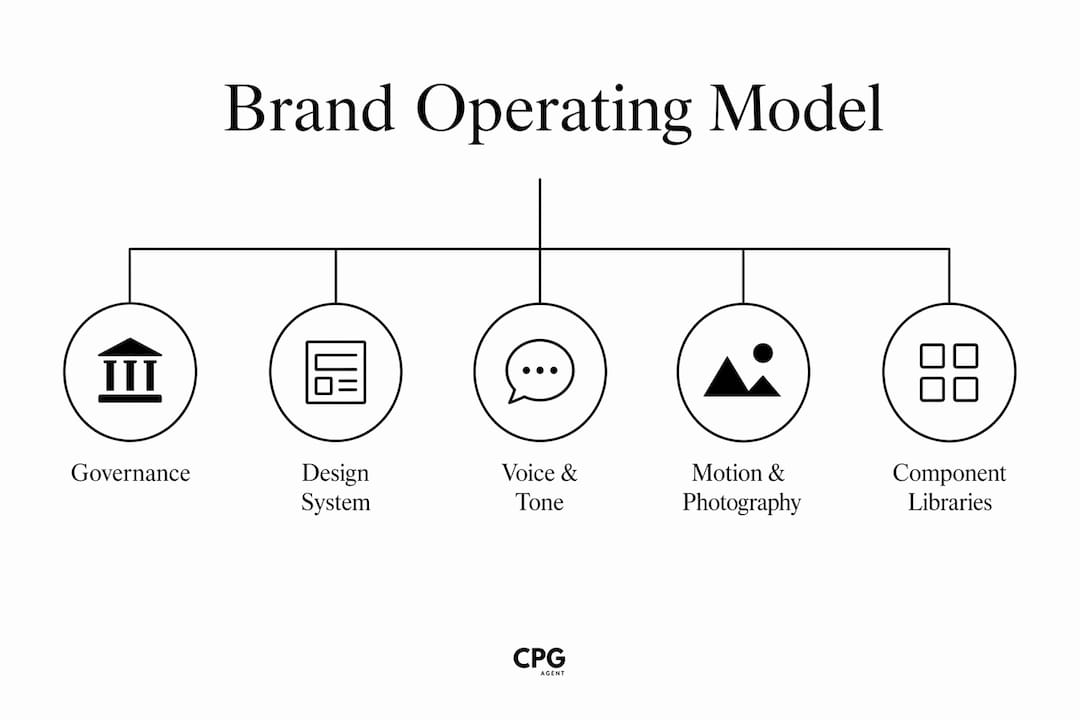
The core components of a well-structured BrandOS include:
- Design tokens: The atomic values for color, spacing, and typography that feed every digital and physical asset
- Component libraries: Pre-built, on-brand UI and creative elements that teams pull from rather than recreate
- Voice and tone rules: Explicit guidelines for language, not just adjectives but sentence structure, reading level, and channel-specific variations
- Motion and photography principles: Rules governing how the brand moves and what visual worlds it inhabits
- Packaging and presentation standards: Physical brand expression governed by the same system as digital
- Governance model: The decision rights framework that specifies who approves what, who resolves exceptions, and how the system evolves
The full scope of a BrandOS extends well beyond a design system. A design system handles digital UI components. A brand operating model governs identity, voice, photography, motion, packaging, presentations, events, and the governance layer that holds all of it together.
Pro Tip: Map your current brand assets against these six component categories. Any category without explicit rules and a named decision owner is a gap in your operating model, not just a gap in your guidelines.
How does a brand operating model differ from a general operating model?
An operating model, as defined by McKinsey, is the backbone that translates strategy into daily execution. It covers governance, decision-making, processes, technology, leadership, and delivery of value. McKinsey identifies 12 interacting elements that together produce organizational clarity and speed. A brand operating model applies this same logic to a specific domain: brand delivery.
The table below shows where the two models overlap and where brand operating models add unique layers.
| Dimension | General operating model | Brand operating model |
|---|---|---|
| Primary purpose | Translate strategy into execution | Translate brand strategy into coherent brand experiences |
| Governance focus | Organizational decision rights | Brand decision rights and exception handling |
| Core assets | Processes, technology, people | Design tokens, voice rules, component libraries, identity systems |
| Measurement | Operational KPIs | Brand coherence, speed to market, channel consistency |
| Evolution trigger | Business strategy change | Market, product, or organizational change |
The practical implication is that a well-designed operating model delivers clarity, speed, and alignment. A brand operating model delivers those same benefits specifically for brand execution. For brand strategists, this framing is useful because it positions brand governance as a legitimate organizational design problem, not just a creative quality control issue. That shift in framing tends to unlock executive support and budget.
What operational frameworks guide brand governance decisions?
The most practical framework for brand governance is "operate vs. orchestrate." This framework describes two distinct modes of brand control. Operating means the central brand team owns the rules and executes tightly. Orchestrating means the central team sets guardrails and incentives while enabling local partners or regional teams to act autonomously within those boundaries.
Neither mode is universally correct. The right choice depends on context:
- Choose operate when consistency is non-negotiable, such as global brand campaigns, packaging across retail channels, or brand identity at launch. Central control prevents drift and protects equity.
- Choose orchestrate when local nuance drives performance, such as regional social content, market-specific promotions, or channel-specific creative adaptations. Tight central control here creates bottlenecks without proportional brand benefit.
- Design hybrid models for brand portfolios with both global and local requirements. The central team operates core identity elements while orchestrating execution at the market or channel level.
- Build exception policies into the governance model explicitly. Formal exception handling specifies when local teams can override global brand policies, what data they need to justify the exception, and who reviews it. Without this, exceptions become the norm and brand coherence fractures.
Brand orchestration is not abdication. It deliberately designs rules and incentives so local teams act coherently within a shared system. The goal is autonomy with consistency, not autonomy instead of consistency. For CPG brands managing multiple markets or retail partners, this distinction determines whether your brand scales or splinters.
Pro Tip: Audit your last 20 brand exceptions. If more than 30% were approved without a documented rationale, your exception policy is not functioning as governance. It is functioning as a workaround.
How to create a brand operating model that actually works
Building a brand operating model starts with governance design, not asset creation. The most common failure mode is investing in a design system or brand refresh without defining who makes brand decisions and how exceptions are handled. A RACI chart alone is insufficient because it tells you who executes tasks, not who drives brand decisions. Frameworks like DACI or RAPID are better suited to brand governance because they explicitly assign decision authority.
The process for building an effective model follows a continuous loop rather than a linear project:
- Diagnose: Audit current brand assets, identify gaps in components, and map where brand decisions are being made informally
- Define: Establish the layered decision stack, from purpose and positioning down to component and template rules, with explicit owners at each layer
- Design: Build the infrastructure, including design tokens, component libraries, voice rules, and governance documentation, as a connected system rather than separate deliverables
- Activate: Onboard teams with the system as their working environment, not as a reference document they consult occasionally
- Govern: Implement decision rights frameworks, exception policies, and regular system audits to catch contradictions before they compound
- Optimize: Iterate the model in response to market changes, product launches, and organizational restructuring, treating the brand operating model as infrastructure that evolves rather than a project that concludes
One layer that CPG and FMCG brands cannot ignore in 2026 is AI signal control. When brand guidance lacks governed infrastructure, AI tools fill the gaps with variable brand interpretations. Generative AI tools used by your marketing team, your retail partners, or your agencies will produce on-brand output only if the brand operating model provides explicit, machine-readable rules. This is not a future consideration. It is a current operational gap for most brands.
For brands at earlier stages, lean brand strategy frameworks offer a practical starting point before building a full BrandOS. The key is to design for iteration from day one rather than treating the initial model as a finished system. Brands that undergo a strategic pivot also need a governance process for updating the operating model itself, not just the brand assets.
Key takeaways
A brand operating model is the governed live infrastructure that connects brand strategy to execution, replacing static guidelines with a system that scales, adapts, and maintains coherence across every channel.
| Point | Details |
|---|---|
| Definition clarity | A brand operating model is a live governance system, not a style guide or PDF reference document. |
| Core components | Every model requires design tokens, voice rules, component libraries, and explicit decision rights. |
| Operate vs. orchestrate | Central control suits consistency; local autonomy suits speed. Hybrid models serve most CPG brands. |
| Governance over assets | Define who makes brand decisions before building the design system, not after. |
| AI-era requirement | Ungoverned brand infrastructure produces variable AI output. Explicit, machine-readable rules are now mandatory. |
Why most brand teams are solving the wrong problem
Most brand teams I work with have invested heavily in brand assets and almost nothing in brand governance. They have beautiful design systems, detailed voice guidelines, and comprehensive photography libraries. What they do not have is a clear answer to the question: who decides when the rules conflict, and what happens when a market team needs an exception?
That gap is where brand coherence breaks down. Not in the assets. In the decision rights. I have seen brands with world-class design systems produce wildly inconsistent work across channels because no one owned the governance layer. The design system existed as a reference. The brand operating model did not exist at all.
The other pattern I see consistently is treating the brand operating model as a one-time build. Organizations invest in a BrandOS project, ship it, and then treat it as done. Eighteen months later, the system is out of date, teams have reverted to workarounds, and the brand looks fragmented again. Treating branding as infrastructure rather than a deliverable changes the organizational commitment required. Infrastructure gets maintained, updated, and funded on an ongoing basis. Projects get closed.
The AI dimension makes this more urgent, not less. If your brand operating model does not include explicit controls for how AI tools interpret and apply your brand, you have already lost some control of your brand signal. The brands that will maintain coherence at scale are the ones that build governance into the system before the gaps get filled by tools making their own interpretations.
— Matthew
How Cpgagent helps you build a live brand operating system
CPG and FMCG brands need more than guidelines. They need a system that ships brand decisions at the speed of the market. Cpgagent is built for exactly that. The Cpgagent platform integrates AI-driven strategy tools, automated workflows, and fractional leadership advisory to help you design, activate, and govern a brand operating model that scales without losing coherence.
Whether you are building a brand operating model from scratch or modernizing a legacy system that has drifted, Cpgagent eliminates the overhead of traditional agency discovery phases. You get rapid, data-backed infrastructure that connects your brand strategy to daily execution, with governance built in from the start. For brands that need to stay ahead on the shelf, that speed is the competitive advantage. Explore how Cpgagent's tools can replace your static brand guidelines with a live operating system.
FAQ
What is a brand operating model in simple terms?
A brand operating model is the system that governs how an organization produces consistent brand experiences across all channels. It combines design assets, voice rules, decision rights, and governance into one connected infrastructure rather than a collection of separate documents.
How does a brand operating model differ from brand guidelines?
Brand guidelines are reference documents. A brand operating model is a live system that embeds rules with assets, assigns decision authority, and includes governance processes for handling exceptions and evolving the model over time.
What are the core components of a brand operating model?
The core components include design tokens, component libraries, voice and tone rules, motion and photography principles, packaging standards, and a governance model that specifies who makes brand decisions and how exceptions are managed.
Why do CPG brands need a brand operating model?
CPG brands managing multiple SKUs, channels, and markets cannot maintain coherence through static guidelines alone. A brand operating model scales brand delivery by making on-brand execution the default, reducing bottlenecks and preventing drift across retail, e-commerce, and social channels.
What is the "operate vs. orchestrate" framework in brand governance?
Operate means the central brand team owns and executes brand rules tightly. Orchestrate means the central team sets guardrails while enabling local teams to act autonomously within them. Most CPG brands use a hybrid of both depending on the channel and market context.