
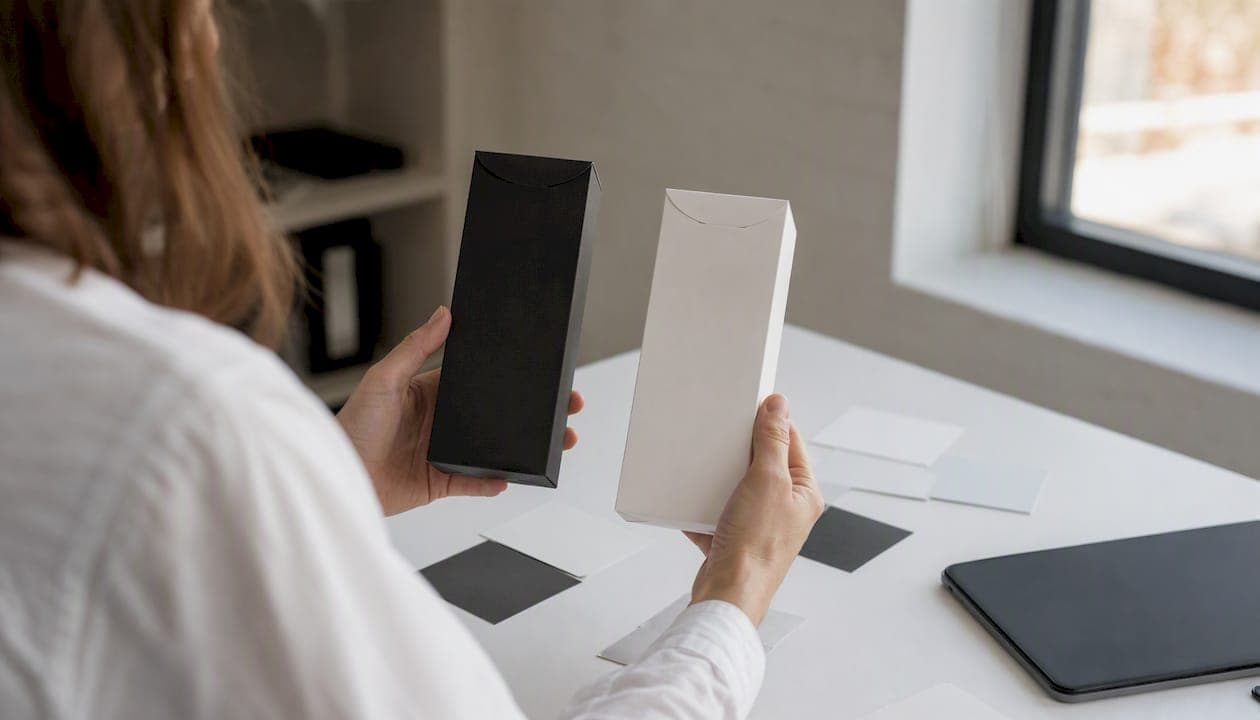
Run two mockups that differ by exactly one variable, recruit at least 100 respondents for an online choice test, and set your go/no-go threshold before you collect a single response. That is the fastest, lowest-cost way to run an FMCG A/B test on packaging. Industry practice splits this into two stages: a "test to learn" round early to explore and form hypotheses, then a "test to win" round later to confirm the winner before committing to a full production run. Skip the first stage and you are betting a print run on internal opinion.
- Build two mockups that differ by one prioritized variable (color, claim hierarchy, or dispensing mechanism).
- Recruit n≥100 for an online choice test, or n≥200 for a discrete-choice experiment.
- Pre-register your primary KPI and significance threshold before launch.
- Check any label claim changes against FDA labeling regulations before fielding.
Pro Tip: Register your primary metric and decision rule in a shared doc before you run the test. Teams that set the threshold afterward almost always move the goalposts.
Key Takeaways
Running a packaging A/B test well requires one variable per round, a pre-registered decision rule, and a sample matched to the effect size you need to detect.
| Point | Details |
|---|---|
| Test one variable per round | Changing two variables at once makes results uninterpretable; isolate the primary variable every time. |
| Sample size drives reliability | Use n≥100 per arm for online A/B tests; n≥200 for discrete-choice experiments to detect meaningful effects. |
| Stage your fidelity | Start with digital mockups for visual tests, then escalate to functional samples and pilot runs only for variables that survive. |
| Pre-register your threshold | Set the go/no-go rule (e.g., ≥5 pp lift at p<0.05) before fielding the test, not after seeing results. |
| Cpgagent operationalizes the process | The platform provides pre-built KPI templates, automated randomization, and fractional CMO support to run tests faster. |
Table of Contents
- Why does packaging A/B testing matter for FMCG brands?
- What packaging variables should you actually test?
- How do you design and run a packaging A/B test step by step?
- Which prototype fidelity and test mode fit your goal?
- Which metrics actually tell you if your packaging is working?
- How large does your sample need to be?
- What do timelines, costs, and common pitfalls look like?
- When do advanced methods like VR, eye-tracking, and EEG pay off?
- What the data actually teaches you about running packaging tests
- Cpgagent cuts the time from mockup to validated winner
- Sources
- FAQ
Why does packaging A/B testing matter for FMCG brands?
A packaging decision that looks right in a design review can fail badly on shelf. Shoppers make purchase decisions in seconds, and a color shift or claim repositioning that reads well on a monitor may not stop a hand in a real retail aisle. The cost of finding that out after a 50,000-unit print run is far higher than a $3,000 online panel.
Early qualitative and quantitative testing reduces expensive late-stage changes by surfacing functional and visual issues when they are still cheap to fix. Redesigns validated against actual consumer behavior, rather than internal preference, produce meaningful sales uplifts. The alternative, a single large blind run, gives you one data point and no recovery path.
The right time to run each stage:
- Test to learn (early concept): Three to five design directions, low-fidelity mockups, qualitative sessions plus a small online poll. Goal: eliminate weak directions and form a testable hypothesis.
- Test to win (pre-production): Two to three finalist designs, higher-fidelity samples, quantitative A/B or discrete-choice test. Goal: pick the winner with statistical confidence before tooling or a full run.
Industry finding: Validated redesigns consistently outperform designs approved only through internal review, with uplifts tied directly to whether consumer behavior data, not stakeholder preference, drove the final decision.
What packaging variables should you actually test?
Test one primary variable per round. Changing two things at once makes it impossible to know which drove the result. Here is a prioritized checklist organized by category:
Visual and aesthetic
- Color blocking and background hue
- Hero image or product photography style
- Typography hierarchy (brand name vs. variant name vs. claim)
- Logo size and placement
Structural and functional
- Pack shape or footprint
- Dispensing mechanism (flip cap vs. pump vs. pour spout)
- Reseal or reclosure design
- Material texture or finish (matte vs. gloss)
Messaging and claims
- Front-of-pack callout (e.g., "30% less sugar" vs. "No artificial sweeteners")
- Nutritional emphasis or benefit hierarchy
- Sustainability or origin claims
- QR code placement and call-to-action copy
Experience and unboxing
- Inner liner or tissue presentation
- Unboxing sequence and reveal
- On-pack QR content variants (recipes, sustainability story, loyalty offer)
Structural and functional changes require physical, functional samples, not digital mockups, because perceived ergonomics and usability influence purchase decisions in ways a 2D image cannot fully capture. Visual and messaging variables are well-suited to online concept tests. Start there. Reserve functional samples and pilot runs for the variables that actually survive the first round.
How do you design and run a packaging A/B test step by step?
Follow these five steps in order. Skipping step one is the most common reason teams end up with ambiguous results.
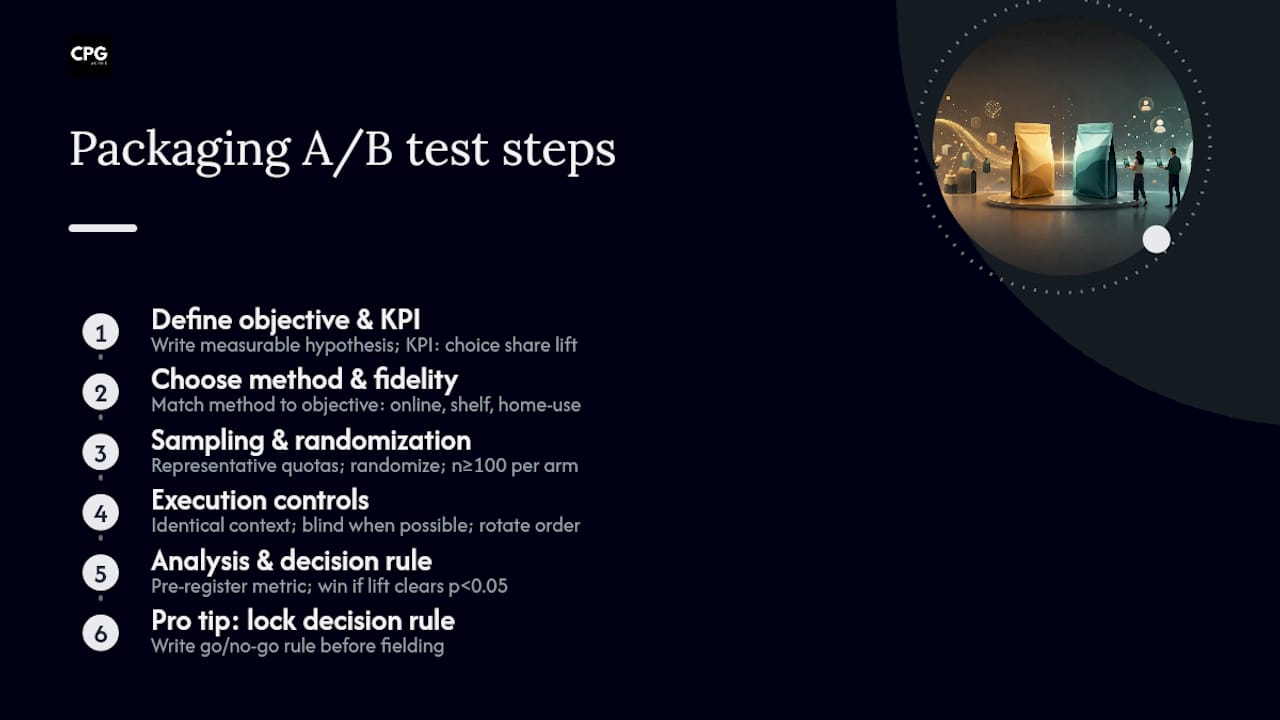
1. Define your objective and primary KPI
Write one measurable hypothesis before anything else. Example: "Changing the front-of-pack claim from 'Natural Ingredients' to 'No Artificial Colors' will increase choice share by at least 8 percentage points among primary shoppers aged 25–44." Your primary KPI is choice share lift. Secondary KPIs (purchase intent rating, first-fixation time) are recorded but do not drive the go/no-go decision.
2. Choose your method and prototype fidelity
Match the method to the objective. Online choice tests work for visual and messaging variables. Shelf simulation or in-store pilots are needed when context (competitive set, lighting, shelf height) is the variable. Home-use trials are required for functional or experience claims. See the prototyping section below for fidelity guidance.
3. Sampling and randomization
Use a representative panel with quotas matching your target buyer profile (age, gender, purchase frequency, geography). Assign respondents randomly to control or test conditions. Capture metadata: device type, completion time, and any open-ended verbatims. For concept testing in FMCG, n≥100 per arm is the floor for detecting coarse effects; n≥200 per arm for discrete-choice designs.
4. Execution controls
Present stimuli in identical context: same shelf environment, same competitive set, same lighting simulation. Blind conditions where possible (no brand name on the test variant) unless brand equity is the variable being tested. Control for order effects by rotating which variant appears first across respondents.
5. Analysis and decision rule
Pre-registered primary metric wins. If choice share lift clears your threshold at p<0.05, proceed to the next fidelity stage or production. If it does not, iterate on the variable before scaling. A result that is directionally positive but underpowered is a signal to increase sample, not to declare a winner.
Pro Tip: Lock the go/no-go rule in writing before you field the test. "We proceed if choice share lift ≥5 pp at p<0.05" leaves no room for post-hoc rationalization when results are close.
Which prototype fidelity and test mode fit your goal?
Prototype fidelity should match what you need to learn, not what looks most impressive in a review meeting. Higher fidelity costs more and takes longer; lower fidelity is faster but misses functional signals.
| Prototype type | Cost range | Turnaround | Best test mode | KPIs supported |
|---|---|---|---|---|
| Digital mockup (2D render) | Low | 1–3 days | Online concept test | Choice share, purchase intent |
| Print mockup (physical flat) | Low–medium | 3 days | Focus group, shelf sim | Visual attention, readability |
| 3D proof / functional sample | Medium | 1–3 weeks | Home-use test, VR shelf | Ergonomics, usability, NPS |
| Low-minimum pilot run | Medium–high | 3 weeks | In-store pilot, unboxing study | Conversion, damage rate, NPS |
Low-minimum orders (some U.S. packaging suppliers offer runs as small as 250–500 units) let you validate final art and structure without committing to full tooling. Pair that with a digital shelf simulation for the visual check and you catch most major errors before an expensive die change.
Connected packaging via on-pack QR or NFC adds a live testing layer: you can A/B test post-scan content variants (recipe vs. sustainability story vs. loyalty offer) and measure engagement and conversion in real time after launch, without reprinting a single unit.
Pro Tip: Run your digital shelf simulation before ordering physical samples. It costs a fraction of a functional sample and eliminates obvious visual failures before you spend on tooling.
Which metrics actually tell you if your packaging is working?
Attention and preference are not the same thing, and confusing them is how teams declare a winner that does not convert.
Primary conversion metrics
- Choice share lift (test vs. control in a forced-choice task)
- Purchase intent score (5-point scale, pre/post exposure)
- Conversion per 100 exposures in a simulated shop
Attention metrics
- First-fixation time: how quickly the pack draws the eye
- Fixation duration: how long attention holds
- Readability score at simulated shelf distance
Operational metrics
- Perceived functionality rating (for structural changes)
- NPS or unboxing sentiment score (for premium or DTC packs)
- Damage and returns rate in pilot runs
Mixed results are common. Higher attention with no conversion lift usually means the pack is visually distinctive but the claim or value proposition is not landing. Run a follow-up qualitative session to diagnose why before iterating. Higher conversion with lower attention suggests the pack works for buyers who find it but may be losing at the awareness stage, a shelf-placement or facings problem, not a design problem.
Benchmark note: Industry practitioners report that packaging changes validated through behavioral testing, rather than internal review alone, consistently produce stronger in-market results, though exact lift figures vary by category, competitive set, and the magnitude of the change being tested.
How large does your sample need to be?
The minimum detectable effect (MDE) determines your required sample, not the other way around. Set the MDE first based on what lift is commercially meaningful, then calculate the sample you need to detect it reliably.
Practical testing protocols recommend n≥100 for online A/B tests and n=200+ for discrete-choice experiments. If you plan subgroup analysis (e.g., by region or shopper segment), multiply those figures by the number of subgroups you intend to compare.
Confidence intervals tell you the range of plausible true effects.
Pro Tip: If budget limits your sample, widen your MDE threshold rather than shrink your sample below n=100 per arm. A test with n=60 per arm is not underpowered — it is uninformative.
Sample-size rule of thumb: For most FMCG packaging A/B tests, n=100 per arm detects effects of 8 percentage points or larger at 95% confidence. Anything smaller requires either a larger sample or a more sensitive method.
What do timelines, costs, and common pitfalls look like?
Typical timeline by phase
| Phase | Duration | Key cost drivers |
|---|---|---|
| Mockup creation and online A/B test | 1–2 weeks | Design time, panel recruitment |
| Functional sample + home-use test | 3–5 weeks | Sample production, recruiter fees |
| Low-minimum pilot run + in-store pilot | 6 weeks | Print run, retail placement, field team |
| Full production scale-up | 8 weeks | Tooling, MOQ, logistics |
Cost ranges in the U.S. vary widely. An online concept test with a 200-person panel typically runs $1,500–$5,000 through self-serve platforms. A moderated home-use test with functional samples can reach $15,000–$40,000. An in-store pilot with retail placement fees adds another $10,000–$30,000 depending on the retailer and number of doors.
Any structural or material change also needs physical performance testing — drop, vibration, compression, and stack tests — to verify integrity during transport before you scale.
Common pitfalls and how to avoid them
- Testing too late: By the time tooling is ordered, changes cost 10x more. Run the first round at the mockup stage.
- Changing multiple variables: Two changes, one result. You will not know which drove it. Test one variable per round.
- Non-representative sample: A panel of 100 college students is not your buyer. Match quotas to your actual shopper profile.
- Ignoring manufacturing scale-up: A winning design that requires a new die or a supplier change can add 12 weeks to your launch. Check scalability before declaring a winner.
- Skipping regulatory review: Any label claim change (nutrition, health, origin) must comply with FDA labeling requirements before the pack goes to print.
When do advanced methods like VR, eye-tracking, and EEG pay off?
Most packaging tests do not need a neuroscience lab. But for large national launches, premium SKUs, or complex structural changes, the additional signal is worth the investment.
VR shelf simulation combined with eye-tracking and mobile EEG can simulate in-store exposure and provide attention and arousal signals that help predict in-market performance. Eye-tracking tells you where attention lands and in what sequence. EEG measures neural arousal, a proxy for emotional engagement that self-reported surveys cannot capture. VR places the respondent in a realistic shelf environment without the cost or logistics of a live store test.
When it pays off: A brand launching a premium personal care line into a crowded shelf set used VR shelf simulation to test three structural pack variants. Eye-tracking data showed that the variant the internal team preferred ranked third for first-fixation speed. The variant that drew the fastest attention also scored highest on purchase intent. Without the VR data, the team would have launched the wrong design.
Connected packaging extends testing beyond launch. On-pack QR codes can serve two content variants to alternating scans, measuring which drives higher engagement, recipe completion, or loyalty sign-up in real time. This is live A/B testing at the moment of consumer engagement, with no reprint required.
Pro Tip: Start with VR shelf simulation before committing to EEG. The shelf sim alone resolves most attention questions at a fraction of the cost, and you can add EEG in a second round if the attention data is ambiguous.
What the data actually teaches you about running packaging tests
The procedural checklist matters less than the discipline behind it. Teams that run packaging tests well share one habit: they decide what success looks like before they see the data.
The most common failure mode is not a bad test design. It is a team that runs a rigorous test, gets a result that is close but not conclusive, and then argues about whether "+4 pp at p=0.08" is good enough to proceed. That argument happens because no one pre-registered the threshold. The test becomes a Rorschach test for whoever has the most authority in the room.
The second failure mode is testing the wrong thing at the wrong fidelity. A digital mockup test is excellent for visual hierarchy and claim messaging. It tells you almost nothing about whether a new dispensing mechanism feels right in a consumer's hand. Using a 2D render to validate a structural change is not a test; it is a guess with extra steps.
Early qualitative work, moderated sessions and home-use observations, is underused. Teams skip it because it feels slow. But qualitative research early surfaces functional issues and unexpected consumer language that makes the quantitative hypothesis sharper and the test more likely to produce a decisive result. A well-formed hypothesis is the difference between a test that answers a question and a test that generates more questions.
After an initial A/B test, iterate on the losing variable before retiring it. A claim that underperforms in one framing may outperform in another. Log every test, every result, and every metadata note. That log is your institutional memory for the next redesign cycle.
Cpgagent cuts the time from mockup to validated winner
Most FMCG teams spend more time coordinating the test than running it: chasing panel vendors, building KPI spreadsheets from scratch, and manually tracking which variant went to which respondent. Cpgagent's AI-powered platform handles the operational layer so your team focuses on decisions, not logistics.
The platform gives product and marketing managers pre-built KPI templates mapped to packaging test objectives, automated randomization and stimulus delivery, and real-time dashboards that flag when a result clears your pre-registered threshold. For teams that need senior oversight without a full-time hire, Cpgagent's fractional CMO service can design the test protocol, interpret results, and own the go/no-go recommendation. You get the rigor of an experienced research lead without the agency retainer. Explore the Cpgagent platform to see how it fits your next packaging validation cycle.
Sources
- What’s the Best Way to Do Consumer Testing of Packaging Designs?
- FMCG Makes Innovation Measurable: Turning Packaging Into Real-Time Testing Platform | LBBOnline
- Packaging Design Testing: Importance, Methods, and Metrics
- UN Combination Packaging Performance Tests Explained
FAQ
Does packaging count as an FMCG product category?
Packaging is not a standalone FMCG category, but it is a core component of every FMCG product and directly affects shelf conversion, brand recognition, and regulatory compliance.
What are the 4 C's of packaging?
The 4 C's commonly referenced in packaging strategy are containment, communication, convenience, and compliance. They describe the functional and regulatory requirements a pack must satisfy before aesthetics are considered.
What performance tests are required for packaging?
Standard performance tests include drop, vibration, compression, and stack tests to verify structural integrity during transport. Any material or structural change to an FMCG pack should pass these physical performance checks before scaling to full production.
How do you conduct an A/B test on packaging in practice?
Define one testable hypothesis, build two variants that differ by a single variable, recruit n≥100 respondents, present stimuli in a controlled online or simulated shelf environment, and compare results against a pre-registered primary KPI at a set significance threshold.
How long does a packaging A/B test take from start to decision?
An online concept test with digital mockups typically takes one to two weeks from brief to result. A functional sample test with a home-use panel runs three to five weeks. An in-store pilot adds six to ten weeks on top of that.