

TL;DR:
- A subscription model in CPG creates predictable revenue and strengthens customer relationships through recurring purchases. Success relies on careful design of product selection, delivery cadence, customer control, and retention infrastructure to avoid stagnation. Implementing tailored onboarding, tiered memberships, and AI-driven payment recovery significantly boosts retention and lifetime value.
A subscription model in CPG is a business structure where customers pay on a recurring basis to receive frequently repurchased products, creating predictable revenue and compounding customer relationships. Unlike a one-time transaction, the subscription model functions as a full lifecycle strategy covering acquisition, retention, and competitive positioning. Brands like Olipop and Graza have used this structure to move from transactional sales to revenue engines with measurable lifetime value. For brand managers evaluating recurring revenue in CPG, the mechanics behind these programs determine whether they scale or stall.
How subscription models work for CPG brands
Subscription programs in CPG operate on a simple premise: match product delivery to consumption behavior, then build flexibility around that rhythm. The mechanics, however, require deliberate design across four core areas: product selection, delivery cadence, customer control, and payment infrastructure.
Product selection and cadence
Starting with a focused product subset of reorderable SKUs is the most reliable way to launch a subscription program without overcomplicating the offer. Recharge, one of the leading subscription commerce platforms, advises brands to identify products customers already repurchase on a predictable cycle before building the subscription architecture around them. This approach prevents the common mistake of offering too many SKUs at launch, which fragments data and makes it harder to optimize cadence. Consumables like olive oil, sparkling soda, and supplements are natural fits because their usage rate maps cleanly to a 30, 45, or 60-day delivery window.

Delivery cadence is not a default setting. It is a retention lever. Graza, the direct-to-consumer olive oil brand, discovered that a 45-day shipment cycle aligned with actual household consumption far better than a standard monthly schedule. That operational adjustment, combined with skip and swap controls, drove measurable results in subscriber behavior and long-term value.
Customer control and self-service management
A highly functional customer portal that allows subscribers to manage cadence, quantity, and payment method without contacting support is critical to reducing churn. Subscribers who feel trapped cancel. Subscribers who feel in control stay. The portal is not a nice-to-have feature. It is the primary interface between your brand and your most loyal customers, and its UX directly affects retention rates.
Pro Tip: Before launching, map the three most common reasons subscribers cancel in your category. Build self-service solutions for each one directly into your portal. Skip, pause, and swap options address the majority of involuntary cancellations before they happen.
Payment recovery infrastructure
AI-powered payment recovery tools can recover up to 23% more failed transactions compared to standard retry logic. That number represents real revenue that would otherwise disappear without a single customer complaint. Recharge's Failed Payment Recovery uses transaction-level data to time retries intelligently and prompts customers to update payment methods through the portal. Payment failure is a non-obvious churn driver. Many brands optimize their onboarding and ignore the back-end recovery layer entirely, which is a costly oversight.
How subscription models drive retention and customer lifetime value
Retention is where subscription programs either justify their operational complexity or collapse under it. The brands that sustain high retention rates share one characteristic: they treat the post-purchase experience as a product in itself.
Onboarding as a retention tool
Olipop's "Gut Journey" onboarding sequence is one of the most cited CPG subscription examples for good reason. Rather than sending a confirmation email and waiting for the next shipment, Olipop built a personalized onboarding sequence combining gut health education, flavor recommendations, and community engagement. The result was a measurable lift in first-to-second order retention and a significant increase in subscriber lifetime value. The lesson is direct: the period between first purchase and second shipment is the highest-risk window in any subscription program, and most brands leave it unaddressed.
Tiered subscriptions and community as retention assets
Olipop rebuilt its subscription architecture around two tiers, Explorer and Insider, each offering distinct value propositions beyond a simple discount. The tiered subscription model lifted 12-month LTV by over 60% compared to prior averages and helped Olipop grow its subscription base from 18% to 34% of total revenue. Community access and flavor discovery drove the upgrade behavior, not price. This is a critical distinction for brand managers who default to deeper discounts when retention softens.
High retention requires habit formation, perceived exclusivity, and community, not just discounts. Discount-driven acquisition creates a subscriber base that churns the moment a competitor offers a better deal. Value-driven retention creates subscribers who identify with the brand.
| Retention lever | Brand example | Outcome |
|---|---|---|
| Personalized onboarding | Olipop Gut Journey | Increased first-to-second order retention |
| Tiered subscription tiers | Olipop Explorer and Insider | LTV lifted over 60%, subscription share grew to 34% of revenue |
| Cadence and skip/swap controls | Graza 45-day cycle | Churn reduced from 11.2% to 4.7% over 18 months |
| AI payment recovery | Recharge Failed Payment Recovery | Up to 23% more failed transactions recovered |
Pro Tip: Audit your subscription churn by type: voluntary versus involuntary. Most brands find that 30 to 40% of cancellations are involuntary, driven by payment failure or cadence mismatch. These are fixable with infrastructure, not marketing spend.
Graza's results make the operational case clearly. By optimizing a 45-day cadence and adding flexible customer controls, the brand reduced involuntary churn from 11.2% to 4.7% and generated approximately $4.2 million in incremental lifetime value over 18 months. That outcome came from fulfillment design, not a new marketing campaign.
What types of subscription models exist in CPG and how do they compare?
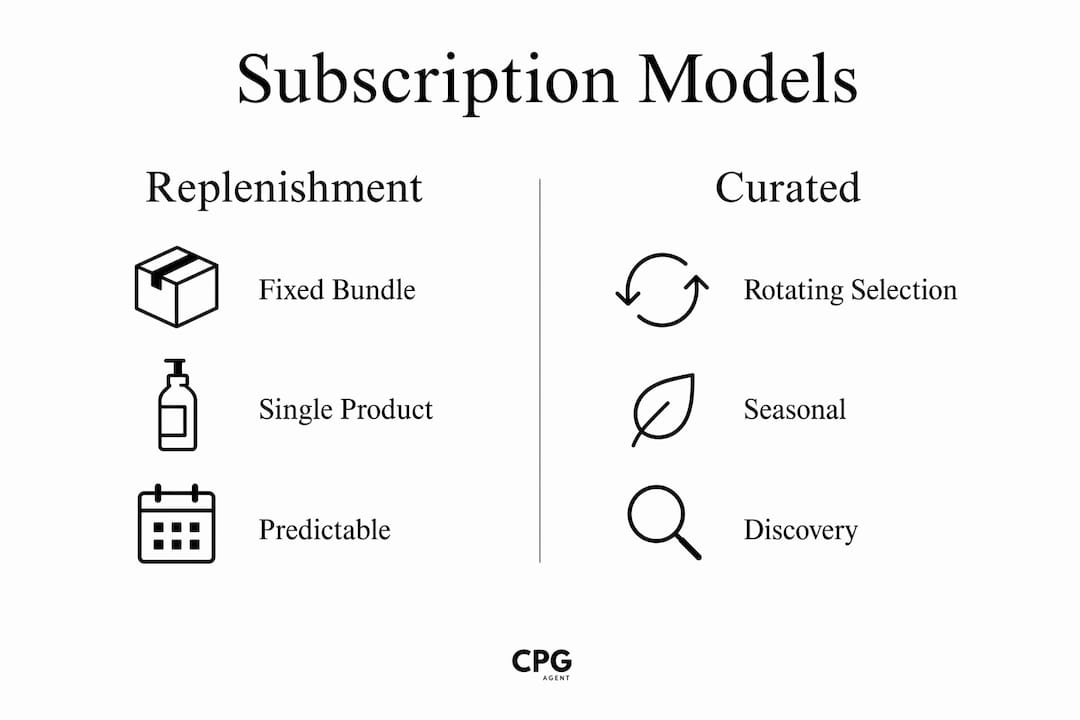
CPG subscription programs fall into three primary structures, each with distinct mechanics, cost implications, and customer experience profiles.
Recurring replenishment is the simplest model. Customers subscribe to a single product or a fixed bundle and receive it on a set schedule. This model works best for commodities with predictable usage rates: coffee, supplements, cleaning products, and personal care items. The operational overhead is low, and the value proposition is convenience plus a modest discount.
Curated or discovery subscriptions deliver a rotating selection of products, often themed or seasonally adjusted. These models generate higher initial excitement but require more curation effort and carry a higher risk of subscriber fatigue if the selections feel repetitive. They work well for brands with broad catalogs or those looking to introduce new SKUs to an engaged audience.
Tiered membership subscriptions layer value propositions on top of replenishment. Subscribers choose a tier based on the benefits they want, ranging from basic discounts to early product access, community membership, or personalized recommendations. This model produces the highest LTV when executed well, as Olipop's results demonstrate, but it requires more sophisticated lifecycle marketing and a clear value ladder.
Key considerations when choosing a model:
- CAC recovery speed: Replenishment models recover customer acquisition cost faster due to lower operational complexity. Tiered models take longer but produce higher LTV.
- Catalog depth: Brands with one or two hero products should start with replenishment. Brands with broader ranges can test curation or tiering.
- Customer data maturity: Tiered and curated models require behavioral data to personalize effectively. Launching them without that data produces generic experiences that underperform.
- Privacy and cancellation messaging: Research published in Marketing Letters in 2026 confirms that subscription willingness increases when brands clearly communicate cancellation ease and data transparency. This applies across all three model types.
How to start and scale a subscription model for your CPG brand
Launching a subscription program that actually scales requires sequencing decisions carefully. Most brands that struggle do so because they build complexity before they have the data to justify it.
-
Start with one to three reorderable SKUs. Pick products with a clear consumption cycle and existing repeat purchase behavior. This gives you clean data on cadence fit before you expand the catalog.
-
Set two or three cadence options, not ten. Offering monthly, every 45 days, and every 60 days covers the majority of consumption patterns without overwhelming the subscriber at signup. You can expand options once you understand your cohort behavior.
-
Build the retention infrastructure before you scale acquisition. Onboarding sequences, community touchpoints, and skip/swap controls should be in place before you invest heavily in paid acquisition. Acquiring subscribers into a leaky program accelerates losses, not growth. Brands exploring lean CPG strategy often underestimate how much retention infrastructure matters at launch.
-
Instrument your cohort data from day one. Track 30, 60, and 90-day retention by acquisition source, cadence selection, and SKU. This data tells you which subscribers are worth acquiring more of and which program elements are causing drop-off.
-
Add payment recovery before you need it. Integrating AI-driven retry logic and in-portal payment update prompts at launch prevents a category of churn that grows proportionally with your subscriber base.
Pro Tip: Treat your first 500 subscribers as a research cohort, not a revenue target. Survey them at 30 and 90 days. The qualitative feedback from this group will tell you more about program design than any dashboard.
Aligning subscription architecture, community strategy, and lifecycle marketing into a coherent system produces compounding retention and lifetime value benefits. Brands that treat these as separate workstreams consistently underperform those that design them together from the start.
Key takeaways
Subscription models in CPG succeed when product selection, delivery cadence, customer control, and retention infrastructure are designed as a single system rather than separate features.
| Point | Details |
|---|---|
| Start with focused SKUs | Launch with reorderable products that have predictable consumption cycles before expanding the catalog. |
| Cadence fit drives retention | Graza's shift to a 45-day cycle cut churn from 11.2% to 4.7%, proving cadence is a retention lever. |
| Tiered models lift LTV | Olipop's Explorer and Insider tiers increased 12-month LTV by over 60% compared to discount-only programs. |
| Payment recovery is non-negotiable | AI-driven retry tools recover up to 23% more failed transactions, preventing involuntary churn at scale. |
| Onboarding determines early retention | Personalized post-purchase sequences like Olipop's Gut Journey directly increase first-to-second order conversion. |
Why most CPG subscription programs underperform their potential
The brands I see struggling with subscription programs share a common pattern: they built the checkout mechanic and called it a subscription strategy. They set up a discount, connected Recharge or a similar platform, and waited for retention to follow. It does not work that way.
Subscription success in CPG is an operational and experiential problem as much as a marketing one. The cadence has to match how people actually use the product. The portal has to make self-management frictionless. The onboarding has to give subscribers a reason to stay before the second shipment arrives. And the payment recovery layer has to catch the silent churn that no survey will ever surface.
What I find most underappreciated is the role of community and identity in retention. Olipop did not grow its subscription base to 34% of revenue by offering a better discount. It built a program where subscribers felt like they were part of something. That is a brand decision, not a platform decision. The technology enables it, but the positioning creates it.
The brands that get this right treat their subscriber base as their most valuable marketing asset. They iterate based on cohort data, not gut feel. They invest in the post-purchase experience with the same rigor they apply to acquisition creative. And they measure LTV to CAC ratios with the discipline of a finance team, not an afterthought. If you are building or rebuilding a subscription program, start there.
— Matthew
Build your CPG subscription program with Cpgagent
Cpgagent is built for brand managers who need to move fast without rebuilding their entire tech stack. The CPG Agent platform includes AI-driven tools for subscription program design, retention analytics, and lifecycle marketing automation, all integrated into a single workflow that eliminates the coordination overhead of managing multiple vendors.
Whether you are launching your first subscription program or optimizing an existing one for better cohort retention, Cpgagent gives you the data infrastructure and strategic frameworks to act on what the numbers are telling you. From cadence modeling to onboarding sequence design, the platform is built around the operational realities of CPG subscription growth, not generic e-commerce assumptions.
FAQ
What is a subscription model in CPG?
A CPG subscription model is a recurring purchase program where customers pay on a set schedule to receive products automatically, generating predictable revenue and higher customer lifetime value for the brand.
How do subscription boxes work for CPG brands?
Subscription boxes deliver a curated selection of products on a recurring basis, typically monthly. CPG brands use them to introduce new SKUs, build brand loyalty, and generate recurring revenue from an engaged subscriber base.
What is the best way to reduce churn in a CPG subscription program?
The most effective approach combines cadence optimization, self-service skip and swap controls, personalized onboarding sequences, and AI-driven payment recovery. Graza reduced churn from 11.2% to 4.7% using cadence and flexibility improvements alone.
How do tiered subscription models improve LTV?
Tiered subscriptions offer distinct value propositions at each level, such as community access, early product releases, or personalized recommendations, which shift subscriber behavior from discount-seeking to brand loyalty. Olipop's tiered rebuild lifted 12-month LTV by over 60%.
When should a CPG brand start a subscription program?
A CPG brand should start a subscription program once it has at least one product with a clear repeat purchase pattern and the operational capacity to support a customer portal, onboarding sequence, and payment recovery infrastructure from day one.