

TL;DR:
- An FMCG marketing calendar is a structured, year-long plan that aligns campaigns, trade promotions, and content with retail windows and cultural moments.
- It ensures timely presence during peak shopping periods, creates operational accountability, and fosters cross-functional collaboration across marketing, sales, supply chain, and finance.
An FMCG marketing calendar is a structured, time-based plan that maps every consumer campaign, trade promotion, and content activity to fixed retail windows and cultural moments across the year. Brand managers in fast-moving consumer goods use it as the single operational document that connects marketing strategy to shelf execution. Without it, campaigns miss peak shopper windows, supply chains scramble, and budgets get wasted on poorly timed activity. Digital marketing calendars organize content creation, publication, and promotion schedules to improve overall effectiveness. The result is a planning tool that is as much about operations as it is about creativity.
What is a marketing calendar in FMCG, and why does it matter?
A marketing calendar in FMCG is the industry's standard term for what some teams loosely call a "promotional planner" or "campaign schedule." The distinction matters: a true FMCG marketing calendar integrates retail event dates, media budgets, trade promotions, product launches, and content schedules into one living document. A simple campaign schedule does not.

The commercial case for building one is clear. 75% of U.S. consumers planned to shop during at least one promotional event in 2025, per a Deloitte survey. That figure means the majority of your shoppers are already primed to buy during specific windows. Your job is to show up in the right place at the right time with the right message.
FMCG moves fast. Category velocity, short product lifecycles, and intense retail competition mean that a brand arriving two weeks late to a seasonal moment loses real revenue. The marketing calendar prevents that by forcing teams to plan backward from the shelf date, not forward from the briefing room.
The importance of a marketing calendar also extends beyond campaign timing. It creates accountability. Every team member knows which promotion is live, who owns it, and what the next activation is. That clarity alone reduces the internal friction that kills good campaigns before they reach the shopper.
Why retail promotional windows define your campaign timing
Shopper marketing success in FMCG depends on mapping campaigns to fixed retail promotional windows rather than arbitrary internal dates. Retailers lock in their promotional programs months in advance. If your brand is not in the plan, you are not on the shelf at the moment shoppers are most motivated to buy.
The major windows every FMCG calendar must anchor to include:
- Q1 occasions: New Year health and wellness, Valentine's Day, and Super Bowl snacking
- Q2 occasions: Easter, Mother's Day, and Memorial Day grilling and outdoor categories
- Q3 occasions: Back-to-school, summer entertaining, and Labor Day
- Q4 occasions: Halloween, Thanksgiving, and the full holiday gifting and food season
Beyond these headline events, micro occasions like National Coffee Day or National Pet Day offer year-round opportunities for targeted campaigns that build loyalty without requiring a major budget. These smaller moments are often underused by mid-size FMCG brands, which creates a real competitive opening.
The timing rule that most brand managers underestimate is the lead time required before in-store activation. Planning media, trade promotions, and shopper marketing materials 2–4 weeks before the in-store date is the minimum. For major seasonal events like Thanksgiving or the holiday season, 8–12 weeks of upstream planning is standard. Retailers need confirmed promotional details well before the event goes live, and your supply chain needs even more runway than your marketing team does.
Pro Tip: Build your calendar backward from the retailer's promotional submission deadline, not from the consumer-facing campaign launch date. That single shift in perspective prevents the most common FMCG planning failures.
How to build an annual FMCG marketing calendar
Building an annual FMCG marketing calendar requires more than dropping campaign dates into a spreadsheet. The structure must reflect how your brand actually goes to market: through retailers, with trade investment, supported by media, and executed by multiple teams simultaneously.
A well-built calendar includes these core components:
- Retail promotional events: All confirmed retailer feature dates, TPRs (temporary price reductions), BOGOs, and in-store display windows. The Annual Operating Plan in CPG includes a promotional calendar that details volume lift from each planned trade promotion.
- Consumer marketing campaigns: TV, digital, and social campaigns tied to each promotional window. These should align with the trade activity so that pull-through demand matches the in-store push.
- Product launches: New SKU introductions, reformulations, and limited-edition releases, each with their own upstream milestones for packaging, production, and retail sell-in.
- Content and social schedule: Organic and paid content mapped to seasonal moments, including influencer activations and brand-owned channels.
- Media budget allocation: Budget assigned by period, not just by campaign, so finance and marketing stay aligned on spend pacing throughout the year.
The format of the calendar matters less than its accessibility. A shared Google Sheet, a project management platform, or a purpose-built tool like those available through Cpgagent's platform all work, provided every stakeholder can view and update it in real time. Static PDFs sent by email are the enemy of a living calendar.
Balancing long-term structure with short-term flexibility is the hardest part of calendar management. Lock in the major retail windows and media commitments 6–12 months out. Reserve 15–20% of your activity slots for culture-led or reactive campaigns that you cannot predict in january. That buffer is not wasted space. It is your agility reserve.
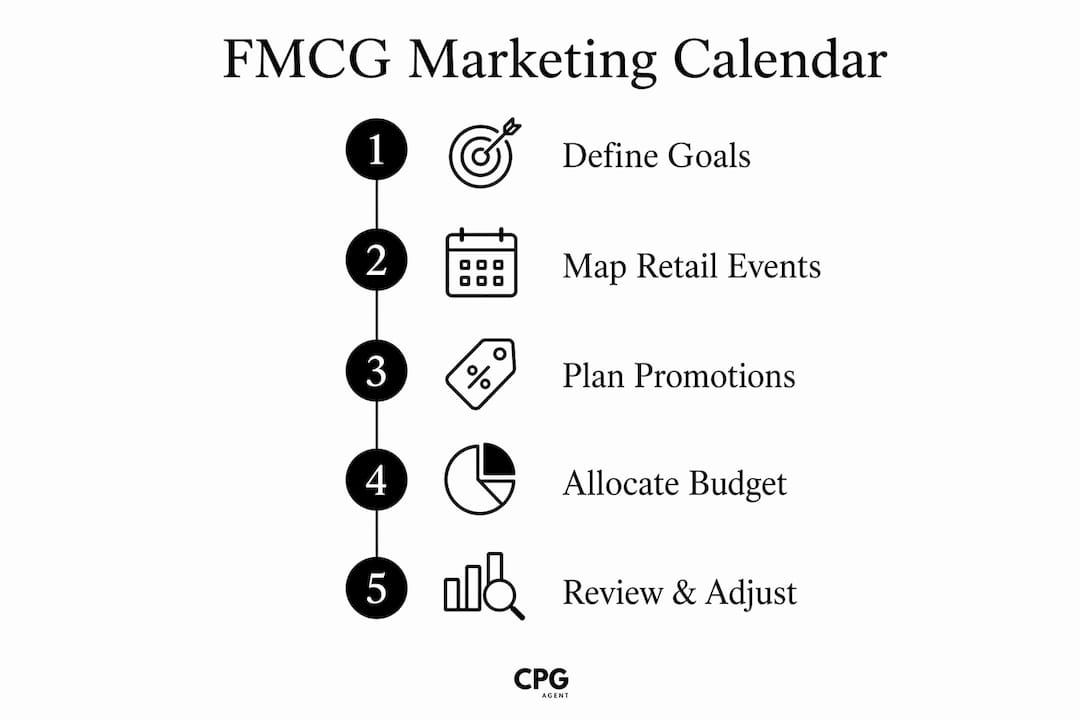
Pro Tip: Color-code your calendar by function: trade promotions in one color, consumer media in another, content in a third. At a glance, any team member can see whether a given week is trade-heavy or media-heavy and flag imbalances before they become problems.
For teams building out their content strategy alongside the promotional calendar, FMCG content marketing planning offers a practical framework for integrating editorial and campaign activity.
Why the calendar must serve the whole organization
A marketing calendar that only marketing uses is not a marketing calendar. It is a wish list. The real power of a shared promotional calendar comes from cross-functional alignment across marketing, sales, supply chain, and finance.
The most common failure mode in FMCG promotional planning is the siloed calendar. Marketing plans a major summer promotion. Sales does not know the confirmed retailer dates until four weeks out. Supply chain has not been briefed on volume expectations. Finance has not approved the incremental budget. The promotion goes live with stock shortages, misaligned trade terms, and no media support. That scenario plays out repeatedly across brands of every size.
A communal, accessible calendar prevents this by making the following visible to every team:
- Upcoming promotional windows with confirmed retailer dates and volume targets
- Supply chain lead times tied to each event, so procurement and production start on time
- Budget commitments by period, so finance can track spend against plan
- Ownership assignments so every promotion has a named accountable person
Operational preparation is where the calendar earns its keep. Marketing calendars must integrate supply chain lead times to prevent stock issues during promotions. A sold-out product during a feature event is not a success. It is a missed revenue opportunity and a retailer relationship problem.
Practical steps to unify calendar data internally include holding a monthly cross-functional calendar review, using shared calendar tools like Slack reminders and editable shared documents, and designating one owner responsible for keeping the master calendar current. The calendar review meeting is not optional. It is the mechanism that keeps the plan alive.
How to keep your calendar agile for culture and consumer trends
A fixed annual calendar is necessary. It is not sufficient. FMCG brands that win in 2026 combine structured promotional planning with the ability to respond to cultural moments in real time.
The evidence for this approach is concrete. Unilever's influencer-led campaign saw a 43% sales increase by validating consumer hacks through scientific testing and amplifying them through social channels. That campaign was not on the original annual calendar. It emerged from listening to what consumers were already doing with the product and moving fast to support it.
Building agility into your calendar requires a few deliberate practices:
- Reserve open slots in the calendar for reactive activations, at least one per month in high-velocity categories
- Monitor social trends weekly using tools that track category-relevant conversations on TikTok, Instagram, and Reddit
- Set a fast-approval process for culture-led content so that a trend spotted on Monday can be live by Thursday
- Assign a culture lead within the marketing team whose job is to surface relevant moments before they peak
Relevance-driven marketing wins by embedding brands authentically in evolving cultural spaces. The calendar is the structure that makes that possible without losing operational control. Without the structure, reactive marketing becomes chaotic. Without the agility reserve, the structure becomes a cage.
For teams mapping which channels to activate during these cultural moments, performance marketing channels for FMCG provides a practical breakdown of where to invest by campaign type.
Key Takeaways
An FMCG marketing calendar is the single most important planning tool a brand team can build, because it connects retail timing, operational readiness, and cultural relevance into one shared document.
| Point | Details |
|---|---|
| Define it correctly | An FMCG marketing calendar integrates retail events, trade promotions, media budgets, and content into one living plan. |
| Anchor to retail windows | Map campaigns 2–4 weeks before in-store activation; major events require 8–12 weeks of upstream planning. |
| Build cross-functional | Supply chain, finance, and sales must all work from the same calendar to prevent stock shortages and budget misalignment. |
| Reserve agility space | Hold back 15–20% of activity slots for culture-led and reactive campaigns that cannot be predicted at the start of the year. |
| Use shared tools | A static PDF is not a calendar. Use editable, real-time platforms so every team member sees the current plan. |
The calendar is the strategy, not just the schedule
Most brand managers treat the marketing calendar as an administrative task. They fill it in after the strategy is set, as a way to communicate decisions that have already been made. That is the wrong sequence, and it costs brands real money.
The calendar should be where strategy gets made, not where it gets recorded. When you lay out the full year on one page, you immediately see the gaps: the six-week stretch in february with no trade support, the Q3 period where three campaigns are competing for the same media budget, the product launch that lands two weeks before a major retailer reset. Those conflicts are invisible in a slide deck. They are obvious in a calendar.
The brands I have seen execute best treat the annual calendar review as one of their most important planning sessions of the year. They bring marketing, sales, supply chain, and finance into the same room. They map every confirmed retailer commitment, every product launch, and every major media investment before they fill in the discretionary activity. That discipline forces trade-offs early, when they are cheap, rather than late, when they are painful.
The other mistake I see consistently is treating the calendar as finished once it is built. A marketing calendar that is not updated monthly is a historical document, not a planning tool. The best teams assign a calendar owner, hold a standing monthly review, and treat any change to the plan as a formal update that gets communicated to every function. That discipline sounds bureaucratic. In practice, it is what separates brands that execute cleanly from brands that are always in reactive mode.
— Matthew
How Cpgagent helps FMCG teams build smarter marketing calendars
FMCG brand teams that want to move from spreadsheet chaos to a connected planning system have a faster path available.
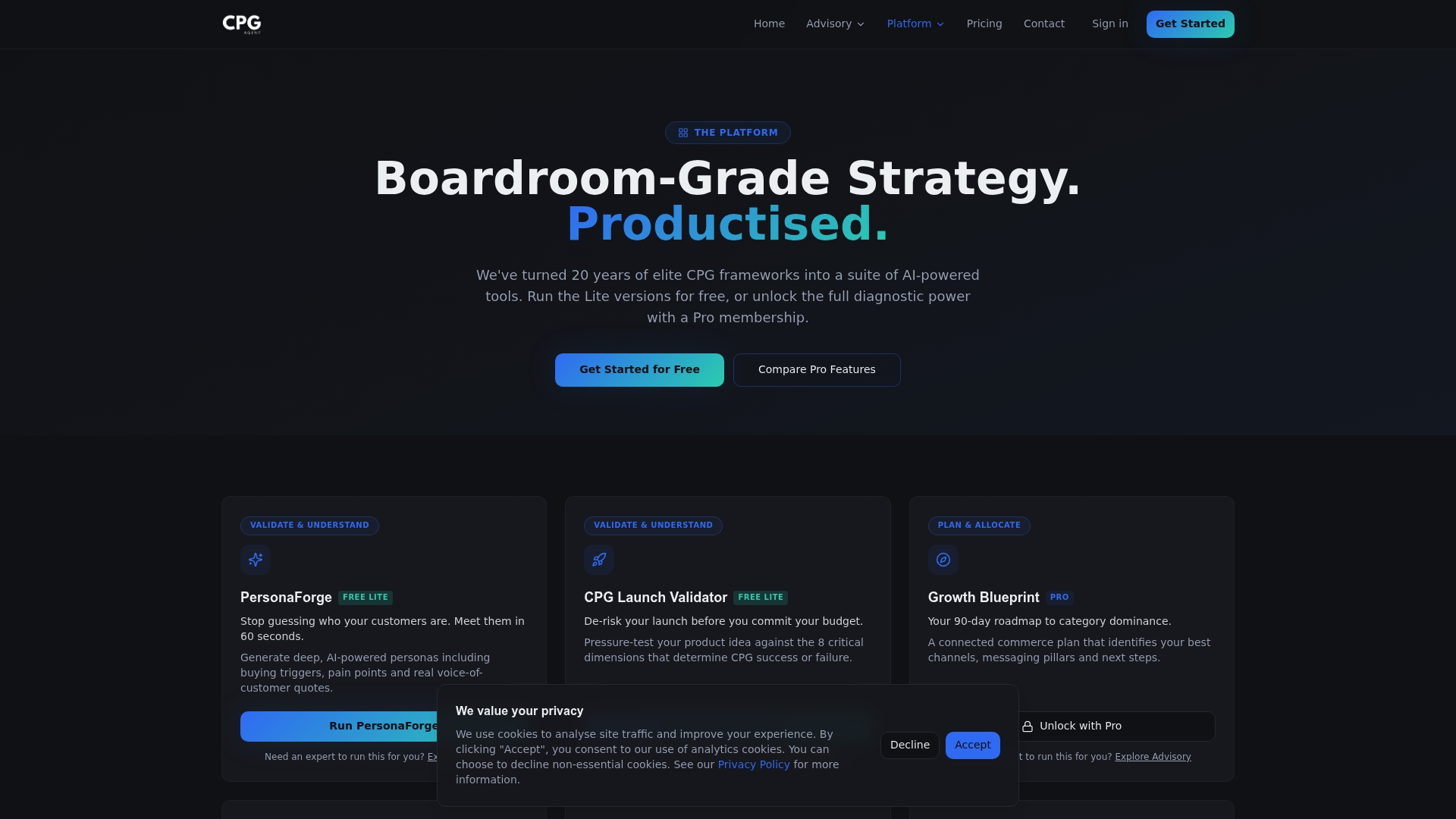
Cpgagent's platform is built for CPG and FMCG brands that need to connect promotional planning, campaign execution, and performance tracking in one place. The platform brings AI-driven strategy tools and automated workflows together so brand managers can build their annual calendar, align it with trade and media commitments, and share it across functions without the overhead of a traditional agency. Teams can access Cpgagent's planning tools to structure their promotional calendar, integrate shopper insights, and keep every stakeholder working from the same current plan. For brands ready to move faster and plan smarter, Cpgagent provides the infrastructure to make it happen.
FAQ
What is a marketing calendar in FMCG?
An FMCG marketing calendar is a structured annual plan that maps consumer campaigns, trade promotions, and content activity to fixed retail windows and cultural moments. It serves as the single operational document connecting marketing strategy to shelf execution.
How far in advance should FMCG brands plan their promotions?
Most in-store activations require 2–4 weeks of upstream marketing preparation at minimum. Major seasonal events like the holiday season typically require 8–12 weeks of planning to meet retailer submission deadlines and supply chain lead times.
Why does cross-functional alignment matter for a promotional calendar?
A calendar used only by marketing fails to prevent stock shortages, budget misalignment, and uncoordinated trade activity. Supply chain, finance, and sales teams must all work from the same shared calendar to execute promotions without operational failures.
How do FMCG brands build agility into a fixed annual calendar?
Brands reserve open activity slots each month for reactive and culture-led campaigns, monitor social trends weekly, and set fast internal approval processes so they can respond to consumer moments within days rather than weeks.
What components belong in an FMCG marketing calendar?
A complete calendar includes retail promotional events, consumer media campaigns, product launch milestones, a content and social schedule, and media budget allocation by period. Each component should be visible to every function involved in execution.