

TL;DR:
- AI is transforming agency teams by automating routine tasks and expanding roles that require human judgment. Agencies that adopt team-wide AI fluency and restructure workflows can protect margins and increase efficiency. Mid-2026, roles focused on templatable outputs are most vulnerable to automation, while strategic roles remain essential.
AI is defined as the primary force reshaping agency team structures in 2026, automating routine production tasks while expanding strategic, editorial, and governance roles. Understanding how AI replaces traditional agency roles matters now because 60% of marketing leaders have already cut external agency spend, moving execution in-house. The shift is not simple job elimination. It is a fundamental restructuring of who does what, how teams are built, and how agencies price their work. For marketing and branding professionals in consumer goods, this transformation demands a clear-eyed view of what AI actually changes and what it cannot touch.
How AI replaces traditional agency roles: the core shift
AI automates the work that follows a repeatable pattern. Roughly 88% of daily repetitive marketing tasks, including data reporting, draft content generation, and performance summaries, are now handled by AI systems. That figure signals a structural change, not a marginal efficiency gain.
The roles most exposed are those built around templatable outputs. Junior copywriters producing first drafts, data analysts compiling weekly reports, and production coordinators managing asset delivery all face direct automation pressure. These positions existed because human labor was the only way to execute at volume. AI removes that constraint.
Strategic, client-facing, and judgment-heavy roles tell a different story. Brand strategists, account directors, and creative directors are not being replaced. Their work requires contextual reasoning, client trust, and cultural sensitivity that AI cannot replicate. Internal marketing roles grew 14% year-over-year even as agency headcount contracted. That growth reflects a redistribution of judgment work, not its disappearance.
Pro Tip: Map every role in your agency against two criteria: does it require repeatable execution, and does it require contextual judgment? The first category is where AI delivers the most immediate impact.
Which agency roles are most affected by AI?
The table below shows how AI impact varies by role type.
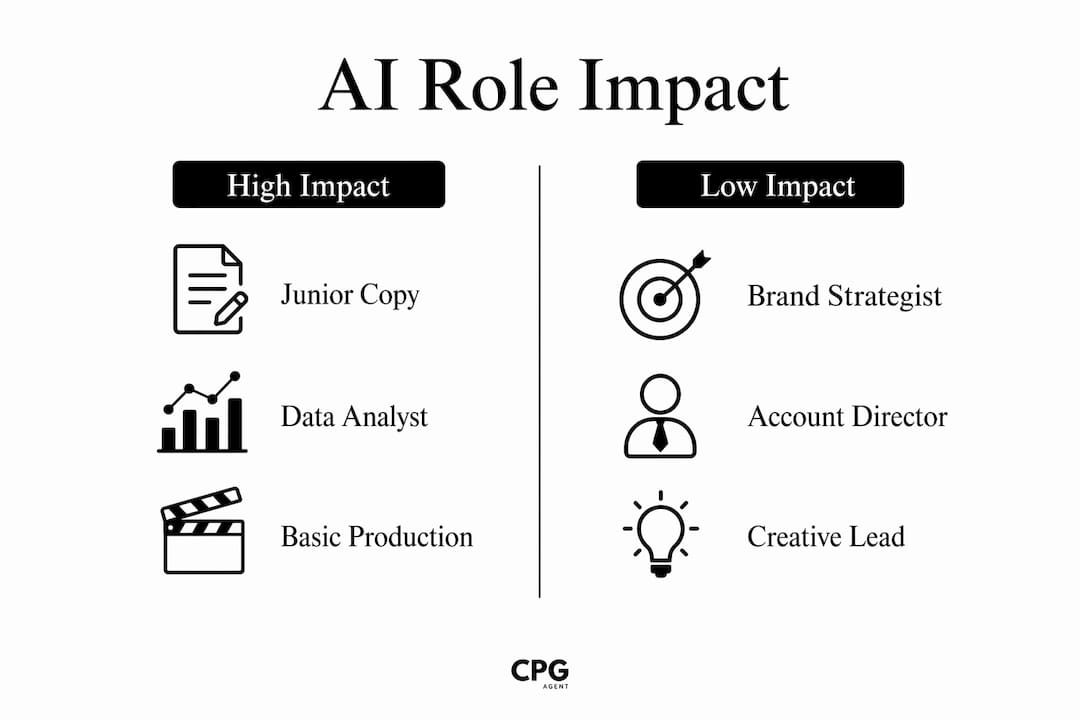
| Role type | AI impact category | What changes |
|---|---|---|
| Junior copywriter / content producer | High automation | AI drafts; human edits and approves |
| Data analyst / reporting specialist | High automation | AI compiles; human interprets and advises |
| Production coordinator | Moderate automation | AI manages workflows; human handles exceptions |
| Brand strategist | Augmented | AI provides data inputs; human drives decisions |
| Account director | Minimal automation | Relationship and judgment work remains human-led |
| AI prompt engineer / agent operator | New role | Manages AI systems and quality outputs |
| AI governance lead | New role | Oversees compliance, audits, and knowledge systems |
New roles are not hypothetical. Prompt engineers, agent operators, and AI governance leads are active hires at agencies that have fully implemented AI across operations. Only 33% of agencies reached that level by mid-2026, which means most teams are still in transition. The agencies that move fastest on role redesign will hold a structural advantage.
The headcount math is also shifting. Fewer junior generalists, more editors and quality assurance specialists. AI produces volume; humans are now responsible for quality control at scale. That is a different skill profile than most agencies hired for five years ago.
How are agencies restructuring teams around AI?
The traditional agency pyramid, with many juniors supporting fewer seniors, is giving way to a hub-and-spoke model. Senior strategists now orchestrate AI agents, directing multiple automated workflows while a smaller team handles editorial review and client communication. The typical ratio shifted from one strategist supporting three producers to one strategist supporting five to seven producers. That ratio change compresses headcount without reducing output.

This restructuring creates specific organizational risks. Agencies that silo AI knowledge in one specialist create a single point of failure. If that person leaves, the AI capability leaves with them. The agencies that outperform are those that treat AI fluency as a team-wide competency, not a niche expertise. Every account manager, strategist, and editor needs a working understanding of what AI can and cannot do.
Time-and-materials billing is another structural pitfall. When AI compresses a task from eight hours to two, hourly billing punishes the agency for its own efficiency. Agencies clinging to that model will see margins erode as AI adoption accelerates. The operational model has to change alongside the team model.
- Audit every workflow for tasks that follow a repeatable pattern and can be handed to AI
- Redesign editorial roles to focus on quality review rather than first-draft production
- Cross-train all senior staff on AI tools relevant to their function
- Build prompt libraries and governance frameworks before scaling AI use
- Replace time-and-materials billing with value-based or fixed-scope pricing
Pro Tip: Run a 90-day AI upskilling sprint across your full team before restructuring headcount. Teams that learn together build shared fluency faster than those trained in isolation.
What financial pressures does AI create for agencies?
AI creates a pricing paradox for agencies. Clients expect cost savings because they know AI reduces production time. Agencies absorb those efficiency gains but struggle to pass them on as margin. Agency net margins dropped to 13% in 2025, falling below the 15% long-run average. That gap reflects the pressure of AI cost expectations without a corresponding shift in pricing models.
Rate increases have slowed sharply. The share of agencies that raised service rates dropped from 28% in 2025 to 20% in 2026. Clients are resisting AI cost pass-throughs, arguing that AI should make agencies cheaper, not just faster. That argument wins when agencies price by the hour. It loses when agencies price by the outcome.
Value-based and fixed-scope pricing models protect margins by decoupling price from time. An agency that delivers a brand positioning framework in three days instead of three weeks has not lost value. It has delivered the same judgment faster. Pricing should reflect the judgment, not the clock. Shifting from hourly to value-based pricing is the single most important financial decision an AI-era agency can make.
The agencies that position AI as a growth catalyst rather than a cost-cutting tool hold the strongest margin position. Selling AI efficiency as a commodity races to the bottom. Selling AI-augmented strategic judgment commands a premium.
What new skills and roles have emerged in AI-augmented agencies?
AI governance is the most underrated new competency in agency operations. Effective AI adoption requires prompt libraries, audit systems, and governance frameworks to prevent quality drift and knowledge silos. Without these structures, AI outputs become inconsistent and brand-damaging. Governance is not a bureaucratic add-on. It is what separates agencies that scale AI well from those that create new problems.
The emerging role stack in AI-augmented agencies looks like this:
- AI prompt engineer. Writes, tests, and maintains the prompts that drive consistent AI outputs across accounts.
- Agent operator. Manages autonomous AI workflows, monitors performance, and escalates exceptions to human reviewers.
- Editorial specialist. Reviews AI-generated content for accuracy, brand voice, and quality before client delivery.
- AI governance lead. Owns the agency's AI policy, audit cadence, and training curriculum.
- Strategic AI advisor. Works directly with clients to identify where AI can accelerate their marketing operations.
Career paths are also changing. Junior roles that once served as training grounds for generalist skills now require AI fluency from day one. The entry point into agency work has shifted from execution to quality control and system management. That is a meaningful change for hiring, onboarding, and professional development.
Agencies that invest in AI fluency as a team capability report revenue per full-time employee gains of 20–50%, often with stable or growing total headcount. The efficiency gains go to output quality and client capacity, not headcount reduction. That is the model worth building toward.
Pro Tip: Treat AI governance as a product, not a policy. Build a living prompt library, assign an owner, and review it quarterly. Agencies that do this consistently outperform those that treat AI as a set-it-and-forget-it tool.
For CPG and FMCG brands navigating this shift, AI-powered consumer research is one of the clearest examples of how agency workflows are being redesigned around AI capabilities rather than human production volume.
Key Takeaways
AI transforms agency operations by automating repeatable execution tasks while expanding the strategic, editorial, and governance roles that require human judgment and client trust.
| Point | Details |
|---|---|
| Automation targets repetitive work | AI handles 88% of daily repetitive tasks; human roles shift to editing, judgment, and oversight. |
| Team structures are changing | Hub-and-spoke models replace pyramids, with one strategist now supporting five to seven producers. |
| Margins are under pressure | Agency net margins fell to 13% in 2025; value-based pricing protects against further erosion. |
| New roles are active, not theoretical | Prompt engineers, agent operators, and AI governance leads are current hires at leading agencies. |
| AI fluency must be team-wide | Agencies that distribute AI knowledge across all roles outperform those that silo it in specialists. |
The uncomfortable truth about AI and agency value
The agencies I see struggling most are not the ones that ignored AI. They are the ones that adopted it without changing how they sell. They cut junior headcount, ran the same deliverables faster, and then watched clients demand lower rates because "AI did the work."
That framing is the trap. AI does not do the work. It handles the execution. The work, the part clients actually pay for, is the judgment about what to make, why it matters, and whether it will land with a specific consumer in a specific context. Agencies that act as strategic orchestrators rather than output factories are the ones holding margin and growing accounts.
The CPG and FMCG sector makes this especially clear. A brand manager at a mid-size food company does not need more content. They need someone who can tell them which product claim will resonate in the Southeast versus the Pacific Northwest, and why. AI can surface the data. It cannot make that call. The danger of commoditizing AI tools is real. Agencies that compete on AI features alone will lose to tech platforms with bigger budgets and faster development cycles.
The agencies worth working with in 2026 are the ones that use AI to free up their best thinkers for more thinking. That is the repositioning that matters. Not cheaper. Sharper.
— Matthew
How Cpgagent supports AI-driven agency transformation
CPG and FMCG brands that want the benefits of AI-augmented agency thinking without rebuilding an entire internal team have a direct path forward with Cpgagent.
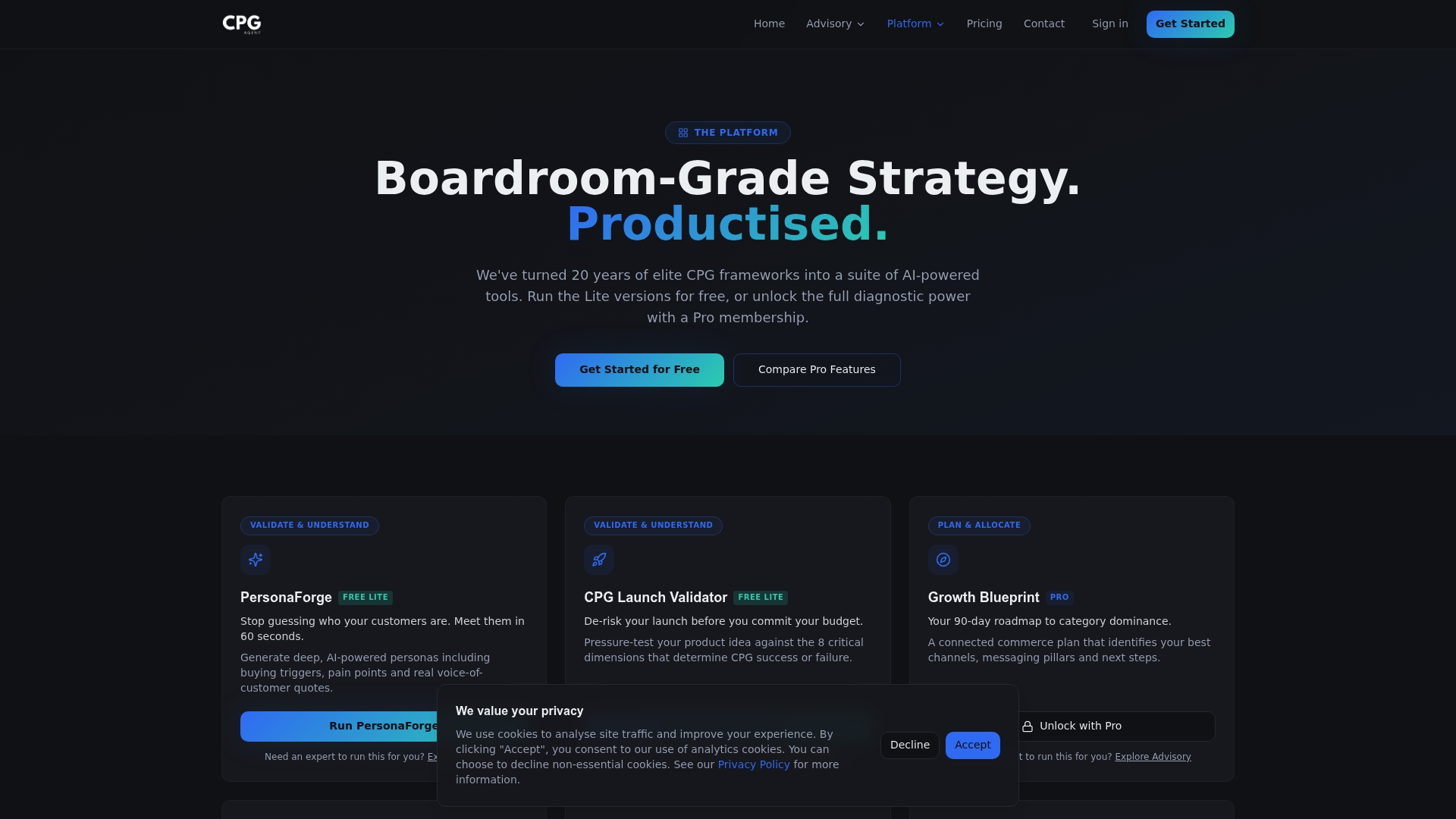
Cpgagent's platform combines AI-driven strategy tools, automated workflows, and fractional leadership advisory in one system built for consumer goods brands. Tools like PersonaForge and Launch Validator replace the templatable work that traditional agencies charged full rates for, while fractional CMO and growth advisory services deliver the strategic judgment that AI cannot replicate. For brands scaling marketing without the overhead of a full agency retainer, Cpgagent offers a direct alternative. You can also explore how CPG brands are scaling without account executives to see the operational model in practice.
FAQ
What agency roles does AI replace most quickly?
AI replaces roles built around templatable, repeatable outputs first. Junior copywriters, data reporting analysts, and production coordinators face the highest automation pressure in 2026.
Does AI cause overall job loss in marketing agencies?
AI caused roughly a 15% headcount reduction at creative agencies by Q2 2026, but internal marketing roles grew 14% year-over-year. The net effect is redistribution, not elimination.
How should agencies price services in the AI era?
Value-based and fixed-scope pricing models protect margins better than time-and-materials billing. When AI compresses task time, hourly billing directly reduces agency revenue for the same output.
What new roles are agencies hiring for because of AI?
Agencies are actively hiring prompt engineers, agent operators, editorial specialists, and AI governance leads. These roles manage AI systems, maintain quality, and prevent knowledge silos.
How does AI fluency affect agency performance?
Agencies that build AI fluency across the full team report revenue per full-time employee gains of 20–50%. Siloing AI knowledge in one specialist creates fragility and limits the performance gain.