
TL;DR:
- Computer vision for planogram compliance uses AI to verify shelves with up to 99% accuracy, surpassing manual audits. It enables continuous monitoring, automatic detection of violations, and real-time alerts to improve store execution efficiently. Integrating this technology with retail systems helps prioritize issues by financial impact and streamlines corrective workflows.
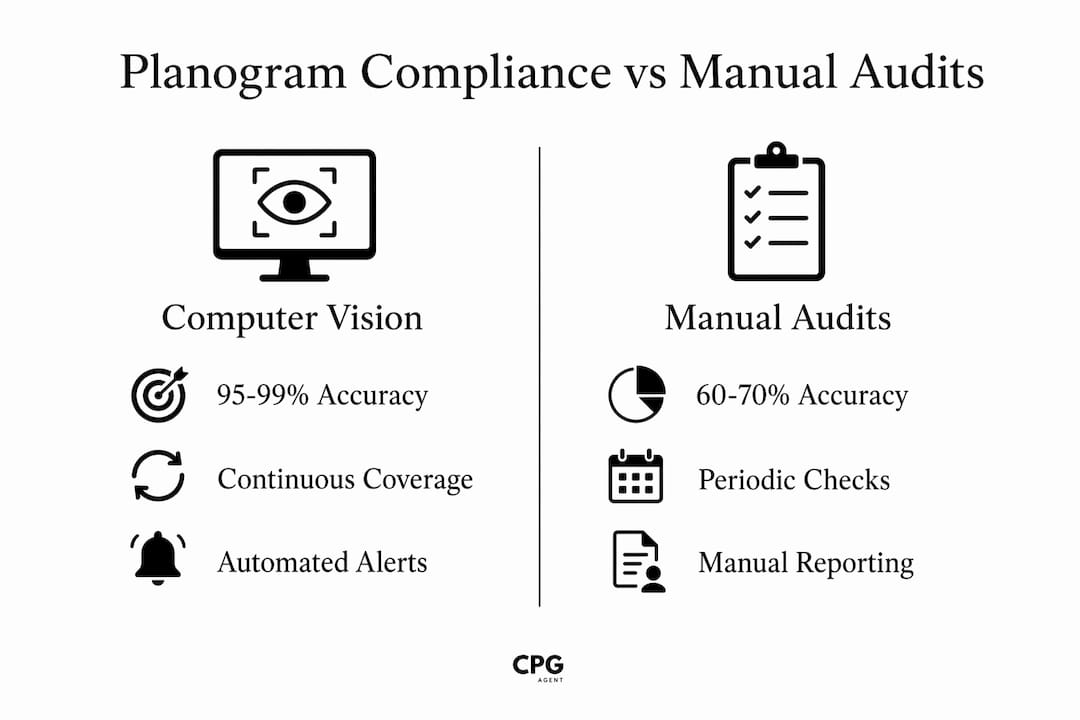
Computer vision for planogram compliance is an AI-powered technology that automatically verifies retail shelves against merchandising plans with 95–99% accuracy, far outperforming the 60–70% accuracy typical of manual audits. The industry term for this capability is "shelf execution intelligence," and it covers everything from SKU detection to facing counts to out-of-stock identification. Retailers using image recognition identify 50–200% more execution gaps than manual scanning uncovers. For merchandising teams managing hundreds of SKUs across dozens of stores, that gap is not a minor inefficiency. It is lost revenue sitting on the wrong shelf.
How does computer vision for planogram compliance work?
The process starts with a planogram library. This library holds the reference models for how every shelf section should look, including product placement, facing counts, and adjacency rules. The AI system compares live shelf images against these reference models to generate a compliance score.

Image capture happens through two main methods. Mobile handheld devices let field reps photograph shelves during store visits. Fixed shelf cameras capture images continuously without requiring human intervention. Each method feeds image data into an object detection model that identifies individual SKUs, counts facings, and flags shelf gaps.
The detection model maps what it sees into a structured format called a RealOGram. This is a digital representation of the actual shelf state, aligned position by position against the planogram. Analysis and compliance reporting occur in real time or within minutes, far exceeding what any manual audit can deliver.
- Ingest the planogram library as the reference standard for each shelf section.
- Capture shelf images via mobile devices or fixed cameras at defined intervals.
- Run object detection to identify SKUs, facings, and product positions.
- Generate the RealOGram by mapping detected products against the planogram layout.
- Score compliance and flag violations such as wrong placement, missing facings, and out-of-stock positions.
- Trigger corrective tasks automatically in workforce or task management systems.
Leading AI platforms achieve 90–95%+ SKU recognition accuracy under real-world store conditions. That performance depends on comprehensive product catalogs that are retrained frequently as packaging changes.
Pro Tip: Retrain your SKU recognition model every time a product undergoes a packaging refresh. Stale training data is the single most common cause of false compliance scores.
Computer vision vs. manual audits: accuracy, speed, and operational impact
The performance gap between AI-driven shelf auditing and manual methods is significant across every measurable dimension.
| Dimension | Manual audits | Computer vision |
|---|---|---|
| Accuracy | 60–70% | 95–99% |
| Coverage | Sample-based, fraction of shelves | Continuous, full-store |
| Speed | Delayed reporting, hours to days | Real time or within minutes |
| Phantom inventory detection | Rarely identified | Flagged automatically |
| Labor cost | High, recurring | Reduced after deployment |
| Consistency | Varies by auditor | Standardized across all stores |
Manual audits sample only a fraction of the shelf during each visit. A store associate checking a 2,000-SKU grocery section in 30 minutes will miss a large share of deviations. Computer vision enables continuous monitoring of entire stores, detecting missing items, misplaced products, and deviations immediately rather than waiting for the next scheduled visit.
"Moving from reactive spot checks to proactive real-time shelf intelligence changes the economics of store execution. You stop chasing problems that already cost you sales and start preventing them before the customer arrives."
Speed matters beyond accuracy. A compliance gap found three hours after a shelf reset costs far less than one discovered two days later during the next manual audit cycle. Real-time alerts let store teams correct violations while the sales window is still open.
The labor impact compounds over time. Manual audit programs require trained field reps, travel time, and data entry. AI-driven shelf compliance technology shifts that labor investment toward corrective action rather than detection, which is where human judgment adds the most value.
Why high inventory levels do not guarantee planogram compliance
Full shelves do not mean compliant shelves. High product availability does not guarantee planogram compliance because misplaced products or mixed brands can cause operational failures even when inventory counts look healthy.
Phantom inventory is the clearest example of this problem. Phantom inventory occurs when a system shows a product as "in stock" but the shelf is actually empty. Computer vision identifies phantom inventory, which accounts for up to 15% of out-of-stock incidents. Without shelf-level image verification, replenishment systems never trigger a reorder because the inventory record says stock exists.
Prioritization matters as much as detection. Not every compliance deviation carries the same financial weight. A misplaced promotional item in a high-traffic aisle costs more than a minor facing count error on a slow-moving SKU. AI scores compliance gaps by revenue and margin at risk, so store teams focus their time on the deviations that actually affect the bottom line.
Key areas where prioritization changes outcomes:
- Revenue-critical SKUs: Flag violations on top-selling products first, before addressing secondary lines.
- Promotional placements: Verify that promotional displays match the agreed layout before the promotion period begins.
- Seasonal resets: Audit compliance immediately after a reset rather than waiting for the next scheduled visit.
- Phantom inventory positions: Treat any position where the system shows stock but the shelf is empty as a high-priority correction.
Pro Tip: Build a compliance priority matrix that weights each SKU by its weekly revenue contribution. Feed that matrix into your AI scoring model so alerts rank by financial impact, not just deviation count.
Compliance data also feeds back into longer-term planning. Shelf execution data connects back to assortment and space planning teams, helping them identify root causes of recurring failures rather than just fixing symptoms on the shelf. A product that consistently falls out of compliance may signal a planogram design problem, not a store execution problem.
How to integrate shelf compliance technology into retail operations
Computer vision platforms deliver the most value when treated as enterprise data sources, not just shelf cameras. Cameras function as enterprise data platforms feeding ERPs, workforce management systems, and task management tools with standardized outputs that go far beyond loss prevention.
The integration workflow follows a clear sequence:
- Connect to ERP systems to cross-reference compliance scores against inventory records and flag phantom inventory positions automatically.
- Feed workforce management tools so store managers receive prioritized task lists based on compliance violations ranked by financial impact.
- Link to category management platforms so space planners see recurring compliance failures and adjust planogram designs accordingly.
- Trigger automated workflows rather than generating static dashboards that require someone to log in and interpret data manually.
- Share data with CPG brand partners so field sales teams and category managers work from the same shelf reality, not separate audit reports.
Automated workflow triggers driven by model outputs deliver more business impact than dashboards alone. A dashboard tells you what happened. An automated task assignment tells a store associate exactly which shelf section to fix and in what order.
The choice between mobile capture and fixed cameras depends on store format and budget. Fixed cameras provide continuous coverage but require installation investment and ongoing maintenance. Mobile capture costs less upfront and works well for periodic compliance checks, but it cannot match the real-time detection that fixed installations provide. Many retailers run a hybrid model, using fixed cameras in high-value sections and mobile capture for the rest of the store.
For CPG brands, AI retail shelf audits provide a direct line of sight into how their products actually appear on the shelf versus how the planogram specifies they should appear. That visibility closes the loop between trade spend and shelf execution, making it possible to measure the return on promotional investments with real data.
Key Takeaways
Computer vision for planogram compliance delivers 95–99% accuracy, continuous full-store coverage, and automated corrective workflows that manual audits cannot match at any comparable cost or speed.
| Point | Details |
|---|---|
| Accuracy advantage | AI achieves 95–99% shelf audit accuracy versus 60–70% for manual methods. |
| Phantom inventory detection | Computer vision flags positions where systems show stock but shelves are empty, covering up to 15% of out-of-stock incidents. |
| Prioritize by financial impact | Score compliance gaps by revenue and margin at risk to focus corrective effort where it matters most. |
| Integrate beyond the shelf | Connect compliance data to ERP, workforce, and space planning systems to fix root causes, not just symptoms. |
| Automate workflows, not dashboards | Trigger task assignments from model outputs so store teams act immediately rather than interpret reports. |
Where most retailers get shelf compliance wrong
The biggest mistake I see retail and merchandising teams make is treating shelf compliance as a reporting exercise rather than an operational one. They invest in a computer vision system, generate compliance scores, and then wait for someone to review a dashboard. The shelf problem persists because no one closed the loop between detection and correction.
The second mistake is measuring compliance without weighting it. A store that scores 85% compliance on a section dominated by low-margin, slow-moving products may actually be in worse shape commercially than a store scoring 78% compliance on a high-velocity, high-margin section. The number alone tells you nothing without the financial context behind it.
What I have found works is starting with one high-impact use case, typically a top-selling category or a promotional aisle, and building the automated workflow before expanding coverage. This approach proves ROI quickly and builds internal support for broader rollout. It also forces teams to think about what action the data should trigger, not just what the data shows.
The future of this technology points toward AI assistants that diagnose root causes automatically. Instead of flagging that a product is out of position, the system will tell you whether the cause is a planogram design error, a delivery failure, or a store execution gap, and recommend the specific fix. That shift from detection to diagnosis is where the real operational value lives. Platforms like Cpgagent are already building toward that kind of integrated, AI-driven execution intelligence for CPG brands.
— Matthew
Cpgagent's platform for shelf compliance and execution
Cpgagent brings AI-driven shelf execution intelligence to CPG and FMCG brands that need more than a compliance score.
The Cpgagent platform connects planogram compliance data to automated workflows, category planning tools, and real-time brand performance insights. It integrates with existing retail tech stacks so your merchandising team gets prioritized, revenue-weighted alerts rather than static reports. Whether you are managing a promotional reset or auditing a national rollout, Cpgagent gives your team the shelf visibility and workflow automation needed to act fast and measure what matters.
FAQ
What is computer vision for planogram compliance?
Computer vision for planogram compliance is an AI-powered system that automatically compares shelf images against planogram reference models to detect violations, score compliance, and trigger corrective actions. It achieves 95–99% accuracy compared to 60–70% for manual audits.
How does AI detect out-of-stock and phantom inventory?
AI shelf monitoring systems capture shelf images and compare detected product positions against planogram layouts, flagging empty positions as out-of-stock. Phantom inventory, where systems show stock but shelves are empty, accounts for up to 15% of out-of-stock incidents and is identified automatically by computer vision.
What is the difference between on-shelf availability and planogram compliance?
On-shelf availability measures whether a product is present on the shelf. Planogram compliance measures whether the product is in the correct position, with the correct facing count, and in the correct sequence. A shelf can be fully stocked and still fail compliance if products are misplaced.
How should retailers prioritize planogram compliance violations?
Retailers should score violations by the revenue and margin at risk for each affected SKU. Fixing a compliance gap on a top-selling promotional item delivers more financial return than correcting a minor facing count error on a slow-moving product.
What systems should computer vision compliance data connect to?
Compliance data delivers the most value when connected to ERP systems for inventory reconciliation, workforce management tools for task assignment, and category management platforms for space planning. Automated workflow triggers from model outputs outperform static dashboards in driving corrective action.