

The single most common scaling mistake challenger brands make is moving fast before the foundation is ready: no validated unit economics, no documented processes, and no team built to execute without the founder in every room. Fix that first, and the other eight mistakes become manageable.
The nine mistakes, in order of how often they kill growth:
- Scaling before product-market fit or operational readiness
- Hiring for quantity instead of quality
- Skipping systems, SOPs, and documentation
- Founder bottlenecks and failure to delegate
- Losing focus and chasing new opportunities
- Customer experience and churn slipping during growth
- Supply chain, inventory, and quality failures
- Investor and board misalignment
- Ignoring cash flow and financial planning
McKinsey research identifies people and organizational issues as the primary cause of scaling failures. HBS scaling research confirms that traction alone does not equal readiness. Cpgagent works with challenger CPG brands at exactly this inflection point.
Pro Tip: In the next 48 hours, write down the three decisions only you can make right now. Everything else on that list is a delegation opportunity.
Table of Contents
- What are the most common scaling mistakes challenger brands make?
- What hiring mistakes do challenger brand founders make most often?
- Which operational systems must you lock before scaling?
- How do you protect customer experience and product quality while scaling?
- How should founders handle delegation and board alignment during scale?
- Your 30-day emergency playbook for challenger CPG brands
- Key Takeaways
- The part most scaling guides skip
- Cpgagent gives challenger brands a faster path through the hard part
- Useful sources and further reading
- FAQ
What are the most common scaling mistakes challenger brands make?
These nine mistakes appear repeatedly across challenger CPG and FMCG brands. Each one has a clear signal, a downstream cost, and a fix you can start this week.
1. Scaling before product-market fit or infrastructure is ready
In practice, this looks like a brand landing a regional retailer before its fulfillment operation can handle the volume, or pushing into 500 doors when velocity data from 20 stores is still inconsistent. HBS warns that traction does not equal readiness, and that repeat purchase rate and repeatable unit economics must be validated before expansion. The downstream harm is brutal: stockouts, chargebacks, and retailer delistings that take 18 months to recover from.
Fix: Test velocity at a small pilot set of stores before broad distribution. Honest Partners Group recommends this explicitly to avoid the cash flow and inventory traps of premature expansion. Watch sales velocity per store per week and repeat purchase rate as your go/no-go metrics.
2. Hiring for quantity or the wrong fit
Founders under pressure to grow headcount fast end up hiring warm bodies instead of right fits. SaaStr documents this pattern as one of the most expensive founder errors: bad hires damage culture, slow execution, and cost far more to unwind than to avoid. A single mis-hire in a key role can set a 10-person team back by a quarter.
Fix: Hire for the three or four roles that directly protect revenue and operations first: customer success, supply chain, sales, and product quality. Define the one metric each role owns before you post the job.
3. Skipping systems, SOPs, and documentation
When a brand runs on tribal knowledge, every new hire starts from zero and every process lives in the founder's head. Inc. identifies this as a direct cause of operational failure during scale. The signal is usually subtle at first: inconsistent product quality, order errors, or customer complaints that spike right after a new hire joins.
Fix: Document your five highest-frequency processes before you hire anyone new. A one-page SOP beats a 40-page manual nobody reads. Start with order-to-fulfill, QC checks, and customer complaint handling.
4. Founder bottlenecks and failure to delegate
The founder who approves every purchase order, reviews every piece of copy, and sits in every retailer call is the ceiling on the company's growth. HBS scaling research describes this as the "founder bottleneck": early intervention by founders prevents teams from learning, and the short-term inefficiency of letting go is the price of long-term scale.
Fix: Build a delegation rubric. Categorize every recurring decision as "founder only," "founder approves," or "team owns." Move one decision per week from the first column to the third.
5. Losing focus and chasing new opportunities
A challenger brand that wins in one channel or category often gets pulled toward adjacent SKUs, new retail formats, and brand extensions before the core is profitable. Shopappy's analysis calls this "channel sprawl" and "audience drift," and frames it as a self-inflicted wound; challenger brands most often lose to themselves, not to incumbents.
Fix: Run a quarterly 90-minute positioning review. Ask one question: does this new opportunity strengthen or dilute the reason our core customer buys from us? If the answer is unclear, it is a no.
6. Customer experience and churn slipping during growth
Response times slow, onboarding gets inconsistent, and product defects creep in as volume grows. Churn accelerates quietly before it shows up loudly in revenue. The signal is a rising customer acquisition cost alongside a flat or falling repeat purchase rate.
Fix: Set a customer success SLA before you scale (24-hour response, 48-hour resolution). Run a monthly sample QC check on retail-shelf product. Build a feedback loop that routes customer complaints directly into your product and marketing review.
7. Supply chain, inventory, and quality failures
Premature distribution expansion is one of the four recurring CPG failures identified by Honest Partners Group. Brands that expand distribution before their supplier SLAs, inventory buffers, and QC processes are locked in face stockouts, quality inconsistencies, and retailer chargebacks that compound fast.
Fix: Before adding a new retail account, confirm: minimum 8-week inventory buffer, documented supplier SLA with penalty clauses, and a QC checkpoint at production and at warehouse receipt.
8. Investor and board misalignment
A board that pushes for growth-at-all-costs metrics while the founder is trying to protect gross margin is a governance failure waiting to happen. Overgrown boards with mismatched investor incentives slow decisions and create conflicting priorities that paralyze the leadership team.
Fix: Align on three to five KPIs the board tracks every quarter. If an investor's incentive horizon does not match your growth stage, address it in writing before it surfaces in a board meeting.
9. Ignoring cash flow and financial planning
Challenger brands often run on optimism: the next PO will cover the gap, the retailer will pay on time, and the co-packer will hold the price. None of those assumptions survive contact with a scaling operation. Cash flow surprises at scale are almost always the result of decisions made three to six months earlier.
Fix: Build a 13-week rolling cash flow model and update it weekly. Flag any week where runway drops below 10 weeks as a trigger for immediate action, not a planning note.
Pro Tip: Apply the subtraction rule Bob Sutton recommends: every time you add a new process or meeting, remove one that no longer earns its place. Cognitive load rises with headcount, and the brands that scale cleanly are the ones that stay lean on internal complexity.
What hiring mistakes do challenger brand founders make most often?
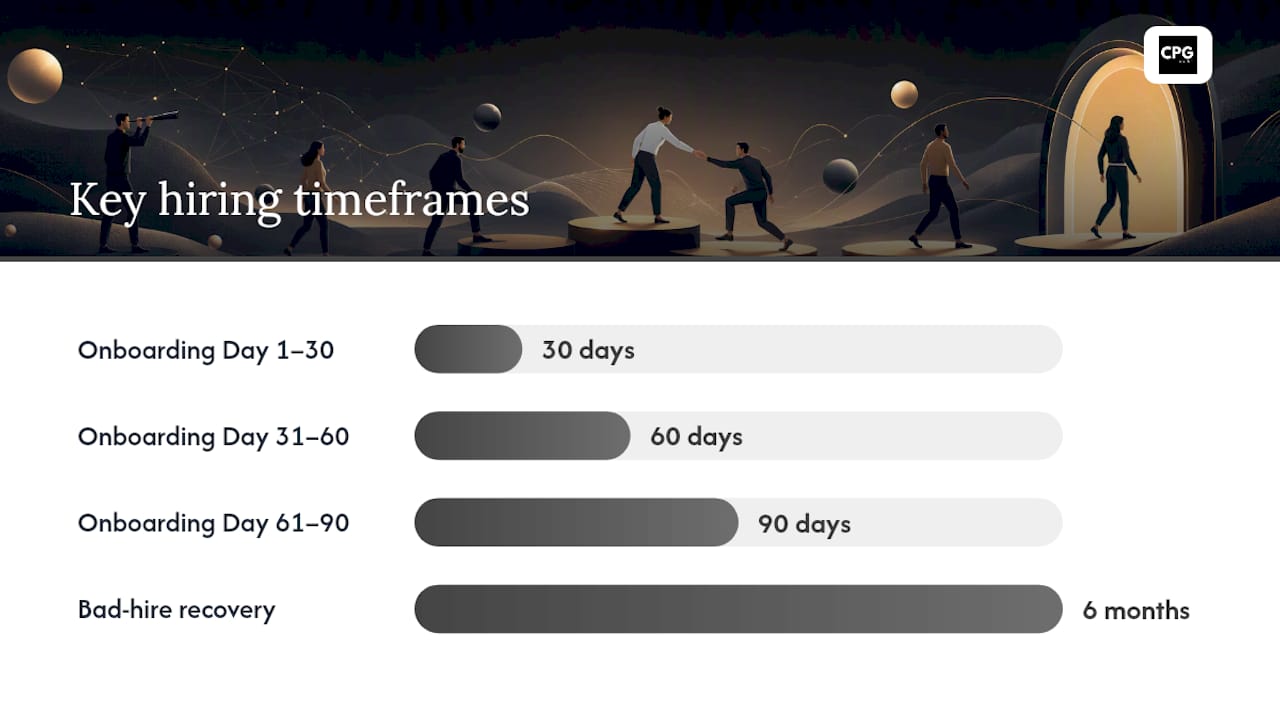
Hiring fast to fill gaps is almost always the wrong move. The cost of a bad hire at a 15-person company is not just the salary: it is the culture drag, the management time, and the six months it takes to recover execution momentum.
Prioritized first roles for early scaling:
- Head of Operations / Supply Chain — owns fulfillment lead time and inventory accuracy
- Customer Success Lead — owns churn rate and repeat purchase rate
- Sales / Retail Account Manager — owns velocity per store and new account qualification
- Product / Quality Manager — owns defect rate and QC process compliance
For each role, write the one metric they own before you post the job. A candidate who cannot speak to that metric in the interview is not the right hire yet.
30/60/90-day onboarding milestones:
- Day 1–30: Shadow existing processes, document what they observe, and identify one improvement
- Day 31–60: Own one process end-to-end with a defined output metric
- Day 61–90: Present a 90-day improvement plan with measurable targets
Culture preservation checklist:
- Share the founding story and positioning rationale in week one, not month three
- Assign a culture buddy from the founding team for the first 30 days
- Run a weekly 15-minute team standup that includes one "why we exist" moment
- Review every new hire's first 30-day observations: they often spot the drift the founding team has normalized
Pro Tip: When headcount doubles, your culture does not automatically survive. Bob Sutton's advice applies here too: subtract the rituals that no longer scale and replace them with lighter, more frequent touchpoints. A 15-minute weekly check-in beats a quarterly all-hands for culture maintenance.
Which operational systems must you lock before scaling?
Operational failures during scale are almost always predictable. Inc.'s analysis of common scaling errors points directly to stretched capacity and lack of process as the root causes of distribution failures. The brands that scale cleanly are the ones that build these systems before they need them.
Operational areas to secure first:
- Demand forecasting (even a simple 13-week rolling model beats no model)
- Inventory buffer policy (minimum weeks of cover by SKU)
- Supplier SLAs with documented lead times and penalty clauses
- QC checkpoints at production, warehouse receipt, and retail audit
- Order-to-fulfill process with a defined owner and SLA
- Returns handling and chargeback dispute process
- Trade spend math: know your net margin per account before you sign
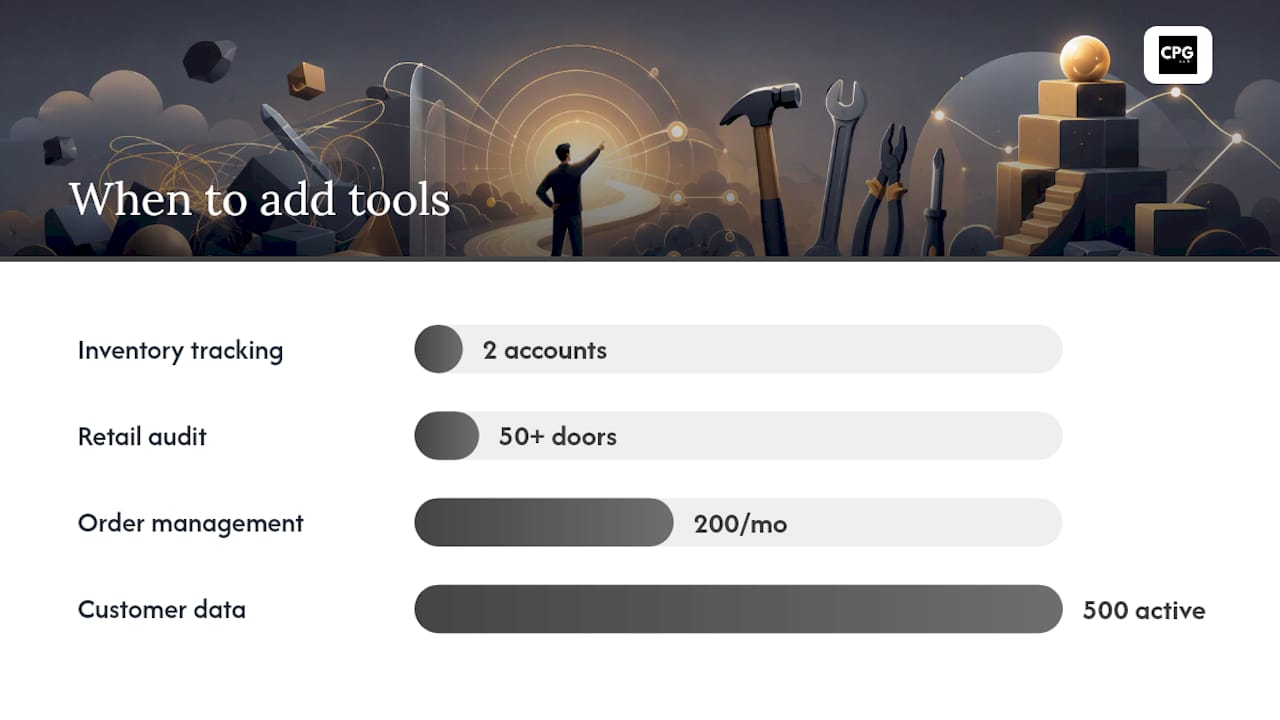
Minimum viable tech stack for a scaling challenger brand:
| Function | Category | When to add |
|---|---|---|
| Inventory tracking | Inventory management software | Before adding a second retail account |
| Demand forecasting | Spreadsheet or lightweight FP&A tool | Before committing to a production run |
| Order management | OMS or ERP lite | When orders exceed 200/month |
| Customer data | CRM or CDP | When direct channel exceeds 500 active customers |
| Retail audit | Field audit app or manual tracker | Before expanding to 50+ doors |
The instinct to invest in a heavy ERP early is almost always wrong. Start with the lightest tool that solves the immediate problem, and upgrade when the constraint is the tool, not the process.
Pro Tip: Bob Sutton's subtraction principle applies directly to your tech stack: before adding a new tool, ask whether an existing one can do the job. Every new system adds onboarding time, integration risk, and cognitive load for a team that is already stretched.
How do you protect customer experience and product quality while scaling?
CX slippage during scale is quiet at first. Response times drift from 12 hours to 48. A production run ships with a packaging inconsistency. A new retail account gets onboarded without a proper sell-in kit. None of these feel catastrophic individually, but together they erode the trust that made the brand worth scaling in the first place.
Six controls to hold experience steady:
- Set a written customer success SLA (response time, resolution time) before adding headcount
- Run a monthly sample QC audit on retail-shelf product, not just production output
- Build a customer onboarding checklist for every new retail account
- Create a rapid feedback loop: customer complaints reviewed weekly, routed to product and marketing within 48 hours
- Track churn rate and repeat purchase rate as leading indicators, not lagging ones
- Assign one person to own the NPS or satisfaction score, with authority to escalate
Two metrics matter most here. Churn rate tells you whether existing customers are leaving faster than you can replace them. Repeat purchase rate tells you whether the product experience is strong enough to earn a second buy. If repeat purchase rate drops more than 5 percentage points quarter-over-quarter, treat it as a five-alarm signal, not a planning note.
Protecting customer experience during scale is not a customer service problem. It is a systems problem. The brands that hold CX steady are the ones that documented the experience before they grew, not after.
A common pattern: a challenger brand adds a third co-packer to meet demand and skips the QC onboarding checklist. Defect rates rise. A retailer flags the issue. The brand spends three months recovering a listing it took two years to earn. A single QC checkpoint at warehouse receipt, added before the third co-packer went live, would have caught the problem in week one.
How should founders handle delegation and board alignment during scale?
The founder who cannot let go is the most common ceiling on challenger brand growth. HBS research on scaling startup challenges describes the pattern clearly: founders who intervene in every decision prevent their teams from developing the judgment to operate independently. The short-term cost of stepping back is real. The long-term cost of not doing it is the company.
Governance mistakes that slow growth:
- Boards with more than five members at the Series A stage
- Investor incentives misaligned with the brand's growth timeline
- No documented escalation path for decisions above a defined spend threshold
- Founder approval required for decisions that should be owned by the ops or marketing lead
Board composition checklist:
- Three to five members maximum at early scale
- At least one operator who has scaled a consumer brand before
- Defined meeting cadence (quarterly board, monthly KPI review)
- Three to five agreed KPIs that the board tracks every quarter, in writing
Delegation rubric:
| Decision type | Owner | Escalation trigger |
|---|---|---|
| Operational (under $5K) | Department lead | None |
| Strategic (over $5K) | Founder + lead | Board notification |
| Brand positioning | Founder | Board alignment required |
| New retail account | Sales lead | Founder sign-off on first 3 |
Pro Tip: The shift from founder-led to operator-led decision-making does not have to happen all at once. Pick one functional area per quarter and hand it over completely. The brand soul survives delegation. It does not survive a founder who is the bottleneck on every decision.
Your 30-day emergency playbook for challenger CPG brands
When a scaling problem surfaces, the instinct is to fix everything at once. That is the wrong move. Triage first, then stabilize, then restart growth.
Week 1: Diagnose and stop the bleeding
- Pull your 13-week cash flow model. If you do not have one, build it today.
- Identify the top three operational failures causing revenue loss or churn.
- Freeze any new distribution commitments until inventory and fulfillment are stable.
- Owner: Founder. Output: Written list of the top three risks, ranked by revenue impact.
Week 2: Stabilize operations and cash
- Confirm inventory buffer levels by SKU. Flag any SKU below 6 weeks of cover.
- Review supplier SLAs. Identify any supplier without a documented lead time commitment.
- Audit trade spend by account. Cut any account where net margin is negative.
- Owner: Head of Operations. Output: Updated inventory position and supplier SLA status.
Week 3: Shore up customers and the core offering
- Run a customer satisfaction pulse (5-question survey or direct outreach to top 20 accounts).
- Audit retail shelf presence in your top 10 doors. Check for out-of-stocks, placement issues, and pricing compliance.
- Review your positioning document. Has anything drifted from the original audience and promise?
- Owner: Customer Success Lead + Founder. Output: Churn rate and repeat purchase rate for the last 90 days.
Week 4: Restart disciplined growth
- Define the one growth lever you will pull next (new accounts, new SKU, new channel) and the readiness criteria it must meet.
- Document the repeatable sales process: pitch deck, qualification criteria, and follow-up cadence.
- Set the three KPIs the team will track weekly for the next quarter.
- Owner: Founder + Sales Lead. Output: Written growth plan with go/no-go criteria.
For hands-on help running this triage, Cpgagent's AI-powered strategy tools cover demand forecasting, retail audit, and growth roadmap validation, so you are not building these diagnostics from scratch.
Pro Tip: Use a lean brand strategy framework to pressure-test your positioning before restarting growth in Week 4. A single positioning drift, caught early, saves months of wasted spend.
Key Takeaways
The most common scaling mistakes challenger brands make are operational and organizational, not product-related, and almost all of them are preventable with the right diagnostics run before growth accelerates.
| Point | Details |
|---|---|
| Validate before expanding | Confirm repeat purchase rate, gross margin, and fulfillment reliability before adding distribution. |
| Hire for key functions first | Prioritize operations, customer success, and sales over headcount volume. |
| Document before you delegate | SOPs and a delegation rubric must exist before the founder steps back from any process. |
| Run the 30-day triage | Use the Week 1–4 playbook to diagnose, stabilize, and restart growth in sequence. |
| Cpgagent accelerates the fix | Cpgagent's platform provides AI-driven diagnostics, growth roadmaps, and fractional CMO support for challenger brands at this exact stage. |
The part most scaling guides skip
The conventional wisdom on scaling challenger brands focuses almost entirely on growth levers: new channels, new SKUs, new markets. What it underweights is the cost of moving before the foundation is solid.
The brands that scale cleanly are not the ones that move fastest. They are the ones that spend an uncomfortable amount of time in the "not yet" phase, validating velocity, locking supplier SLAs, and documenting processes that feel obvious when the team is five people and catastrophic when it is fifty.
The hardest lesson is this: the positioning that made the brand worth scaling is also the thing most at risk during scale. Audience drift and channel sprawl are not strategic failures. They are the natural result of saying yes to every opportunity that looks like growth. The brands that protect their positioning through scale treat it as an operational constraint, not a marketing aspiration. A quarterly positioning review is not a branding exercise. It is a growth control.
If there is one thing worth doing before the next growth push, it is writing down the three things the brand will not do, no matter how attractive the opportunity looks. That list is harder to write than a growth plan. It is also more valuable.
Cpgagent gives challenger brands a faster path through the hard part
Challenger brands that have hit a scaling wall typically face the same problem: the diagnostics that would tell them exactly what to fix are buried in spreadsheets, supplier emails, and founder intuition. Cpgagent replaces that guesswork with rapid, data-backed clarity.
The Cpgagent platform gives founders AI-powered tools for demand forecasting, retail audit, growth roadmap validation, and persona research, plus fractional CMO and senior marketing leadership for brands that need an experienced operator in the room without a full-time hire. The result is a faster triage cycle and a clearer path from "something is broken" to "here is the fix and the owner."
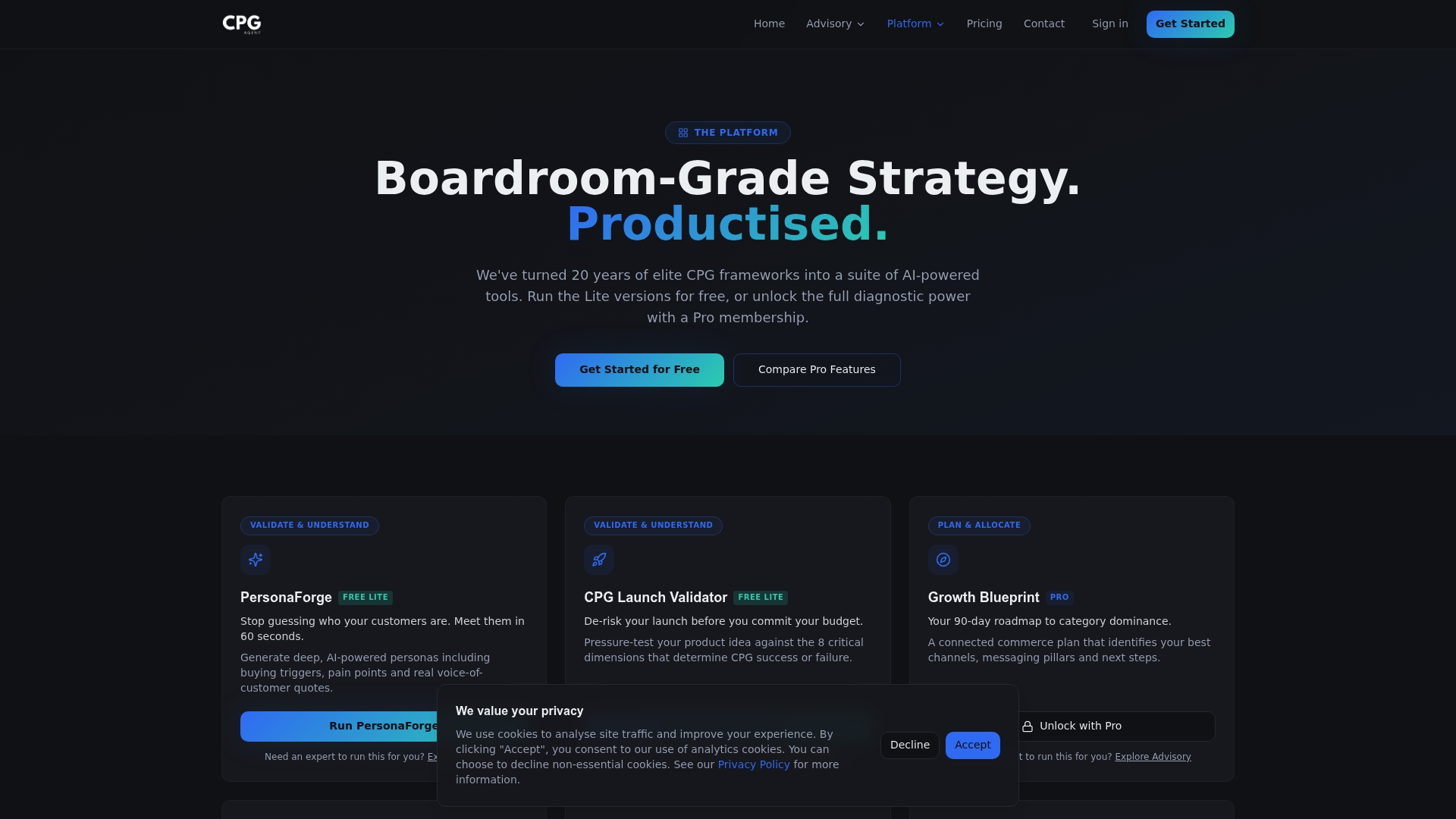
If your brand is at the inflection point between early traction and real scale, the 30-day playbook above is the starting point. Cpgagent's platform is where you run it with tools and expert support already built in. Book a consult or start a trial at cpgagent.com/platform.
Useful sources and further reading
The research below informed this guide. Each source is worth reading in full if you want to go deeper on a specific area.
- From start-up to centaur: Leadership lessons on scaling
- 4 Startup Challenges to Avoid When Scaling Your Business
- The dos and don'ts of rapid scaling for startups
- How challenger brands beat legacy retail on positioning
- Why Most Brands Never Scale — Honest Partners Group
- The 6 Most Common Mistakes Founders Make When They ..
- The 5 Most Common Mistakes When Trying to Scale a Company
FAQ
What is the single biggest scaling mistake challenger brands make?
Scaling distribution before validating unit economics and fulfillment reliability. HBS research confirms that traction does not equal readiness, and premature expansion is the fastest path to retailer chargebacks and cash flow failure.
Look for a repeat purchase rate above 30% within 90 days, gross margin above 40% at retail after trade spend, consistent sales velocity in pilot stores for at least 8 weeks, and at least 12 months of cash runway.
Why do challenger brands lose focus during growth?
Channel sprawl and audience drift are the most common causes, as Shopappy's analysis identifies. Every new opportunity that looks like growth pulls the brand away from the positioning that made it worth scaling in the first place.
How can Cpgagent help a brand that is already in a scaling crisis?
Cpgagent's platform provides rapid diagnostics, AI-powered growth roadmaps, retail audit tools, and fractional CMO support, giving founders the tools and senior expertise to triage and stabilize without a long agency onboarding process.
What is the fastest operational fix for a challenger brand hitting a wall?
Build a 13-week rolling cash flow model, confirm inventory buffer levels by SKU, and document your top five operational processes before adding any new headcount or distribution commitments.