

TL;DR:
- Most successful CPG ads focus on testing and optimizing the hook rather than relying on a single creative approach. Achieving a 30-35% hook rate on TikTok and Meta is essential to avoid higher CPMs and algorithm penalties. Systematic use of diverse frameworks and templates accelerates testing, ensuring continuous improvement without excessive production.
Most CPG marketing teams spend weeks producing video content, only to watch it flatline in the first three seconds. The CPG Hook Library 5 High-Converting Hook Frameworks for TikTok and Meta Ads addresses exactly this problem: not the production, not the product, but the hook. A single misconception drives most of this waste, and that's the belief that one creative approach works across platforms, products, and audiences. It doesn't. What stops the scroll on TikTok and what converts on Meta are genuinely different animals, and the brands winning right now are the ones who treat hook writing as a systematic practice, not a creative guess.
Table of Contents
- Key takeaways
- Why hooks are the real CPG ad metric
- The 5 hook frameworks every CPG brand needs
- Fill-in-the-blank hook templates for CPG brands
- How to test, refresh, and avoid creative fatigue
- My honest take on CPG hook strategy
- How Cpgagent helps you build and scale your hook library
- FAQ
Key takeaways
| Point | Details |
|---|---|
| Hook rate is your leading metric | Target 30-35%+ hook rate on Meta and TikTok to avoid CPM penalties from the algorithm. |
| Five frameworks cover most CPG needs | Pattern Interrupt, Curiosity Gap, Social Proof, Problem-Agitation, and Founder Authority each serve distinct audience moments. |
| Templates accelerate testing | Fill-in-the-blank hooks let you launch 4-6 variations per video without reshooting the entire ad. |
| Refresh cycles matter by platform | Refresh creative every 2-4 weeks on Meta and weekly on TikTok to protect CPMs and auction health. |
| Systematic libraries beat one-off videos | Testing multiple hook types on a single core offer video produces better ROI than producing brand new content each cycle. |
Why hooks are the real CPG ad metric
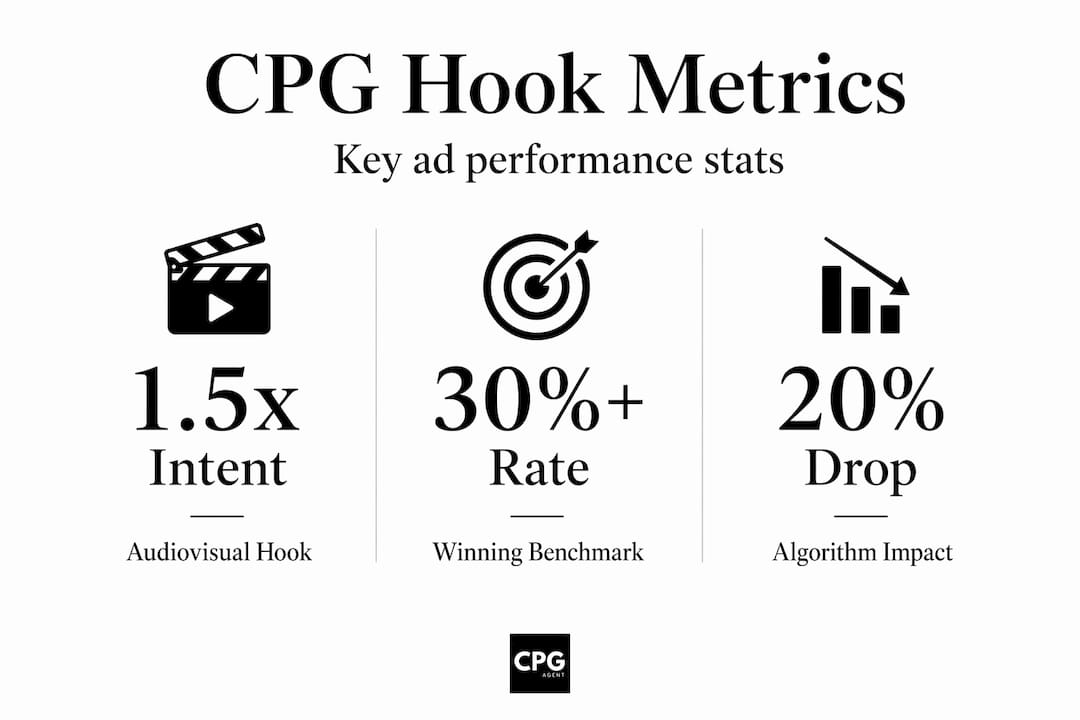
Before you build your hook library, you need to understand what the platforms are actually measuring. Both Meta and TikTok use hook rate as a proxy for creative quality. Hook rate is the percentage of people who watch the first three seconds of your video after seeing it in their feed. Meta benchmarks confirm that 30-35% or above is competitive performance. Anything below 25% signals that the algorithm considers your creative weak, and you pay for it in higher CPMs.
The penalty is not abstract. A drop in hook rate causes Meta's algorithm to deprioritize your ad in auction, which pushes your costs up and your delivery down. You're not just losing attention. You're losing budget efficiency in real time. TikTok operates similarly but has a shorter tolerance window. Feeds move faster and users are trained to skip anything that feels like an ad within the first second.
Here's a practical benchmark table to keep in your back pocket:
| Metric | TikTok target | Meta target | Below this = warning |
|---|---|---|---|
| Hook rate (3-sec view rate) | 35%+ | 30-35%+ | Below 25% |
| Hold rate (watch to 50%) | 20%+ | 25%+ | Below 15% |
| CTR (click-through rate) | 1.5%+ | 1.2%+ | Below 0.8% |
| Creative refresh cadence | Weekly | Every 2-4 weeks | No rotation = fatigue |
Pro Tip: Watch hold rate alongside hook rate. A high hook rate with a low hold rate means your opening grabbed attention but the creative failed to deliver on its promise. Fix the body of the ad, not just the hook.
One more thing worth calling out: audiovisual hooks in the first 1-2 seconds boost top-20% purchase intent by 1.5x compared to visual-only hooks. Sound-on creative isn't optional on TikTok, and it's rapidly becoming the standard on Meta Reels as well.
The 5 hook frameworks every CPG brand needs
These five frameworks account for the majority of high-performing CPG ad creative across TikTok and Meta. Each one works differently in the brain, which is exactly why you need all five in rotation rather than defaulting to your favorite.
-
Pattern Interrupt. This framework breaks the visual or auditory expectation a user has for what comes next in their feed. Think: unexpected sounds, jarring cuts, or a visual that simply doesn't fit the scroll context. For CPG brands, this could be an extreme close-up of a texture, a loud noise, or a person doing something physically surprising with your product. It works because the brain is wired to pay attention to things that break pattern.
-
Curiosity Gap. This one opens a loop the viewer can only close by watching more. "I stopped buying this after I found out what's actually in it" is a curiosity gap hook. It works because humans are cognitively uncomfortable with unresolved questions. For CPG brands, the gap is usually tied to an ingredient, a process, a comparison, or an unexpected outcome.
-
Social Proof. Numbers and community validation are powerful CPG tools because food, beverage, and personal care purchases are heavily peer-influenced. A hook that leads with volume ("500,000 people switched to this"), a visible crowd reaction, or a loaded comment section screengrab tells the viewer this product has already been vetted. Social proof frameworks yield ROAS of 3.8 to 4.6x for premium and mission-driven CPG brands according to 2026 campaign data.
-
Problem-Agitation. This framework names a specific, painful problem in the first two seconds and twists the knife slightly before offering relief. For functional food and beverage brands, this is particularly potent because the target buyer is often already frustrated. Bloating, energy crashes, bad skin days, and restless nights are all problem hooks that land hard before your product becomes the solution.
-
Founder Authority. This works when a real person, ideally the founder or a recognizable expert, speaks directly to camera with credibility and conviction. TikTok's preference for native creator-style ads means that founder-led hooks often outperform polished production because they appear organic, not packaged. The hook here is trust. "I spent 12 years in food science before I made this" triggers immediate authority bias.
Pro Tip: Don't use Founder Authority hooks on cold audiences alone. Pair them with a retargeting campaign on Meta where the viewer has already seen your product once. Warm audiences convert at significantly higher rates with this framework.
Each framework maps to a different consumer psychology trigger. Running all five simultaneously, even on a single product, tells you something priceless: which trigger your specific audience responds to. That data shapes your creative roadmap for the next quarter.
Fill-in-the-blank hook templates for CPG brands
This is where strategy becomes execution. These templates are designed to be grabbed, adapted, and tested. The use of emojis in hooks raises top-20% purchase intent by 2.5x in video formats, so consider adding a native visual element when adapting these for Reels or TikTok.
Pattern Interrupt templates:
- "Wait. Did that just [unexpected action with product]?"
- "[Loud sound effect or visual shock] This is what [product benefit] actually looks like."
- "Nobody talks about [unusual product attribute]. We need to fix that."
Curiosity Gap templates:
- "I used to buy [competitor category] until I learned what's actually in it."
- "This [product type] does something most people have never seen. Watch to the end."
- "The reason [common problem] keeps happening? It's not what you think."
Social Proof templates:
- "[Number] people switched from [old solution] to [your product] this month. Here's why."
- "Our DMs are full of people saying [specific result]. So we decided to show you."
- "This [product] has [number] five-star reviews. The most common word? [Specific descriptor]."
Problem-Agitation templates:
- "If you've ever dealt with [specific pain point], you already know how bad it gets by [time of day]."
- "Most [product category] products promise [benefit] and deliver [frustrating outcome]. We got tired of it."
- "Nobody wants to talk about [embarrassing or frustrating problem]. We will."
Founder Authority templates:
- "I spent [X years] in [relevant field] before I realized [industry insight]. That's why I made this."
- "As a [relevant credential], I won't put anything in this product I wouldn't give my own [family member]."
- "Every [product category] brand says [common claim]. Let me show you what we actually do differently."
Adapting these to your brand voice takes minutes. What takes discipline is committing to testing 4-6 hook variations on a single core video script rather than producing five separate videos. The ROI on systematic testing almost always beats the ROI on volume production.
How to test, refresh, and avoid creative fatigue
Building a hook library is step one. Keeping it alive is the ongoing job. Here's what creative fatigue actually looks like before your account manager notices it:
- Hook rate drops below 25% across multiple ad sets simultaneously.
- CPM creep of 15% or more week over week with no targeting change.
- Frequency climbs above 3.5 on Meta without a corresponding engagement lift.
- Your best-performing creative from last month is now your worst performer.
These are signals, not coincidences. Refreshing creative every 2-4 weeks on Meta and weekly on TikTok improves CPMs by up to 37% and prevents the algorithm from treating your ads as low-quality inventory.
The following comparison shows how reactive versus proactive hook management plays out over a 90-day cycle:
| Approach | Hook refresh cadence | CPM trend | ROAS trend |
|---|---|---|---|
| Reactive (replace after drop) | Every 6-8 weeks | Creeps up 20-30% | Declines 15-25% |
| Proactive (systematic rotation) | Weekly/biweekly | Stable or decreasing | Stable or improving |
| Hook library with A/B testing | Continuous variation | Lowest sustained CPMs | Highest sustained ROAS |
The practical workflow looks like this: each week, pull hook rate and hold rate from your dashboard. Flag anything below threshold. Pull the next hook template from your library, adapt it to your active offer, and launch a new variation into the same ad set alongside the existing creative. Let Meta's Andromeda algorithm, which dynamically matches creatives to individual users, do the optimization work.
For CPG brands managing creative strategy without agency overhead, this workflow is exactly what separates teams that scale from teams that stall. The refresh cadence is not creative indulgence. It's budget protection.
Pro Tip: Build your hook library in a shared doc with columns for framework type, platform target, performance data, and last run date. Treat it like a catalog, not a one-time project. The library compounds in value the longer you maintain it.
My honest take on CPG hook strategy
I've seen CPG brands spend $40,000 producing gorgeous brand films that generate a 12% hook rate. I've also seen a founder filming in their kitchen with an iPhone hit 52% because the hook landed.
What I've learned after watching hundreds of these accounts perform is this: most marketers treat the hook as the opening line of an ad. The best marketers treat it as a separate product. One that gets tested, iterated, and retired on its own schedule.
The systematic hook taxonomy approach, testing 4-6 distinct openings on the same core video, is genuinely the highest-leverage creative move available to CPG brands right now. You don't need more videos. You need more hypotheses about what makes your buyer stop. And you need a system for confirming or eliminating those hypotheses fast.
What I think most people miss is the platform-native storytelling piece. TikTok doesn't reward ads that look like ads. It rewards content that fits the feed. Your Founder Authority hook on TikTok should feel like a creator sharing something real, not a brand making a pitch. Meta is more forgiving of polished production, but it still rewards specificity in the hook over generic benefit claims.
The future here is AI-powered hook generation against a structured framework library. Brands that build that infrastructure now will have a significant compounding advantage. The creative output scales. The learning compounds. The CPMs stay lower.
— Matthew
How Cpgagent helps you build and scale your hook library
Running a systematic hook library across TikTok and Meta requires more than a shared Google doc. It requires infrastructure that connects creative testing to real-time performance data, flags fatigue signals automatically, and generates new hook variants without adding headcount.
Cpgagent's platform tools are built specifically for CPG and FMCG brands that need to move at this pace. The platform connects directly to Meta and TikTok ad systems to pull hook rate, hold rate, and CPM data into a single dashboard. When performance drops below threshold, you get flagged before the algorithm penalizes your account. AI-powered hook variant generation means your library grows with every campaign cycle, not just when your team has bandwidth. For brands serious about CPG brand differentiation, this is the infrastructure that makes it possible at scale without the overhead of a traditional creative agency.
FAQ
What is a good hook rate for CPG ads on Meta and TikTok?
A hook rate of 30-35% or above is considered competitive on both Meta and TikTok. Anything below 25% signals creative fatigue and typically leads to higher CPMs as the algorithm penalizes low-quality creative.
How often should a CPG brand refresh its creative hooks?
CPG brands should refresh hooks weekly on TikTok and every 2-4 weeks on Meta. Proactive refresh cycles have been shown to improve CPMs by up to 37% compared to reactive replacement after performance drops.
Which hook framework works best for functional food brands on TikTok?
Problem-Agitation and Founder Authority hooks tend to perform especially well for functional food brands on TikTok because they feel native to creator-style content and speak directly to the buyer's specific frustration before presenting the product as the solution.
Do I need to produce new videos for each hook variation?
No. Testing 4-6 hook variations on a single core video script produces higher ROI than creating entirely new videos for each creative angle. The hook is the variable; the offer and body of the video can stay constant across tests.
Why does hook rate matter more than CTR for CPG ads?
Hook rate is a leading indicator of creative quality that directly affects your CPM and auction health. CTR measures what happens after engagement, but hook rate tells you whether the algorithm will even give your ad the chance to generate clicks in the first place.