

AI creative testing lets marketing teams score and forecast creative variants before a single dollar of media spend hits a platform. The recommended approach is simple: run every asset through pre-launch scoring and forecasting, kill the weak variants, and only launch what clears the bar. Done right, this cuts wasted spend, compresses decision cycles from weeks to hours, and lets brand teams test more hypotheses without adding headcount.
TL;DR:
- Pre-launch AI scoring and forecasting can eliminate up to 60% of wasted media spend by filtering weak creative variants before campaign launch.
- Combining scoring models, synthetic-audience simulation, and performance forecasting provides a more accurate prediction of creative effectiveness than relying on one signal alone.
- Building a structured brief template before generating variants ensures that each asset remains on-brief, reducing post-generation cleanup and improving efficiency.
- Ongoing performance tracking and fatigue detection, integrated into the pipeline, enable automated creative refreshes and continuous improvement for future campaigns.
- Human review remains essential to address cultural nuance, brand safety, and final decision-making, as AI tools serve as inputs rather than replacements for judgment.
Table of Contents
- What Is AI Creative Testing and How Does It Differ From Older Methods?
- Why AI Creative Testing Matters for Performance and Budget
- How Does the AI Creative Testing Workflow Actually Work?
- What Tools and Data Do You Need to Set This Up?
- How Do You Turn Scores and Forecasts Into a Launch Decision?
- How Do You Track Performance and Feed Learnings Back Into Future Briefs?
- How CPG Agent Applies This Pipeline in Practice
- What Ethical Risks Come With AI Creative Testing?
- How Does AI Creative Testing Change Creative Team Roles?
- A Straight Answer on Getting Started
- Put This Pipeline to Work With CPG Agent
- Sources
- FAQ
What Is AI Creative Testing and How Does It Differ From Older Methods?
AI creative testing evaluates ad creative, images, video, copy, or combined assets, using machine learning models to predict performance before launch, rather than waiting on live spend or slow consumer panels to generate a verdict. Traditional A/B testing burns real budget to learn what works; panel-based pretesting takes days or weeks to recruit respondents and tabulate results. AI-driven approaches compress that timeline into minutes or hours by running assets through trained models instead of live audiences.
Three approaches dominate the category today:
- Scoring models that rate creative on attributes like clarity, emotional pull, and brand fit.
- Synthetic-audience simulation that predicts how defined audience segments will likely respond.
- Forecasting models that estimate click-through rate, conversion likelihood, or fatigue curves based on historical performance patterns.
Most serious workflows combine all three rather than relying on one signal alone.
Why AI Creative Testing Matters for Performance and Budget
The math is straightforward once you see it laid out. Media budgets get spent whether or not the creative works, and legacy testing methods only tell you it failed after the spend is gone.
Pre-launch filtering can eliminate roughly 40% to 60% of wasted budget by removing weak variants before they ever reach a campaign, according to Lapis's AI ad optimization playbook. The same guidance recommends launching only the top half of scored variants after scoring and forecasting.
That reduction compounds with two other advantages:
- Speed to decision. Scoring and forecasting can return results in minutes to days rather than the weeks a traditional panel study takes.
- Test volume. Because each evaluation costs a fraction of a live media test, teams can run far more creative hypotheses per quarter.
- Brand risk stays real. Faster testing without quality gates just means faster mistakes, so scoring thresholds and human review still matter before anything ships.
How Does the AI Creative Testing Workflow Actually Work?
Every effective pipeline runs on what practitioners call the "inner loop": a repeatable sequence that turns a brief into a launch-ready set of assets. Here's the sequence, step by step.
- Research and enrichment. Pull first-party performance data, audience definitions, and category benchmarks into one dataset before writing anything.
- Structured brief creation. Convert research patterns (hook type, offer, format) into a brief template that maps directly to generation prompts.
- Variant generation. Produce multiple creative directions from that single brief using generative tools, rather than commissioning one asset and hoping.
- Scoring and forecasting. Run every variant through a scoring model for quality signals and a forecasting model for predicted performance.
- Selection. Keep only variants that clear both the score threshold and the forecast bar, not just one or the other.
- Launch and monitor. Deploy the winners and track live signals against what the models predicted.
Scoring and forecasting answer different questions, and that's why you need both. A score tells you whether the creative is well built: is the message clear, does it match brand voice, does the visual hierarchy work. A forecast tells you whether it's likely to perform against a specific goal, like click-through rate or conversion. A beautifully scored asset can still forecast poorly for a specific audience segment, and a rough-scoring asset occasionally forecasts well because it matches a pattern the model has seen convert before. You need both numbers before you decide.
Asset clustering and fatigue detection plug in right after launch. Tag every variant by hook, format, and offer type at the generation stage, and the system can group similar creative into clusters, then flag when a cluster's performance starts declining across the group rather than one asset at a time.
Pro Tip: Build your brief template before you touch any generation tool. A template that maps hook, offer, and format into structured prompts, as recommended in MarqOps's 2026 advertising guide, means every variant is on-brief by design instead of requiring cleanup after the fact.
What Tools and Data Do You Need to Set This Up?
Building a working pipeline means assembling five tool categories rather than buying one platform that claims to do everything.
- Research tools that surface audience insight and category patterns, feeding the brief stage. AI-powered consumer research tools handle this well when connected to first-party data.
- Generation tools like Adobe Firefly, which supports custom models for consistent brand style across image, video, and audio output, or platform-native options like Google Flow, built to move creative from concept to execution inside ad workflows.
- Scoring and forecasting engines that evaluate variants before spend.
- Optimization layers that manage in-flight budget and rotation once campaigns go live.
- Analytics dashboards that close the loop by comparing forecasted performance to actual results.
The data inputs matter more than the tools themselves. You need first-party performance history (what actually worked in past campaigns), structured briefs (so generation stays on-target), audience definitions with enough specificity to mean something, and platform benchmarks for the channels you're testing against.
On the operational side, tag every asset at creation, maintain a searchable creative library instead of scattered folders, and automate the handoff from scoring results to media buying so approved variants launch without a manual bottleneck. Teams using AI tools for marketing operations tend to formalize this handoff early, which saves weeks once volume increases.
How Do You Turn Scores and Forecasts Into a Launch Decision?
Numbers alone don't make decisions. You need a rule that turns a score and a forecast into a clear go or no-go, or your team just argues about borderline cases forever.
Scoring dimensions typically cover:
- Clarity, whether the message lands in the first three seconds.
- Emotional resonance, whether the creative triggers a reaction beyond neutral scrolling.
- Brand fit, whether tone, color, and voice match established guidelines.
- Format compliance, whether the asset actually meets platform specs and aspect ratios.
Forecasting outputs generally predict click-through rate, conversion probability, or an early fatigue curve estimate. Calibration matters here: a forecast trained on last year's category benchmarks can drift when a platform algorithm changes, so recalibrate quarterly rather than trusting a model indefinitely.
Adtest pairs a multi-dimensional score with a small first-party audience validation sample, reconciling model confidence against real human reads when nuance or brand safety is on the line, and still delivers results in minutes to days rather than weeks. That combination matters most when the creative touches sensitive territory a model alone might misjudge.
A workable decision rule: launch only variants that score above your quality threshold and forecast in the top half of the batch. Anything that clears one bar but misses the other goes back for revision, not launch. That single rule is what actually captures the 40% to 60% waste reduction Lapis describes, because it filters on two independent signals instead of one.
How Do You Track Performance and Feed Learnings Back Into Future Briefs?
Launching isn't the finish line. The metrics you track after launch tell you whether your scoring and forecasting models are actually calibrated to reality, and they build the dataset that makes your next round of briefs sharper.
- Track creative-level metrics daily for the first week. Click-through rate, hook rate (how many viewers watch past the first three seconds), and conversion rate all show early signal faster than weekly rollups.
- Set a fatigue threshold. A common trigger is a meaningful CTR decline over a rolling window; when a cluster crosses it, automated rotation swaps in the next-ranked variant rather than waiting for a human to notice.
- Archive winners and losers with full tagging intact. Every asset's hook, format, offer, and outcome data feeds back into the tag-to-metric mapping that informs the next brief.
Agentic optimization systems can now analyze hundreds of signals and rebalance budgets or trigger creative refreshes on very short cycles, according to Lapis's playbook, which means fatigue detection increasingly runs on autopilot rather than a weekly manual review. That still doesn't replace the archive step. Without it, every campaign starts from zero instead of building on what the last one proved.
How CPG Agent Applies This Pipeline in Practice
The workflow above isn't theoretical. It maps directly onto how brand teams already use structured AI tools to move from research to launch-ready creative.
- PersonaForge handles the research and enrichment stage, building audience definitions from first-party and category data before a brief gets written.
- Launch Validator sits at the scoring and forecasting stage, giving teams a go or no-go signal before media spend commits to a direction.
- Fractional CMO and growth advisory engagements add the governance layer this pipeline needs: someone senior enough to set the score threshold, arbitrate borderline calls, and get stakeholders aligned on what "launch-ready" actually means for the brand.
Teams that skip governance tend to either over-trust the model (launching anything that scores well, brand voice be damned) or under-trust it (running every asset past committee anyway, which erases the speed advantage). The CPG Agent platform is built around keeping that balance workable for lean marketing teams without a full agency stack behind them.
What Ethical Risks Come With AI Creative Testing?
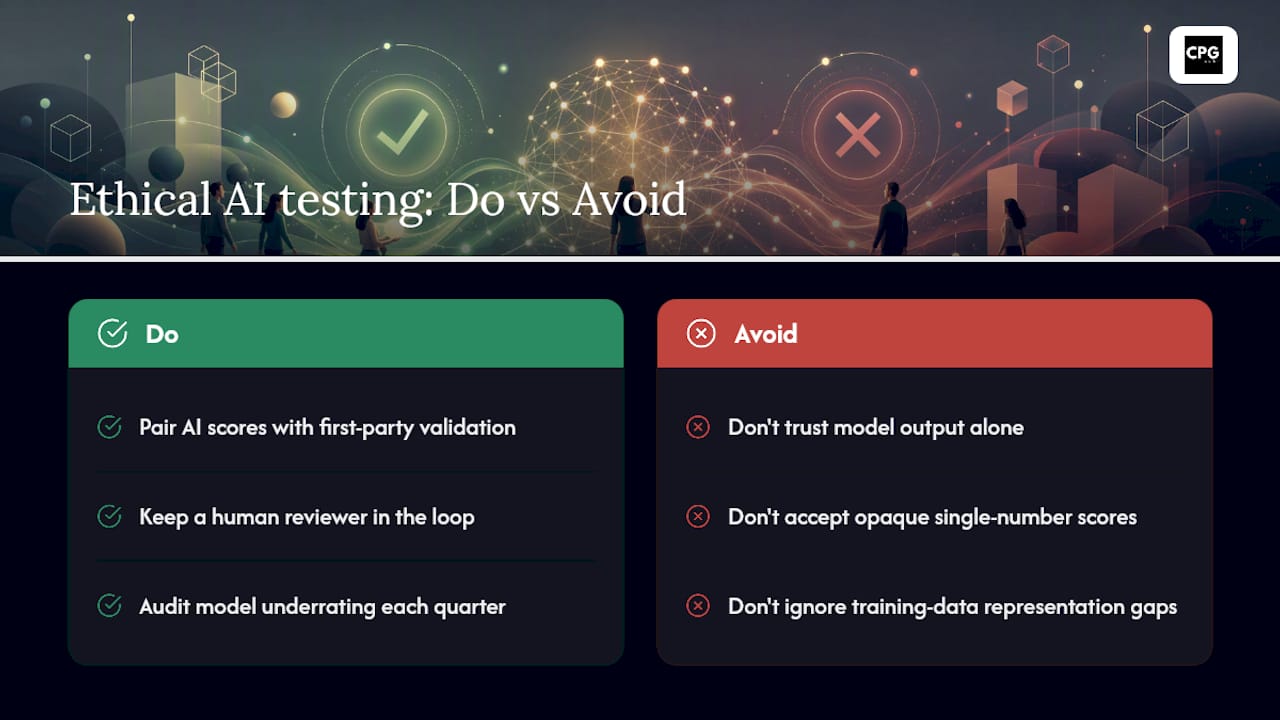
Bias in AI creative testing usually enters through the training data, not the algorithm itself. If a scoring model learned "what works" from a dataset skewed toward one demographic's response patterns, it will systematically underrate creative aimed at audiences underrepresented in that training set. A brand testing creative for a multicultural campaign against a model trained mostly on mainstream category benchmarks risks getting confidently wrong scores.
Synthetic-audience simulation carries a related risk. A model predicting "how audience X will respond" is working from statistical patterns, not lived experience, and it can flatten real cultural or generational nuance into a single average that misses how a specific community actually reads a message. That's part of why pairing AI scores with a small first-party audience validation sample, rather than trusting the model output alone, matters most on culturally sensitive or emotionally loaded creative, a point AdTest.AI's methodology makes directly.
There's also a transparency question worth sitting with. When a model rejects a variant, teams should be able to see which dimension drove the low score, not just a single opaque number. A scoring system that returns "38/100" with no breakdown gives a creative team nothing to act on and erodes trust in the process fast.
The practical fix isn't avoiding AI scoring. It's treating the model as one input among several, keeping a human reviewer in the loop for anything touching sensitive claims, protected categories, or culturally specific messaging, and periodically auditing which variants the model consistently underrates. Teams that build this audit step into their quarterly review catch drift before it becomes a pattern of excluding the same kinds of creative every cycle.
How Does AI Creative Testing Change Creative Team Roles?
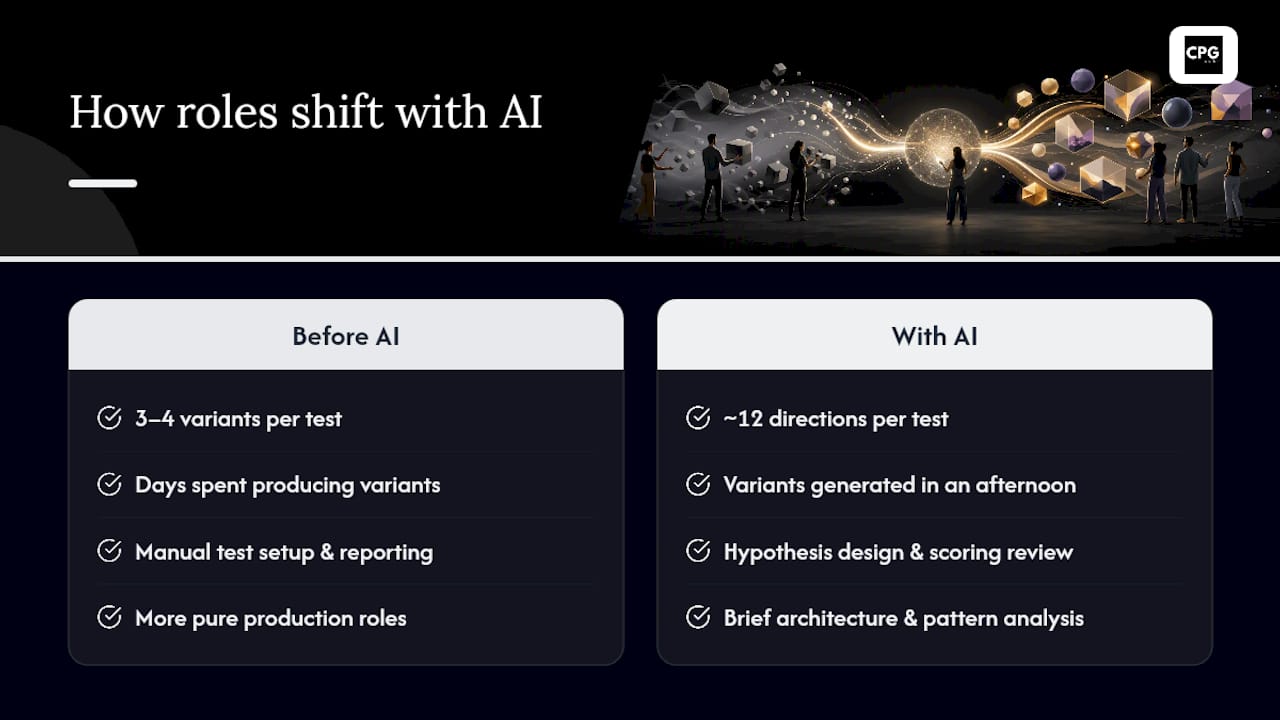
The honest answer is that it shifts where creative talent spends time, rather than eliminating the need for it. Copywriters and designers who used to spend days producing three or four variants for a single test now generate a dozen directions in an afternoon, which sounds like it reduces the role. In practice, it moves the skilled work upstream: writing the brief that shapes what gets generated matters more than it used to, because a vague brief produces a dozen mediocre variants just as easily as it once produced one.
Strategists and creative leads increasingly spend their time on hypothesis design (what pattern are we actually testing, and why) and on reviewing borderline scoring calls, rather than on manual test setup and reporting. That's a real shift in day-to-day work, not a cosmetic one. Segwise's guide to building a data-backed creative engine makes a related point: the value comes from a unified system that tags creative elements and surfaces patterns, letting strategists focus on hypotheses and offers instead of manual test administration.
For brand teams, this usually means fewer people doing pure production work and more people doing brief architecture, scoring calibration, and cross-campaign pattern analysis. Junior creative roles that were mostly execution focused are the ones most likely to see real change, while senior creative strategists and brand voice owners become more central, not less, because someone still has to decide what "on-brand" means when a model is generating at volume.
A Straight Answer on Getting Started
Start smaller than you think you need to. Run one 60 to 90 day pilot on a single campaign line, set a clear target (say, a measurable cut in cost per acquisition versus your last comparable launch), and put one senior person in charge of the score threshold before you scale past it. Brand safety guardrails and stakeholder buy-in matter more early than tool sophistication.
— Matthew
Put This Pipeline to Work With CPG Agent
Cpgagent gives brand teams the exact machinery this playbook describes, without the retainer structure or months-long onboarding a traditional agency requires to get there. Where legacy testing means booking a panel study and waiting weeks for a verdict, Cpgagent's tools score and forecast creative variants in-house, on your timeline, integrated with the stack you already run.
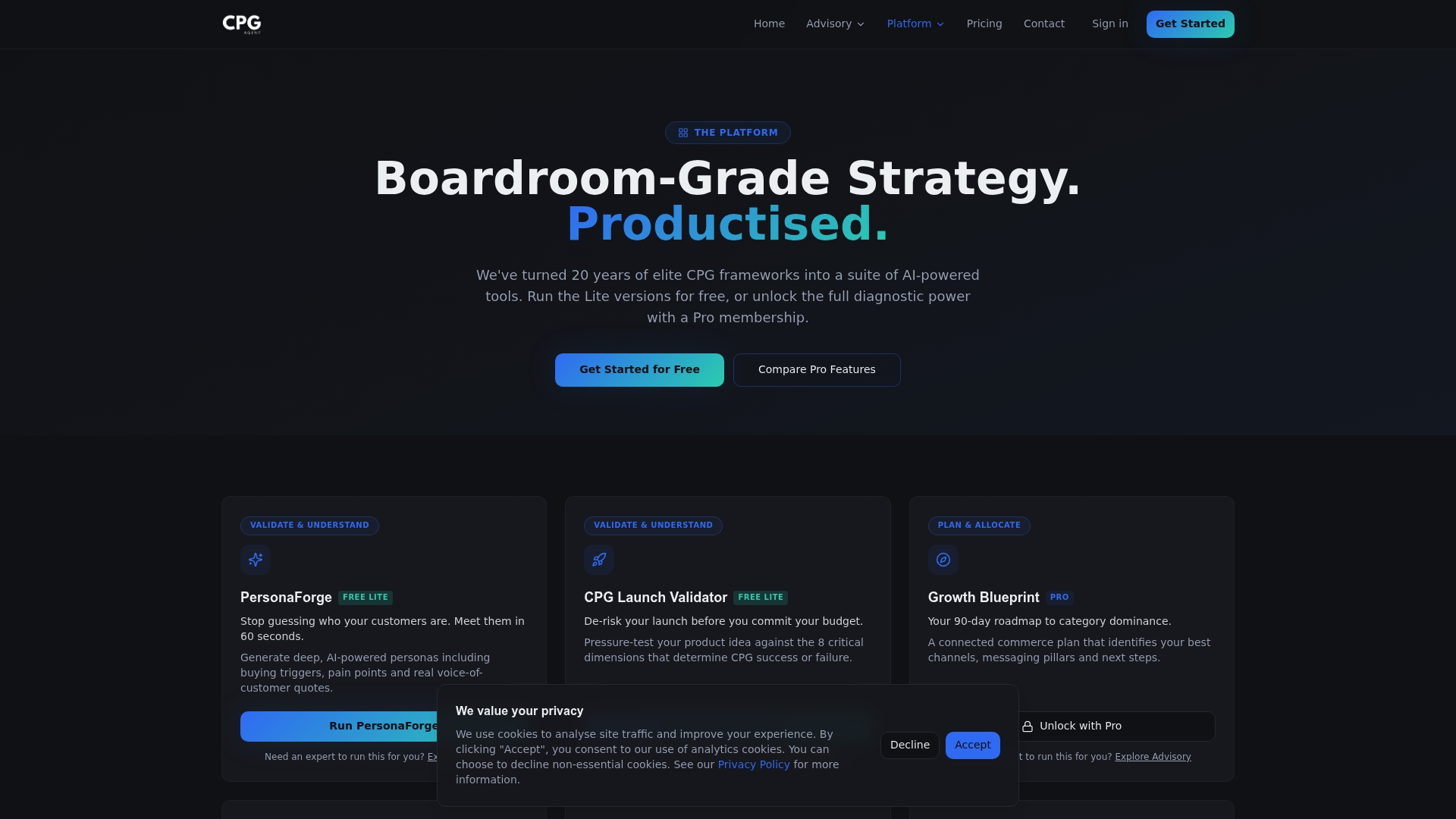
PersonaForge builds the audience and research layer, Launch Validator handles the scoring and forecasting decision, and if your team needs senior guidance for governance and threshold calls, advisory services can support without a full-time executive hire. Brands at various stages, from startups validating a first launch to established portfolios modernizing a legacy pipeline, can access this approach without rebuilding their tech stack from scratch.
If you're ready to see how this maps to your own creative pipeline, visit the CPG Agent platform and start scoping a pilot around your next campaign line.
Sources
For deeper detail on the tools and standards referenced above, see Lapis's AI ad optimization playbook, AdTest.AI, Adobe Firefly, Google Flow, and Google's AI era marketing guide.
- AI ad optimization playbook (Lapis) — trylapis resources
- Adtest
- Google Flow — AI creative studio for video, images & custom tools
FAQ
How Do I Become an AI Creative Tester?
There's no formal certification path; the role usually grows out of media buying, creative strategy, or marketing analytics backgrounds combined with hands-on experience running scoring and forecasting tools like the ones described above.
What Is the 30% Rule in AI Creative Testing?
There's no single, widely recognized "30% rule" tied specifically to AI creative testing; if you've seen the phrase, it likely refers to a specific vendor's internal benchmark rather than an industry standard, so treat it with caution rather than as settled guidance.
Is AI Ad Scoring Software Worth the Cost?
For teams running frequent creative tests, pre-launch scoring tools tend to pay for themselves through the 40% to 60% reduction in wasted media spend that filtering weak variants before launch can produce.
Does AI Creative Testing Replace Human Creative Judgment?
No. AI scoring and forecasting narrow the field of variants worth considering, but brand fit, cultural nuance, and final launch decisions still need a human reviewer, especially on sensitive or emotionally loaded creative.