

The fastest way to move a Target listing's performance is to close the gaps flagged in its Content Health Score, starting with images, video, bullets, and attribute completeness. Pair those content fixes with clean inventory and fulfillment data, since a beautiful page attached to a broken supply chain still tanks. Brands that triage this way typically see visibility and conversion improve within weeks, not quarters.
TL;DR:
- Improving the Content Health Score by fixing images, videos, and attributes can significantly boost visibility and conversions within weeks, not months.
- Prioritize creating a hero image, lifestyle photos, and a product video, as these assets can increase conversion rates by up to 3.5 times.
- Write concise, focused bullets covering key specs and benefits, and ensure long copy is clear, non-repetitive, and well-structured for quick skimming.
- Regularly audit and optimize product attributes, variant grouping, and media assets, with a focus on core SKUs to maximize impact efficiently.
- Ensure mobile page loads under 2.5 seconds and implement UX fixes like sticky add-to-cart buttons and lazy-loading to improve mobile conversion rates.
Table of Contents
- What Is the Target Content Health Score and Why Does It Control Visibility?
- Image and Rich Media Strategy: What to Produce First
- How Do You Write Bullets and Long Copy That Convert?
- Which Attributes Actually Drive Discoverability on Target?
- How Many Reviews Does a Target PDP Need to Convert?
- What Mobile Performance Metrics Actually Affect Conversion?
- What Should a PDP Audit and KPI Framework Look Like?
- What Does a 30/60/90-Day Remediation Plan Look Like?
- How Specialized Platforms Support Target PDP Remediation
- How Does PDP Work Connect to the Rest of the Funnel?
- How Should You Handle Product Variations and Bundles on a Target PDP?
- PDPs Are Media Assets, Not Paperwork
- Getting Started With Cpgagent
- Sources
- FAQ
What Is the Target Content Health Score and Why Does It Control Visibility?
Target's Content Health Score is a color-coded scorecard that grades each TCIN on the completeness of its listing content: image count, video presence, bullet quality, long description depth, and attribute accuracy. Low scores don't just sit quietly in a dashboard. They actively suppress a product's presence in search results and category browsing, which is the mechanism most brand managers underestimate when they treat content as a "nice to have" instead of a visibility lever.
The scorecard updates on a rolling cadence, and Target refreshes it biweekly or monthly depending on the seller relationship. That means a fix made today doesn't always show up in reporting immediately, so patience matters as much as speed.
Here's what typically pulls a score down:
- Fewer than three product images, or images that don't meet Target's technical specs
- No video asset on the PDP
- Bullets under the recommended count or written in vague marketing language
- Missing or incomplete product attributes (size, color, material, compatibility)
- Long stretches with zero reviews or Q&A activity
Sub-80 content scores paired with extended periods of no sales can trigger listing removal, according to Imagine.io's Target Plus content quality analysis. That's the real cost of ignoring the scorecard: it's not a soft signal, it's a gate.
Low scores also bleed into paid media. Target's ad auctions reward listings with strong organic content signals, so a weak PDP means you're paying more per click to compensate for a page that isn't converting on its own. Fixing the score isn't just an SEO play. It's a media efficiency play.
Image and Rich Media Strategy: What to Produce First
Not all assets carry equal weight, and brands that spread production budget evenly across every SKU waste money on low-traffic items while starving the pages that actually drive revenue. Build the asset stack in this order:
- Hero shot on white background at a minimum of 2400 pixels so the zoom function works cleanly on mobile.
- Four to five lifestyle images showing the product in use, from different angles, ideally including scale references (a hand holding the item, a room shot for furniture).
- A packaging or label shot for anything regulated, food-adjacent, or supplement-related, where guests want to verify ingredients or certifications before buying.
- One video, 30 to 60 seconds, either a quick how-to or in-use B-roll. This is the asset most brands skip and the one with the biggest single payoff.
Target's own guidance states that PDPs with more than three images see conversion increase by roughly 1.6 times, and PDPs that include video convert about 3.5 times higher than those without. Video typically appears as the third media asset in the gallery, so it needs to be ready before launch, not bolted on months later.
Pro Tip: Shoot modular. Capture your hero and lifestyle images in one session using interchangeable backdrops and props, then layer in spec overlays during post-production instead of reshooting for every size or color variant.
Production shortcuts that actually hold up: batch multiple SKUs in a single studio day, use text overlays for dimensions and specs instead of separate infographic slides, and start collecting user-generated content from early buyers through post-purchase email so you have a video library building itself in the background. Bazaarvoice's guidance on Target PDPs pushes brands to treat the page like a dynamic, scrollable media asset rather than a static spec sheet, and that framing should guide what you shoot first.
How Do You Write Bullets and Long Copy That Convert?
Target expects between 4 and 10 bullets in the "About this item" section, and each one should do a specific job rather than repeat the same claim in different words. A well-built bullet set covers: one core spec, one functional benefit, one use-case scenario, and one compatibility or pairing note. Skip the fifth bullet if you don't have a fifth genuine point to make. Padding with filler hurts more than a shorter, sharper list.
Long copy needs a minimum of 50 words, though two to three short paragraphs work better than one dense block. Guests skim. Give them a first paragraph that states what the product is and who it's for, then a second that covers materials, care, or technical detail, and stop there.
Formatting rules that keep copy clean:
- Use sentence case, not title case, inside bullets and long copy
- Never repeat a fact already stated in the bullets inside the long description
- Include exact dimensions, weight, and material composition wherever applicable
- Cut adjectives that don't carry information ("amazing," "perfect," "must-have")
- Match voice to a factual retail tone, not a landing-page sales pitch
Pro Tip: Read your bullets out loud. If a sentence sounds like something a salesperson would say on a showroom floor rather than something a spec sheet would print, rewrite it.
Writing for Target's format is different from writing for a brand's own site or Amazon, and treating all three channels identically is a common mistake. A closer look at retailer-specific PDP copy strategy breaks down how tone and structure should shift by channel.
Which Attributes Actually Drive Discoverability on Target?
Structured attributes, not keyword density, determine whether a product surfaces in Target's filters and category browse. This is the part of PDP work that gets the least attention and delivers some of the highest return, because a shopper filtering by size or color simply never sees a product with a missing or mismatched attribute field, no matter how good the copy is.
Check these fields first, since they carry the most weight in filter logic and category placement:
- Size and color, mapped consistently across every variant
- Compatibility fields for anything sold as an accessory or add-on
- Product type classification, confirmed against Target's taxonomy rather than a generic internal category
- TCIN-to-variant mapping, verified so parent/child relationships aren't broken
Catalog architecture is a governance problem as much as a content problem. According to Adverio's Target catalog optimization research, poor variant grouping causes split velocity, where sales and reviews scatter across multiple listings instead of consolidating under one parent, diluting both social proof and search ranking. Fixing this means auditing how variants are grouped and confirming inventory sync so a popular color doesn't stock out while an unrelated variant sits unsold and drags down the group's performance data.
Run this check quarterly, not once. Taxonomies shift, Target adds new attribute fields periodically, and a listing that was perfectly mapped a year ago can quietly fall out of sync.
How Many Reviews Does a Target PDP Need to Convert?
You don't need hundreds of reviews to see a lift. Even a single review measurably improves conversion compared to a listing with zero social proof, signaling to hesitant shoppers that someone bought and used the product. That said, momentum matters, and brands should treat review count as an ongoing target rather than a box to check once.
Operationally, set a clear service level for Q&A: respond within 48 hours. A question sitting unanswered for a week reads as a brand that isn't paying attention, and it costs conversions on every visitor who scrolls down to check.
Tactics that reliably move the needle:
- Post-purchase email sampling programs that request a review 10 to 14 days after delivery
- Social campaigns that route existing customers toward the Target listing specifically, not just a generic "leave us a review" ask
- Review invites embedded in packaging inserts for higher-ticket items
- A monitoring routine that flags negative reviews or unanswered questions for quick triage
Bazaarvoice's research on Target PDPs frames reviews and UGC as part of the full-funnel media mix, not a bolt-on section at the bottom of the page. Treat review generation with the same planning rigor you'd give a paid media calendar.
What Mobile Performance Metrics Actually Affect Conversion?
Speed and touch ergonomics matter more on Target than most brand teams assume, because the majority of PDP traffic arrives on a phone with variable connection quality. Largest Contentful Paint under 2.5 seconds on a typical 4G connection is the target most performance audits use as a baseline, and pages that miss this target tend to see measurably lower add-to-cart rates, according to Metric Uno's PDP optimization framework.
The usual culprits are third-party review widgets, oversized unoptimized images, and extra JavaScript pulled in by add-on apps that nobody has audited in over a year.
Mobile UX fixes that pay off immediately:
- A sticky add-to-cart button that stays visible as the shopper scrolls through images and copy
- Swatches sized for a thumb tap, not a mouse click
- The best-selling variant pre-selected by default instead of forcing a choice before showing price
- Lazy-loading for below-the-fold images so the initial page paint stays fast
| Metric | Target benchmark | Common cause when missed |
|---|---|---|
| Largest Contentful Paint | Under 2.5 seconds on 4G | Unoptimized hero images, third-party widget bloat |
| Interaction latency | Low response time to taps | Excess JavaScript from review or Q&A plugins |
| Mobile add-to-cart visibility | Sticky, always on screen | Fixed-position CTA not implemented in template |
Audit every third-party script quarterly. A widget added two years ago for a feature nobody uses anymore is still costing load time today.
What Should a PDP Audit and KPI Framework Look Like?
A useful audit doesn't treat every PDP element as equally urgent. The strongest frameworks score listings across four dimensions: content foundation, SEO and discoverability, media and engagement, and brand readiness. This structure, outlined in Genrise's four-dimension PDP audit framework, forces prioritization instead of a flat checklist where a missing comma gets the same weight as a missing video.
Build your audit around these steps:
- Score every SKU 1 to 5 across the four dimensions rather than pass/fail
- Flag any SKU scoring below 3 on content foundation for immediate remediation
- Track KPIs at the template level, not just per-SKU, to catch systemic issues
- Set a testing cadence that segments results by device and traffic source before drawing conclusions
The core KPI set to track: page views, add-to-cart rate, conversion rate, revenue per session, and LCP. Tracking add-to-cart alone is a trap, since a lift there doesn't guarantee revenue unless checkout and inventory stay aligned, a point GrowthRock's PDP testing research makes clear.
| Audit dimension | What it measures | Priority signal |
|---|---|---|
| Content foundation | Images, video, bullets, long copy | Fix first if below threshold |
| SEO/discoverability | Attributes, taxonomy, search placement | Fix second, ongoing |
| Media/engagement | Video, UGC, review velocity | Continuous, not one-time |
| Brand readiness | Consistency across SKUs, tone, compliance | Quarterly review |
What Does a 30/60/90-Day Remediation Plan Look Like?
Start with triage, not a full catalog sweep. Fixing your top 20 revenue SKUs in the first sprint produces outsized returns compared to spreading equal effort across hundreds of listings, a pattern Adverio's catalog research confirms repeatedly.
- Days 1 to 10 (immediate triage): Fix images, bullets, and attribute gaps on the top 20 revenue SKUs. Owner: catalog manager, with creative support.
- Days 10 to 30: Produce and upload video assets, launch a post-purchase review sampling campaign. Owner: creative lead and performance marketing.
- Days 30 to 60: Run variant grouping and inventory sync audits across the full catalog. Owner: supply chain and catalog teams jointly.
- Days 60 to 90: Test layout and module ordering changes, measure LCP improvements, and re-score against the Content Health Scorecard. Owner: performance marketing with engineering support.
| Sprint window | Primary KPI | Exit criteria |
|---|---|---|
| Days 1 to 10 | Content Health Score | All top 20 SKUs above 80 |
| Days 10 to 30 | Video coverage, review count | Video live on top SKUs, review velocity up |
| Days 30 to 60 | Attribute accuracy | Zero split-velocity variants |
| Days 60 to 90 | LCP, conversion rate | LCP under 2.5s, conversion trending up |
A related sprint model for Shopify CRO testing uses a similar structure and can be adapted for teams running parallel Target and DTC remediation work.
How Specialized Platforms Support Target PDP Remediation
Running this playbook by hand across a full catalog takes real bandwidth, which is where a purpose-built system helps. Tools include shopper insight work, testing new listings before a full rollout, and audit workflows that map directly onto the four-dimension scoring model covered above. Fractional senior marketing advisory is available for teams that need direction without a full-time hire.
Practical deliverables look like a catalog audit scored by SKU, a prioritized fix list ranked by revenue impact, and a creative production guide that tells your team exactly which assets to shoot first. For brands managing dozens or hundreds of TCINs, that structure turns a vague "improve our PDPs" mandate into a sequenced project with owners and deadlines. A digital shelf analytics approach that prioritizes top SKUs first pairs directly with this kind of remediation sprint.
How Does PDP Work Connect to the Rest of the Funnel?
A PDP doesn't operate in isolation. It's the landing point for every paid search click, every retargeting ad, and every social campaign that drives a shopper toward Target, so weak content there wastes spend generated everywhere else in the funnel. If your ad creative promises a benefit the PDP doesn't reinforce visually within the first screen, you lose the shopper right at the moment they were closest to buying.
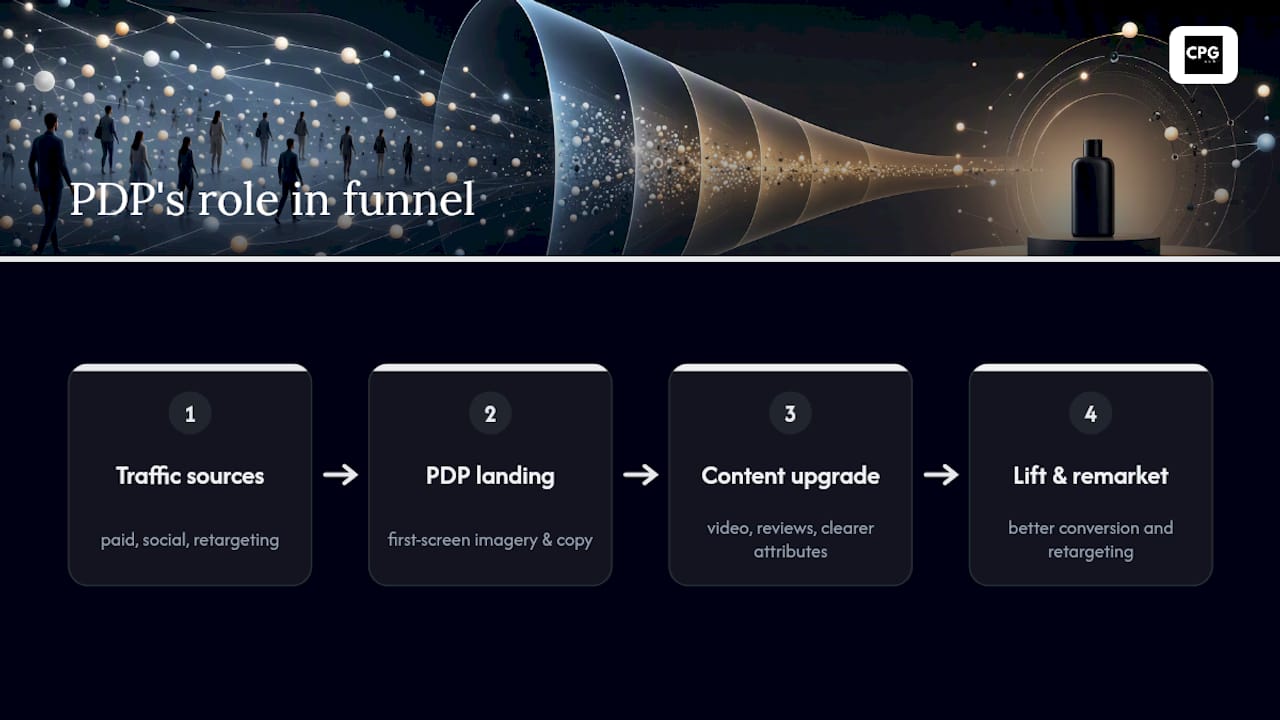
Remarketing amplifies this problem or this advantage, depending on which direction your content points. A shopper who abandoned a PDP and gets served a retargeting ad a week later lands back on the same page. If nothing has changed, that second visit converts at roughly the same low rate as the first. If the page has since gained a video, fresh reviews, or clearer attributes, that same retargeted click has a real shot at closing.
Treat PDP fixes as upstream media investments, not isolated catalog housekeeping. When a listing's Content Health Score improves, ad efficiency improves alongside it, since Target's auction rewards pages with stronger organic engagement signals. That means the PDP and paid media budget are not separate line items. They're one system, and optimizing one without the other leaves real money on the table.
Coordinate content sprints with campaign calendars. Launch new creative assets before a planned remarketing push, not after, so the traffic you're paying to bring back lands on a page that's actually ready to convert it.
How Should You Handle Product Variations and Bundles on a Target PDP?
Variation and bundling decisions affect Content Health scoring and conversion in ways that are easy to get wrong. The core rule: group true variants (same product, different size or color) under one parent listing, and keep genuinely different products as separate TCINs even if they're frequently bought together.
Bundling works best when it solves a real shopper problem, not when it's used to inflate average order value artificially. A "starter kit" bundle that pairs a core product with its most commonly needed accessory tends to outperform a bundle that just stacks unrelated items to hit a price point. Guests can tell the difference, and a bundle that feels like padding gets returned more often, which drags down both review sentiment and the Content Health Score over time.
For variant-heavy catalogs, the biggest risk is split velocity: when color or size variants are listed as separate parents instead of grouped children, sales and reviews scatter across multiple pages instead of consolidating. That dilutes the social proof and search signal each individual listing would otherwise carry. Audit your variant structure the same way you'd audit images or bullets, since a wrongly split catalog undoes content work done everywhere else on the page.
When in doubt, default to fewer, better-organized parent listings with clean variant selectors rather than a sprawling set of near-duplicate TCINs competing against each other in the same search results.
PDPs Are Media Assets, Not Paperwork
Most brand teams still treat the PDP like a form to fill out once at launch and revisit only when something breaks. That's backward. A PDP with strong content actively lowers the cost of every ad dollar pointed at it, because Target's own systems reward pages that engage shoppers with better placement and lower effective costs.
The gap I see most often isn't lack of effort, it's lack of ownership. Merchandising owns the catalog, marketing owns the ads, and operations owns fulfillment, but nobody owns the PDP as a single connected asset. Fix that reporting line before you fix another bullet point.
— Matthew
Getting Started With Cpgagent
Running the full audit and remediation cycle across a growing catalog can consume a marketing team's bandwidth without the right tooling. Specialized platforms provide a direct execution path instead of slower agency engagement: audit workflows that score catalogs across multiple dimensions, creative production guidance for prioritizing image and video shoots, and fractional CMO support when senior direction is needed without adding headcount.
Three ways to evaluate fit: run a catalog audit to see where your Content Health scores actually stand, pilot the remediation workflow on your top 20 revenue SKUs before committing catalog-wide, or bring in fractional advisory support for a defined sprint. Visit the Cpgagent platform to see the tools in action and start a conversation about which option fits your current catalog size and team bandwidth.
Sources
- Mastering Target Plus Content Quality Score: How to Optimize for Conversion & Marketplace Success
- Innovating product detail pages for full-funnel inspiration on Target
- Target Catalog Optimization Strategy for Growth Brands
FAQ
What Is a Good Target Content Health Score?
Target flags scores below 80 as risky, especially when paired with extended periods of no sales, which can lead to listing removal.
How Many Images Does a Target PDP Need?
Target recommends at least three images, though four or five deliver a stronger conversion lift, with pages showing more than three images converting roughly 1.6 times better.
Does Video Actually Improve Target PDP Conversion?
Yes. Target reports that PDPs with video convert about 3.5 times higher than those without, making video one of the highest-leverage assets a brand can add.
How Fast Should a Target PDP Load on Mobile?
Aim for a Largest Contentful Paint under 2.5 seconds on a 4G connection, since slower load times correlate directly with lower add-to-cart rates.
How Can Cpgagent Help With Target PDP Optimization?
Cpgagent's platform provides audit workflows scored across content, discoverability, engagement, and brand readiness, along with fractional advisory support for teams executing a remediation sprint.