

TL;DR:
- Stage-weighted media planning allocates marketing budgets based on customer lifecycle stages to maximize impact. It emphasizes investing more in retention and advocacy, which drive higher profits and customer loyalty. Proper planning and data-driven adjustments improve campaign performance and long-term growth.
Stage-weighted media planning is the strategic allocation of media budget across distinct customer lifecycle stages to maximize campaign impact. Rather than spreading spend evenly, this approach assigns different budget weights, channels, and messaging to each phase: awareness, consideration, decision, retention, and advocacy. For CPG and FMCG marketers, this distinction matters enormously. A brand that treats a first-time buyer the same as a loyal repeat purchaser wastes budget and misses the compounding returns that come from getting the weighting right. The framework is sometimes called lifecycle-weighted media allocation in formal planning literature, but both terms describe the same core discipline.
What is stage-weighted media planning and how does it work?

Stage-weighted media planning works by matching budget weight, channel selection, and messaging intensity to the specific objective of each customer journey phase. The logic is straightforward: a consumer who has never heard of your brand needs reach, while a consumer who has bought twice needs reinforcement and community. Treating both the same way produces mediocre results at every stage.
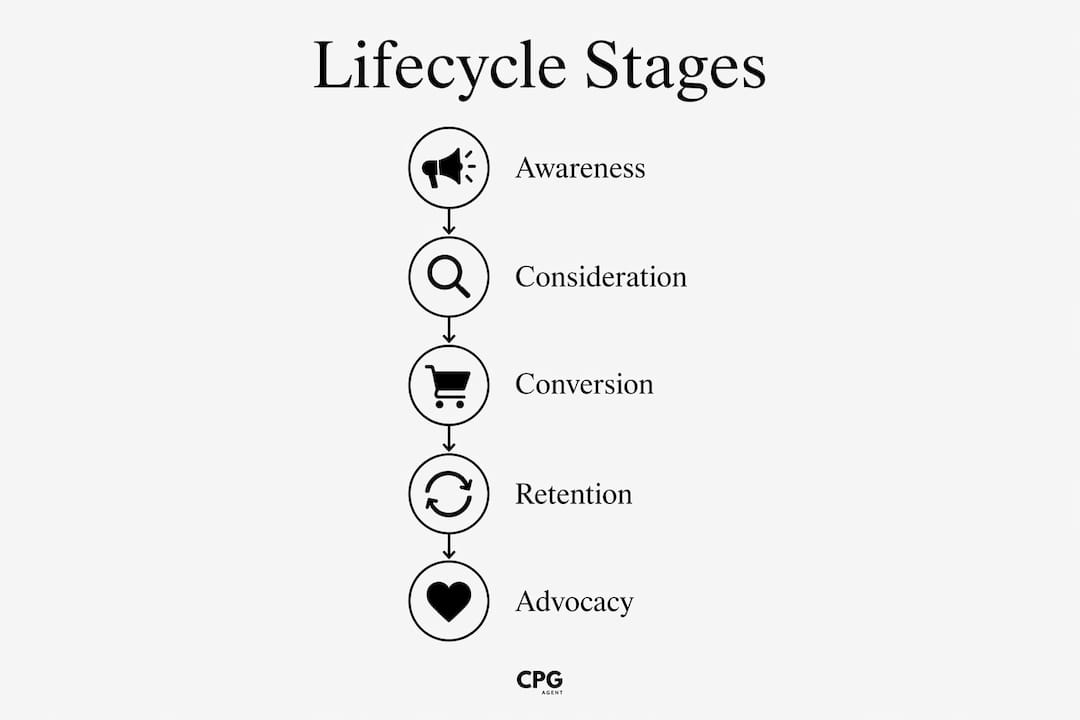
The five standard lifecycle stages each carry distinct marketing objectives:
- Awareness: Maximize reach and introduce the brand to new audiences. Channels like connected TV, programmatic display, and paid social perform here. The primary KPI is brand lift.
- Consideration: Shift from reach to frequency. Retargeting, search, and content marketing move prospects closer to a decision. The primary KPI is engagement rate and site traffic.
- Decision: Concentrate spend on conversion-focused tactics. Retail media, promotional offers, and direct response ads drive purchase. The primary KPI is conversion rate.
- Retention: Invest in loyalty programs, email, and personalized offers to keep buyers active. The primary KPI is repeat purchase rate and customer lifetime value.
- Advocacy: Activate satisfied buyers as brand amplifiers through referral programs, UGC campaigns, and community channels. The primary KPI is Net Promoter Score and referral volume.
Media planning frameworks as of 2026 recommend prioritizing broad reach during the awareness phase and shifting budget toward higher frequency in later consideration and decision phases. This phased shift is not optional. It is the mechanism that makes the whole system work.
The channel mix changes because audience behavior changes. Channel selection should follow audience behavioral research, asking "Is our audience actually there?" rather than defaulting to popular platforms. A brand launching a new protein snack bar should ask where health-conscious buyers research products before committing spend to any single channel.
| Lifecycle stage | Primary objective | Key channels | Lead KPI |
|---|---|---|---|
| Awareness | Build reach | CTV, programmatic, paid social | Brand lift |
| Consideration | Increase frequency | Retargeting, search, content | Engagement rate |
| Decision | Drive conversion | Retail media, direct response | Conversion rate |
| Retention | Extend lifetime value | Email, loyalty, personalization | Repeat purchase rate |
| Advocacy | Generate referrals | UGC, community, referral programs | NPS, referral volume |
What evidence supports stage-weighted media planning in CPG?
The financial case for weighting media toward later lifecycle stages is well established. A 5% increase in retention correlates to a 25%–95% increase in company profits. That range is wide because it reflects different business models, but even the lower bound is a compelling reason to fund retention campaigns properly rather than treating them as an afterthought.
Most CPG media plans over-index on awareness and under-fund retention and advocacy. The result is a leaky funnel: brands spend heavily to acquire customers, then lose them before recouping the acquisition cost.
Peer advocacy influences 81% of consumer purchase decisions, making the advocacy stage one of the highest-return investments a CPG brand can make. A buyer who recommends your product to three friends costs nothing in media spend and delivers qualified leads with built-in social proof.
The customer journey itself does not behave like a straight line. Buyers cycle back and re-evaluate at multiple points, re-entering the consideration stage after a competitor promotion or a product reformulation. This circular reality means a media plan built on a linear funnel model will always leave money on the table. Weighting budgets to account for re-entry points, especially between consideration and retention, produces more durable results.
Stage-specific weighting also protects conversion quality. Rushing buyers prematurely from consideration to conversion reduces product confidence and increases churn. A consumer who buys before they are ready returns the product, leaves a negative review, or simply never repurchases. The cost of that premature push shows up in retention metrics months later.
Best practices and common pitfalls in stage-based media planning
The most reliable media plans are built on audience research, not assumptions. Before assigning budget weights, map where your actual buyers spend time, how long they typically spend in each stage, and what triggers their movement forward. This research changes the weighting model significantly across CPG categories. A premium skincare brand and a value-tier snack brand will have very different consideration windows.
Four practices that separate high-performing teams from the rest:
- Assign stage-specific ownership. Top-performing teams give each lifecycle stage a distinct owner, KPI, and budget trigger. When one person owns awareness and a different person owns retention, accountability sharpens and budget drift decreases.
- Predefine budget reallocation triggers. Successful teams predefine budget reallocation rules before launch rather than making reactive adjustments mid-campaign. A trigger might be: "If awareness brand lift exceeds 15%, shift 10% of awareness budget to consideration." This removes emotion from budget decisions.
- Design stage transitions deliberately. The move from consideration to decision is where most CPG brands lose buyers. Plan the transition with the same rigor you apply to the stage itself. A well-timed retail media placement at the moment a consumer is comparing options is worth far more than a generic awareness impression.
- Treat the plan as dynamic, not fixed. A media plan locked at launch is already outdated by week three. Build in scheduled review points and permission to shift weights based on performance data.
Pro Tip: Map your stage transition triggers before the campaign launches. Knowing in advance what metric signals readiness to move budget from awareness to consideration removes the guesswork and keeps the plan moving forward on data, not gut feel.
The most common pitfall is treating the media plan as a static document. Brands that set budgets in January and review them in december will consistently underperform against brands that run quarterly or monthly reallocation reviews. The second most common pitfall is ignoring the advocacy stage entirely. For CPG brands with repeat purchase potential, advocacy is where the compounding returns live.
How to apply stage-weighted media planning in your campaigns
Start with lifecycle mapping before touching a budget spreadsheet. Segment your audience by where they currently sit in the journey: new to the category, aware but not purchased, lapsed buyers, active loyalists. Each segment gets a different weight and a different message. This segmentation work is what separates a weighted plan from a standard media plan.
Once segments are mapped, align your channel mix to each stage's behavioral reality. Buyers in the awareness stage are not searching for your brand yet, so search spend there is wasted. Buyers in the decision stage are comparing options actively, so retail media and search become the highest-priority channels. The FMCG media planning guide published by Cpgagent covers this channel-to-stage alignment in detail for fast-moving consumer goods categories.
A practical five-stage budget framework for a mid-size CPG brand might weight spend as follows: awareness receives the largest initial allocation to build the audience pool, consideration receives a growing share as the campaign matures, decision receives concentrated spend around key retail moments, and retention and advocacy together receive a meaningful share that most brands currently underfund. The exact percentages shift by category, launch phase, and competitive intensity.
Dynamic weighting requires monitoring the right KPIs at each stage. Tracking conversion rate during the awareness phase tells you nothing useful. Tracking brand lift during the decision phase is equally irrelevant. Match the metric to the stage, and review weekly during active campaigns. When a stage metric signals saturation or underperformance, the predefined trigger system moves budget accordingly.
Pro Tip: Use Cpgagent's AI-driven planning tools to model budget shift scenarios before committing spend. Running a scenario where retention receives 5% more budget than planned can reveal profit impact projections that justify the reallocation before you spend a dollar.
For brands managing limited CPG budgets, stage weighting is especially powerful because it forces prioritization. You cannot fund every stage equally on a constrained budget, so the weighting decision becomes a discipline that protects the highest-return activities.
Key Takeaways
Stage-weighted media planning outperforms flat-budget approaches because it matches spend intensity to the actual objective and behavior of buyers at each lifecycle phase.
| Point | Details |
|---|---|
| Weight by stage, not by channel preference | Assign budget based on lifecycle objectives, not platform popularity or habit. |
| Retention deserves serious investment | A 5% retention increase can drive 25%–95% profit growth, making it one of the highest-return stages. |
| Advocacy is underfunded in most CPG plans | Peer advocacy influences 81% of purchase decisions, yet most brands allocate minimal budget here. |
| Predefine reallocation triggers | Set budget shift rules before launch to avoid reactive, emotion-driven mid-campaign changes. |
| The journey is circular, not linear | Plan for buyers to re-enter earlier stages and build weighting models that account for re-evaluation loops. |
Why most CPG media plans get the weighting backwards
After working with CPG and FMCG brands across multiple growth stages, the pattern I see most often is a media plan that is 70% awareness and 30% everything else. That ratio made sense when brand building was the only game in town. It does not make sense now, when retention data is accessible, advocacy is measurable, and the cost of losing a loyal buyer to a competitor is quantifiable.
The circular customer journey insight changes everything about how I think about budget allocation. When a buyer re-enters the consideration stage after a competitor runs a promotion, a brand with zero retention budget has no mechanism to pull them back. The awareness spend that acquired them in the first place is now working for the competitor. Brands that invest in retention and advocacy create a gravitational pull that keeps buyers from drifting.
The teams I have seen execute this well share one trait: they run their lifecycle stages as a connected system. Each stage feeds the next. Advocacy feeds awareness through word of mouth. Retention feeds advocacy through loyalty. Decision feeds retention through onboarding. When you build the media plan to reflect those connections, the whole system performs better than any individual stage could on its own.
My practical recommendation: start by auditing your current plan for retention and advocacy budget share. If those two stages together receive less than 20% of total media spend, you have found your biggest opportunity. Shift budget there before adding to awareness, and measure the profit impact over two quarters. The results will make the case for a permanent reallocation.
— Matthew
How Cpgagent supports lifecycle-driven media planning
CPG and FMCG brands that want to move from flat-budget media plans to true stage-weighted allocation need more than a spreadsheet. They need a system that maps lifecycle stages, models budget scenarios, and tracks stage-specific KPIs in one place.
Cpgagent's platform is built for exactly this kind of orchestrated campaign management. The AI-driven tools model budget shift scenarios across lifecycle stages, flag when predefined triggers are met, and surface retention and advocacy opportunities that most brands miss. For teams managing multiple SKUs or regional campaigns, the platform connects stage ownership, budget rules, and performance data into a single workflow. Explore the campaign planning tools to see how stage-weighted allocation works in practice for CPG and FMCG brands.
FAQ
What is stage-weighted media planning?
Stage-weighted media planning is the practice of allocating different budget weights, channels, and messaging to each phase of the customer lifecycle. It replaces flat-budget media plans with a system that matches spend intensity to the actual objective of each stage.
How does stage-based marketing differ from traditional media planning?
Traditional media planning often allocates budget by channel or platform. Stage-based marketing allocates budget by customer journey phase first, then selects channels that match where buyers in that phase actually spend their time.
Which lifecycle stage delivers the highest ROI for CPG brands?
Retention and advocacy consistently deliver the highest return on incremental spend. A 5% increase in retention can increase profits by 25%–95%, and peer advocacy influences 81% of purchase decisions at zero incremental media cost.
How often should you rebalance stage budget weights?
High-performing teams review stage budget weights monthly during active campaigns and predefine reallocation triggers before launch. Waiting until end-of-campaign to rebalance means missing the performance windows where shifts would have mattered most.
What KPIs should you track for each lifecycle stage?
Track brand lift for awareness, engagement rate for consideration, conversion rate for decision, repeat purchase rate for retention, and Net Promoter Score for advocacy. Matching the metric to the stage is what makes the data useful for budget decisions.