

Price pack architecture (PPA) is the deliberate design of pack sizes, price points, and pack roles across a portfolio so every SKU earns its place on the shelf without cannibalizing its neighbors. Done well, it lifts EBIT margins by up to four percentage points, according to Roland Berger, by rebuilding the mix instead of just raising sticker prices. The rest of this piece walks through how to audit, design, test, and govern it.
TL;DR:
- A well-designed price pack architecture can increase EBIT margins by up to four percentage points through strategic rollouts of different pack sizes and prices.
- Building a balanced ladder with clear roles for entry, routine, upsize, and upscale packs prevents cannibalization and captures different shopper occasions effectively.
- Effective PPA relies on comprehensive data, including scanner, survey, and simulation insights, to accurately model demand elasticity and avoid unintended price inversions.
- Cross-functional governance with clear guardrails is essential to maintain PPA integrity over time, preventing pack role overlap and operational costs from undermining margins.
- Quick, controlled pilots lasting 8 to 12 weeks and guided by shopper occasion research ensure the ladder remains aligned with market dynamics and shopper preferences.
Table of Contents
- What Price Pack Architecture Is (And What It Isn't)
- Why PPA Matters: The Commercial Case
- Core Components: Ladder, Roles, and Price-Per-Unit Curves
- A Step-by-Step Framework to Audit and Redesign Your PPA
- The Data and Analytics That Make PPA Defensible
- Making PPA Stick: Implementation and Governance
- Testing and Pilots: Design, Metrics, and Common Pitfalls
- Common Mistakes and Risks to Watch For
- An 8 to 12 Week Checklist to Launch a PPA Program
- How Price Pack Architecture Evolved Into an RGM Discipline
- What Case Studies Reveal About PPA Wins and Misses
- How Competitive Moves Should Shape Your Pack Ladder
- Why Shopper Behavior Has to Drive Pack Design, Not Just Cost Math
- Packaging Costs and Manufacturing Realities That Constrain Every Ladder
- An Editorial Take on Where PPA Actually Pays Off
- Cpgagent: The Platform Built to Move PPA From Spreadsheet to Shelf
- Sources
- FAQ
What Price Pack Architecture Is (And What It Isn't)
Price pack architecture is the practice of mapping every pack size and price point in a product line into a deliberate ladder, so each SKU serves a distinct shopper need and none of them compete with each other for the same trip. It sits inside revenue growth management (RGM) alongside price realization, promotion strategy, and mix management, but it specifically owns the question of "how many sizes, at what prices, doing what job."
That's different from pack-size optimization, which usually means engineering the cheapest pack to manufacture and ship. It's also different from shrinkflation, which quietly shrinks a pack while holding the price flat and hoping nobody notices. The New York Times has covered how that public backlash plays out when shoppers catch on. PPA can include a smaller pack, but only as one deliberate rung on a ladder, priced and communicated on purpose.
The ladder itself is the core artifact. Line up every pack size for a product line by price and by price-per-unit, and you get a visual staircase. Each step should represent a real jump in either quantity or occasion, not a marginal SKU that duplicates the one next to it.
Typical rungs on that ladder include:
- A small trial or convenience pack aimed at a low-commitment occasion
- A standard pack that most repeat buyers default to
- A larger multipack aimed at stock-up trips
- A premium or bulk format aimed at value-per-unit shoppers
Get those roles blurry and you end up with two SKUs fighting for the same basket instead of covering two different ones.
Why PPA Matters: The Commercial Case
The financial case for PPA is straightforward: it captures margin that a blanket price increase leaves on the table. Roland Berger's research puts the potential EBIT margin gain from transformational PPA work at up to four percentage points, which is a meaningfully larger swing than most brands get from a single across-the-board price hike.
By the numbers: Roland Berger's analysis of transformational PPA programs found EBIT margin gains of up to four percentage points, framing PPA as a structural RGM lever rather than a one-time pricing tweak.
A flat price increase hits every buyer the same way, including the price-sensitive ones who might defect to a private label instead of absorbing it. PPA spreads that pressure differently. It nudges some shoppers toward better-margin packs, holds an anchor pack steady to protect the value seekers, and lets a premium format capture willingness to pay from buyers who were never price sensitive in the first place.
It also reduces channel conflict. When a club-store multipack and a convenience-store single carry genuinely different price-per-unit positioning, retailers stop comparing notes and undercutting each other's shelf price. EY's modeling shows that whether upsizing, shrinking, or repricing a pack improves cash margin depends entirely on the elasticity and margin per unit of that specific pack. There's no universal answer. That's precisely why ad hoc shrinkflation, applied the same way across a whole line, tends to underperform a properly modeled ladder.
Core Components: Ladder, Roles, and Price-Per-Unit Curves
Building a defensible PPA starts with three tools: the pack-price ladder, the pack roles framework, and the price-per-unit curve. Together they tell you where your portfolio has gaps, overlaps, and pricing errors nobody has caught yet.
The ladder plots every SKU's total price against its size, usually by weight or volume. The step ratio between adjacent rungs (the price increase divided by the size increase) tells you whether you're rewarding bigger baskets or accidentally punishing them. A healthy ladder gives a modest per-unit discount for stepping up in size, enough to nudge behavior without giving away margin.
Assigning each SKU a defined role clarifies what job it's doing:
- Entry: low price point, designed to win a first trial or a low-commitment occasion, often thinner margin by design
- Routine: the volume anchor most loyal buyers default to, balanced margin and velocity
- Upsize: a larger multipack for stock-up missions, priced to reward bulk buying without collapsing per-unit revenue
- Upscale: a premium format or larger size at a premium per-unit price, capturing willingness to pay from less price-sensitive shoppers
Pro Tip: Plot price-per-unit against pack size for your entire line and look for a dip in the middle. That inversion, where a mid-size pack is cheaper per unit than a smaller one, is usually an unintentional promotion that's quietly training shoppers to skip your Routine pack altogether.
Ladder inversions like that are more common than most brand managers assume, especially after a few years of piecemeal price changes layered on top of each other without anyone stepping back to look at the whole curve.
A Step-by-Step Framework to Audit and Redesign Your PPA
Revology Analytics lays out a seven-step process for engineering a pack-price ladder, and the version below adapts it into a workable sequence for most brand teams.
- Inventory every SKU by channel. Pull current pack size, price, and price-per-unit for each SKU in every retailer and channel where it sells. Grocery, club, convenience, and e-commerce often carry different pack mixes entirely.
- Chart the ladder per channel. Build the price-per-unit curve for each channel separately. A ladder that looks clean in grocery can be badly inverted in convenience.
- Attach fully loaded economics. Layer in gross profit per kilogram or per unit, including freight, packaging, and trade spend, so you're comparing real margin contribution, not just list price.
- Estimate willingness to pay and elasticity. Use pricing research methods (covered in the next section) to understand how demand shifts if a given pack's price or size changes.
- Design a target ladder. Propose new pack sizes, prices, or role reassignments that close gaps and fix inversions, informed by the elasticity work.
- Simulate before committing. Run the proposed ladder through a demand simulation to catch cannibalization before it hits shelves.
- Pilot in a controlled market or channel, then set governance guardrails and put the whole ladder on a quarterly review cycle.
L.E.K. frames PPA as an "underdeveloped muscle" inside most RGM programs precisely because step one, the basic inventory and channel-by-channel charting, rarely gets done properly. Teams jump straight to redesigning packs without ever mapping what they actually have.
The Data and Analytics That Make PPA Defensible
A pack-price ladder built on gut feel gets challenged the moment it reaches finance or a retailer buyer. The data that survives that scrutiny comes from a mix of sources layered on top of each other.
Syndicated scanner data and retailer point-of-sale feeds give you actual sell-out volume and price by SKU and by store cluster, while your own sell-in economics show what each pack actually earns after trade spend and freight. Neither alone tells the full story. Scanner data shows what shoppers did; it doesn't explain why, or what they'd do if the price moved.
That's where elasticity estimation comes in. Transactional regression models on historical scanner data give a baseline elasticity, but they only describe the price range you've already tested. Price sensitivity meter (PSM) surveys and Gabor-Granger studies ask shoppers directly what they'd pay, which helps outside the historical range. Conjoint analysis goes further, forcing tradeoffs between pack size, price, and brand to reveal how shoppers actually weigh those factors against each other.
- Scanner and POS data for observed elasticity within existing price ranges
- PSM and Gabor-Granger surveys for stated willingness to pay
- Conjoint studies for tradeoff-based preference modeling
- Simulation platforms for testing scenarios before they go to market
By the numbers: Buynomics documents a case where simulation-driven PPA changes, modeled through virtual shopper behavior, produced a profit uplift alongside significant time savings for the pricing team compared to running the same analysis manually.
Track results against net sales value (NSV), gross profit per kilogram, and a price-volume-mix (PVM) breakdown so you can see whether a margin gain came from price, volume, or mix shift, and whether that shift is sustainable.
Making PPA Stick: Implementation and Governance
A well-designed ladder falls apart within two quarters if nobody owns it. PPA needs a standing cross-functional group, typically finance, sales, and marketing, meeting on a fixed cadence (monthly at launch and quarterly once stable) with clear decision rights over who can approve a pack change or a price move.
L.E.K. calls the strongest outcomes "win-win-win": the consumer gets a pack that fits their occasion, the retailer gets a differentiated assortment, and the manufacturer protects margin. That only happens when the governance group has teeth, not just a recurring meeting invite.
Guardrails prevent the ladder from eroding one small exception at a time:
- Per-unit price floors below which a pack can't be discounted, even in a promotion
- Channel corridors that define acceptable price-per-unit ranges by retailer type
- Promoted-price floors that stop a temporary discount from resetting shopper expectations permanently
Pro Tip: Put your promoted-price floor in writing before the first promotion calendar goes out, not after a regional sales lead has already blown through it to hit quota. Retroactive guardrails almost never stick.
SKU complexity has a real cost that rarely shows up in the initial pack-design math. Every new size adds forecasting error, inventory holding costs, and production changeover time. A new pack has to clear that operational bar, not just a consumer-appeal bar, before it earns a permanent slot on the ladder.
Testing and Pilots: Design, Metrics, and Common Pitfalls
Before a new ladder goes national, test it. Three approaches work well together: A/B tests in matched e-commerce environments, geo-controlled pilots in a handful of physical markets, and pre-launch simulations using virtual shopper models to stress-test scenarios cheaply before committing shelf space.
- Run the simulation first. Catch obvious cannibalization or pricing errors before spending pilot budget.
- Pilot in two to four comparable markets for at least one full purchase cycle, ideally 8 to 12 weeks, to smooth out stockpiling behavior around the launch.
- Isolate promo effects. Hold promotional calendars constant between test and control markets so a price cut elsewhere doesn't contaminate your read.
- Check cross-elasticity and flowback. Confirm volume gained on the new pack isn't just cannibalized from an existing SKU, and watch whether shoppers who bought the discontinued size simply switch brands instead of trading up.
Common Mistakes and Risks to Watch For
Most PPA programs fail for organizational reasons, not analytical ones. The math is usually fine; the rollout isn't.
- Shrinkflation without transparency. Reducing pack size while holding price flat, without communicating the change, invites the exact backlash the New York Times has documented in mainstream coverage.
- Overlapping pack roles. Two SKUs both trying to be the "value" option cannibalize each other instead of covering separate occasions.
- Treating PPA as a one-time project. RetailWire's discussion of shrinkflation and PPA makes the point directly: margin leaks back in within a year or two if nobody keeps reviewing the ladder against shifting costs and competitor moves.
- Retailer conflict from inconsistent corridors. Letting one channel's price-per-unit undercut another's invites buyers to compare notes and squeeze your margin.
- Ignoring supply-chain drag. A pack that looks great in a spreadsheet can quietly wreck forecast accuracy on the plant floor.
An 8 to 12 Week Checklist to Launch a PPA Program
You don't need a year-long transformation to get moving. A focused pilot fits inside a single quarter.
- Weeks 1 to 2: Inventory every SKU's price, size, and channel; identify your current Routine (anchor) pack.
- Weeks 3 to 4: Chart the price-per-unit ladder and flag any inversions or gaps.
- Weeks 5 to 6: Pick one pilot hypothesis (a new Upsize pack, a repriced Entry pack) and assign a governance owner.
- Weeks 7 to 10: Run the pilot in two to four markets, with KPIs (NSV, GP/kg, cross-elasticity) defined up front.
- Weeks 11 to 12: Review results against guardrails and decide on rollout, iteration, or kill.
How Price Pack Architecture Evolved Into an RGM Discipline
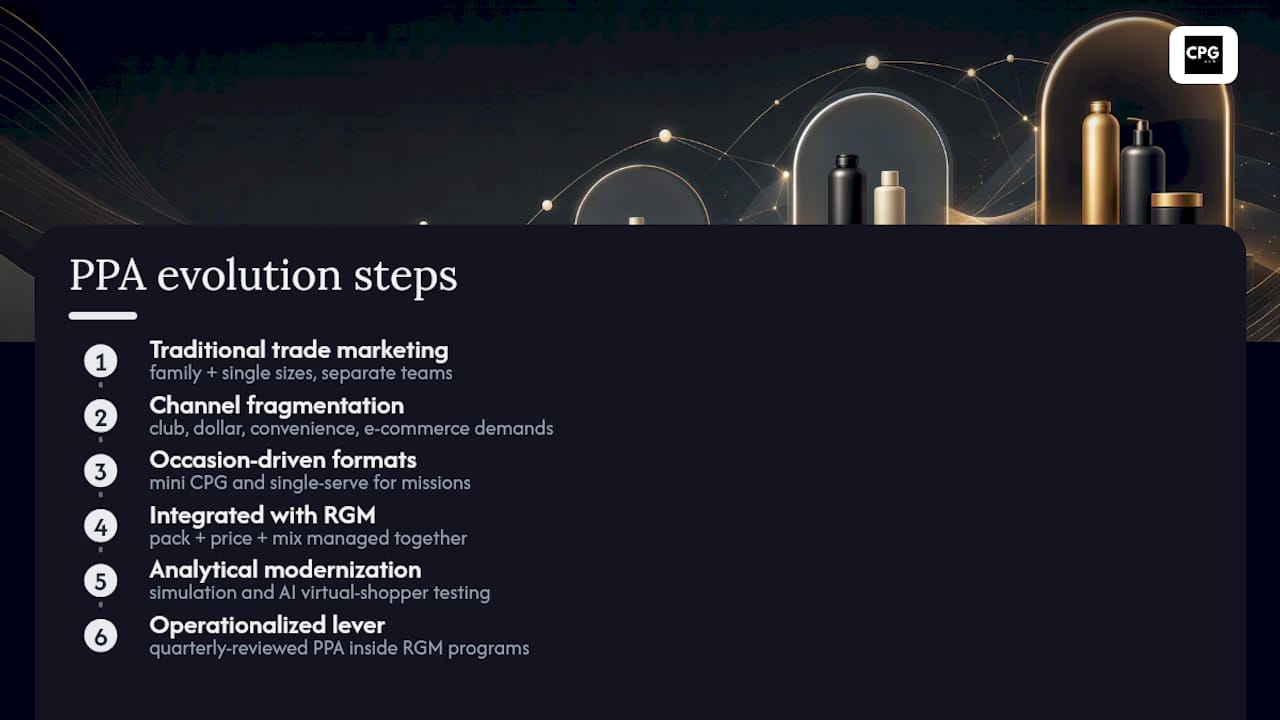
PPA has roots in old-fashioned trade marketing, back when "pack architecture" mostly meant offering a family size and a single size and calling it a day. The shift started as retail channels fragmented: club stores, dollar stores, convenience formats, and e-commerce each developed their own shopper expectations around pack size and price-per-unit, and a one-size-fits-all lineup stopped working across all of them at once.
Harvard Business Review documented a related shift: the rise of smaller, occasion-specific "mini CPG" formats as shoppers moved toward single-serve and on-the-go consumption rather than stocking a pantry the way earlier generations did. That trend forced brand teams to think in terms of occasions and missions rather than just container sizes.
The bigger conceptual shift came when pricing and category teams folded PPA into revenue growth management as a formal discipline, alongside price realization, trade optimization, and mix management. Before that, pack decisions and price decisions often lived in separate teams that rarely talked to each other. A packaging engineer optimized for manufacturing cost while a pricing analyst optimized list price, with nobody responsible for how the two interacted on a shelf.
The most recent evolution is analytical: simulation and AI-driven virtual shopper modeling now let teams test dozens of ladder configurations before committing to a single pilot, compressing what used to be a slow, expensive test-and-learn cycle into weeks. That shift is why PPA has moved from a periodic packaging exercise to a standing, quarterly-reviewed lever inside modern RGM programs.
What Case Studies Reveal About PPA Wins and Misses
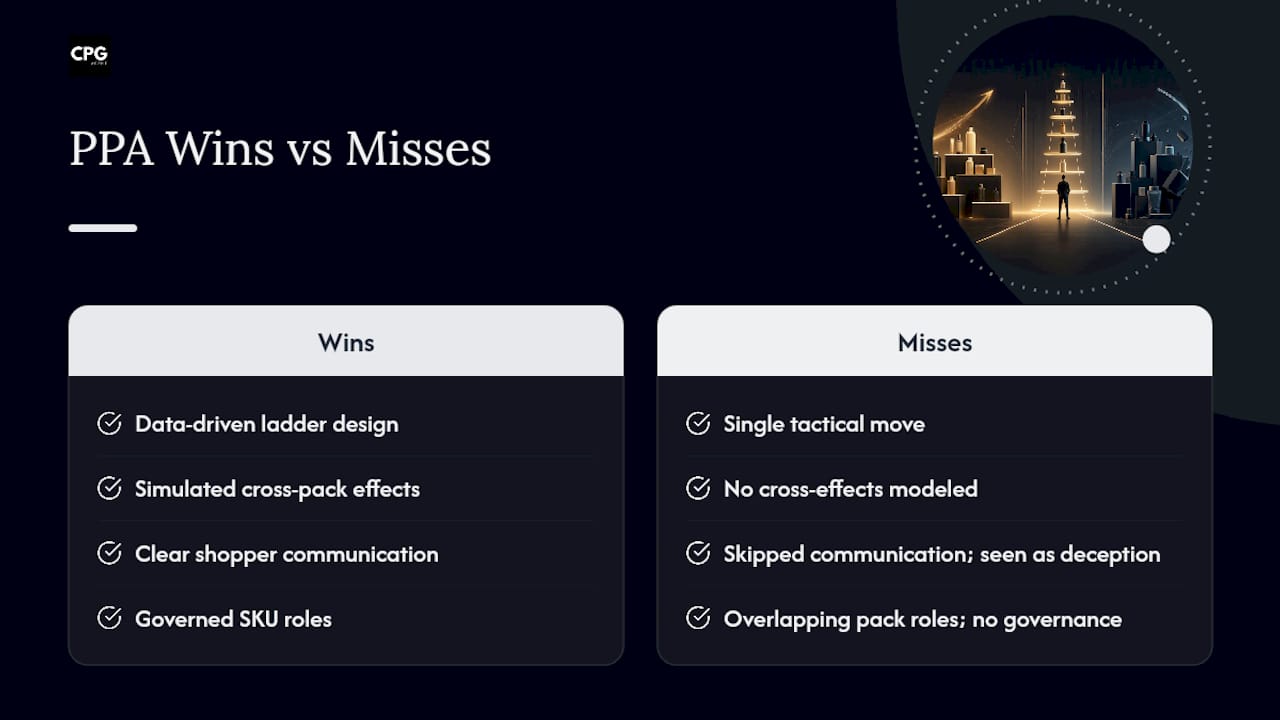
The clearest wins come from brands that treated PPA as data-driven ladder design rather than a single tactical move. Buynomics documents cases where simulation-driven repricing and pack redesign produced measurable profit uplift by modeling how shoppers would actually substitute between pack sizes before any change reached shelves. The common thread in those wins isn't a clever price point. It's that the team modeled cross-effects between packs before committing, catching cannibalization that a spreadsheet-only approach would have missed.
The misses follow a familiar pattern. A brand shrinks a pack size to protect margin against rising input costs, holds the price flat, and skips clear communication about the change. Shoppers notice the lighter box within a few purchase cycles, and the story becomes about the deception rather than the product. The New York Times has traced several of these episodes, where a defensible cost-driven decision turned into a reputational liability purely because of how (or whether) it was explained.
Another recurring miss involves overlapping pack roles introduced faster than the organization can govern them. A team launches an Upsize pack to chase a stock-up occasion, but nobody retires or reprices the existing Routine pack to protect its role. The two SKUs end up splitting the same demand instead of growing the category, and the "win" shows up as flat total volume with a worse margin mix. The distinguishing factor between the successes and failures is rarely the pack itself. It's whether the ladder was modeled as a system before launch, or bolted on one SKU at a time.
How Competitive Moves Should Shape Your Pack Ladder
A pack-price ladder doesn't exist in isolation. It sits next to every competitor's ladder on the same shelf, and shoppers compare price-per-unit across brands whether or not your internal model accounts for it.
When a competitor introduces a new pack size at an aggressive price-per-unit, your Routine pack is the one most exposed, since it's the SKU most price-sensitive shoppers default to. Ignoring that move and holding your ladder static effectively cedes the value-conscious segment. Reacting reflexively with an across-the-board price cut is usually worse, since it erodes margin on your Upscale and Upsize packs that weren't under competitive pressure in the first place.
The more defensible response is targeted: identify exactly which of your packs competes directly with the competitor's new size, at the same channel and the same price-per-unit range, and respond there specifically. Leave the rest of your ladder untouched. This is where channel corridors earn their keep. A private-label multipack undercutting you in club stores doesn't necessarily require a response in convenience, where the competitive set and shopper mindset are completely different.
Retailers also use your ladder as a benchmark to negotiate their own private-label pricing, which means a ladder redesign can shift retailer dynamics well beyond the shelf it touches directly. Brands that model competitive response scenarios into their pilot simulations, rather than reacting after the fact, tend to hold margin better when a rival makes the first move.
Why Shopper Behavior Has to Drive Pack Design, Not Just Cost Math
Pack design fails when it starts from manufacturing convenience and treats shopper behavior as an afterthought. The ladder has to start from occasions: what mission is this shopper on, and what pack fits that mission without asking them to overpay or overbuy.
A single person buying a snack for today's commute and a parent stocking a pantry for the week are not the same shopper, even if they buy the identical product. Assigning distinct pack roles, Entry for the first, Upsize for the second, only works if the underlying research actually maps those occasions rather than assuming them.
Conjoint studies and PSM surveys, covered earlier as elasticity tools, do double duty here: they reveal which attributes (size, price, package format) actually drive the tradeoff decision for a given shopper segment, rather than relying on assumptions from the brand team's own intuition. L.E.K.'s approach explicitly puts consumer research ahead of channel diagnostics for exactly this reason: designing the ladder around a retailer's shelf constraints before understanding shopper missions tends to produce a ladder that looks tidy on paper and underperforms in the aisle.
Occasion-based thinking also explains why the "mini CPG" shift documented by Harvard Business Review matters beyond just pack size. It's a signal that shopper missions have fragmented, and a portfolio built around one or two legacy pack sizes is increasingly mismatched to how people actually shop.
Packaging Costs and Manufacturing Realities That Constrain Every Ladder
No pack ladder survives contact with the plant floor if it ignores production economics. Every new pack size adds a changeover cost on the manufacturing line, and that cost has to get absorbed somewhere in the pack's margin math, not treated as a rounding error.
Freight economics matter just as much. Moving more product per shipment lowers the per-unit freight cost, which is often the quiet reason an upsized multipack can afford a better per-unit price than a small pack while still protecting margin. That logistics efficiency, more than any pricing cleverness, frequently explains why Upsize packs can undercut their per-unit price without sacrificing profitability.
SKU proliferation carries a real operational tax beyond the obvious changeover cost. More pack sizes mean more forecasting error, since demand for each individual SKU becomes harder to predict than demand for the category as a whole. That translates into higher inventory holding costs and more frequent stockouts or overstock situations, both of which erode the margin gain a new pack was supposed to deliver in the first place.
This is why a defensible PPA program folds operational cost into the design phase rather than treating it as an implementation afterthought. A pack that looks profitable on a pricing spreadsheet can still be a net loss once you account for the changeover time it steals from higher-volume SKUs and the inventory buffer it forces across the supply chain. The strongest ladders are the ones where finance, manufacturing, and pricing all had a seat at the table before the pack size was finalized, not after.
An Editorial Take on Where PPA Actually Pays Off
Most PPA programs stall in the same place: the diagnostic phase, where nobody wants to admit how tangled the existing ladder already is. The quickest wins tend to come from fixing an obvious inversion that's been sitting in scanner data for months, not from launching an ambitious new pack size. Sequence PPA after you've got clean sell-out data flowing and before you touch trade spend optimization, since a messy ladder will make every trade decision look worse than it is.
The internal blocker is almost never analytical. It's governance: nobody owns the ladder once it's built. That's the gap we built our platform around, pairing rapid simulation with the fractional leadership that actually keeps a pack-price ladder from drifting a year later.
— Matthew
Cpgagent: The Platform Built to Move PPA From Spreadsheet to Shelf
Cpgagent gets a pack-price ladder from diagnosis to pilot in weeks, not the quarters a traditional agency engagement usually takes. The platform pairs AI-driven simulation tools with fractional senior marketing leadership, so a brand team gets both the modeling horsepower and the decision-maker who can actually govern the guardrails once they're set.
The tools that matter most for PPA work include rapid persona research to map shopper occasions onto pack roles, launch validation to stress-test a new pack size before it hits a single retailer, and simulation capabilities that mirror the virtual-shopper modeling behind the Buynomics case results referenced earlier. For teams without a dedicated pricing function, a fractional CMO engagement adds the cross-functional governance a ladder needs to survive its first budget cycle.
Brand managers running lean teams and pricing professionals inheriting a tangled legacy portfolio both fit the same starting point: a working session on your current ladder. Visit the Cpgagent platform to book a demo and see how a pilot hypothesis could look inside your own scanner data within the first two weeks.
Sources
- More brilliant pack design: How Price Pack Architecture is powering FMCG growth | Roland Berger
- Price Pack Architecture: The 7-Step Guide To Engineering Profitable Pack-Price Ladders
- Consumer Price Pack Architecture | L.E.K. Consulting
- Pack price architecture: unwrapping the secret to profitable product pricing | EY
- The role of price pack architecture for revenue growth | Buynomics
FAQ
What Are the 5 C's of Pricing?
Definitions vary across firms, but a common version covers Cost, Customer (willingness to pay), Competition, Channel, and Corporate objectives. Price pack architecture work touches all five, since a pack's price only makes sense once you've mapped cost, elasticity, competitive positioning, and channel dynamics together.
What Is a Price Pack?
A price pack is a specific combination of pack size and price point offered to shoppers, such as a 12-ounce single or a multipack at a set price. Price pack architecture is the discipline of designing how multiple price packs relate to each other across a product line.
What Are the Four Main Types of Pricing Methods?
The four commonly cited approaches are cost-plus pricing, competitor-based pricing, value-based pricing, and dynamic pricing. PPA leans heavily on value-based pricing methods like conjoint analysis and Gabor-Granger studies to set price points that match what shoppers are actually willing to pay per occasion.
What Are the Three C's of a Pricing Strategy?
The classic framing is Cost, Customer, and Competition, the three forces that bound where a price can realistically sit. A pack-price ladder built with tools like Cpgagent's simulation capabilities tests all three simultaneously rather than treating them as separate checks.
How Long Does a PPA Pilot Take to Run?
A well-scoped pilot runs 8 to 12 weeks, covering diagnosis, a controlled market test, and a governance review before a rollout decision. That timeline matches the checklist most brand teams follow to launch their first PPA program without a full-scale transformation project.